

68
4 Notes
1. For a more thorough procedure, instead of manually creating
the complex, the drug molecule could be docked into CD’s
cavity using special docking software, where different docking
poses could be ranked energetically. However, the approach
described in this tutorial is accurate enough for the scope of this
chapter.
2. The MMFF was used for the topologies of the drug molecules,
since it is a compatible force field with charmm36 (a built-in
force field in gromacs) that was used in order to treat the rest of
the molecules, in this case, the water molecules. Other force field
combinations can be used but you should always check the compatibility between them; otherwise large errors might occur.
3. The different directives of .top and .itp files should share a common order. For further details about this error visit gromacs
manual
at
http://www.gromacs.org/Documentation/
Errors#Invalid_order_for_directive_xxx.
4. In this specific system, both drug molecules are neutral.
However, in case you might use this tutorial for a charged species, or even for different protonation states of CAN, addition
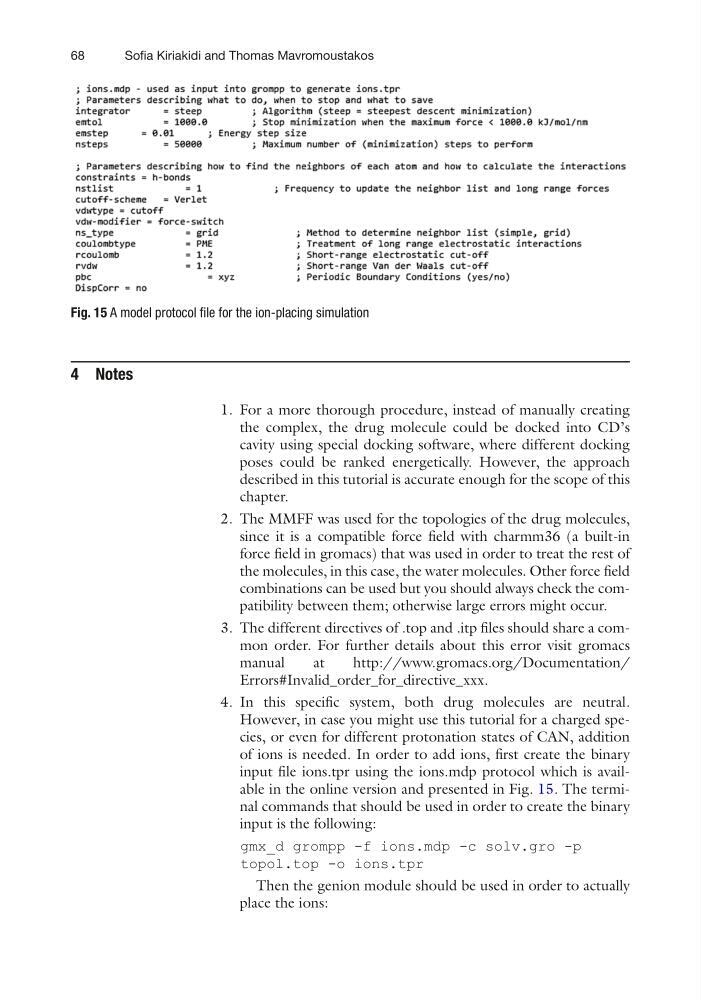
of ions is needed. In order to add ions, first create the binary
input file ions.tpr using the ions.mdp protocol which is available in the online version and presented in Fig. 15. The terminal commands that should be used in order to create the binary
input is the following:
gmx_d grompp -f ions.mdp -c solv.gro -p
topol.top -o ions.tpr
Then the genion module should be used in order to actually
place the ions:
Fig. 15 A model protocol file for the ion-placing simulation
Sofia Kiriakidi and Thomas Mavromoustakos
4 Notes
1. For a more thorough procedure, instead of manually creating
the complex, the drug molecule could be docked into CD’s
cavity using special docking software, where different docking
poses could be ranked energetically. However, the approach
described in this tutorial is accurate enough for the scope of this
chapter.
2. The MMFF was used for the topologies of the drug molecules,
since it is a compatible force field with charmm36 (a built-in
force field in gromacs) that was used in order to treat the rest of
the molecules, in this case, the water molecules. Other force field
combinations can be used but you should always check the compatibility between them; otherwise large errors might occur.
3. The different directives of .top and .itp files should share a common order. For further details about this error visit gromacs
manual
at
http://www.gromacs.org/Documentation/
Errors#Invalid_order_for_directive_xxx.
4. In this specific system, both drug molecules are neutral.
However, in case you might use this tutorial for a charged species, or even for different protonation states of CAN, addition
of ions is needed. In order to add ions, first create the binary
input file ions.tpr using the ions.mdp protocol which is available in the online version and presented in Fig. 15. The terminal commands that should be used in order to create the binary
input is the following:
gmx_d grompp -f ions.mdp -c solv.gro -p
topol.top -o ions.tpr
Then the genion module should be used in order to actually
place the ions:
Fig. 15 A model protocol file for the ion-placing simulation
Sofia Kiriakidi and Thomas Mavromoustakos