

302
4. Choose the appropriate temperature scanning range and the
scanning rate (see Notes 7 and 8).
5. Prior to measurements the crucibles should be subjected to a
temperature over the transition of the used lipid, in order to
ensure efficient equilibration.
6. Before each heating cycle, the samples should be equilibrated at
a constant temperature (isotherm cycle at the starting temperature for 5–10 min) (see Note 9).
7. At least two heating-cooling cycles should be carried out, in
order to ensure good reproducibility of the data and obtain
identical thermograms (see Note 10).
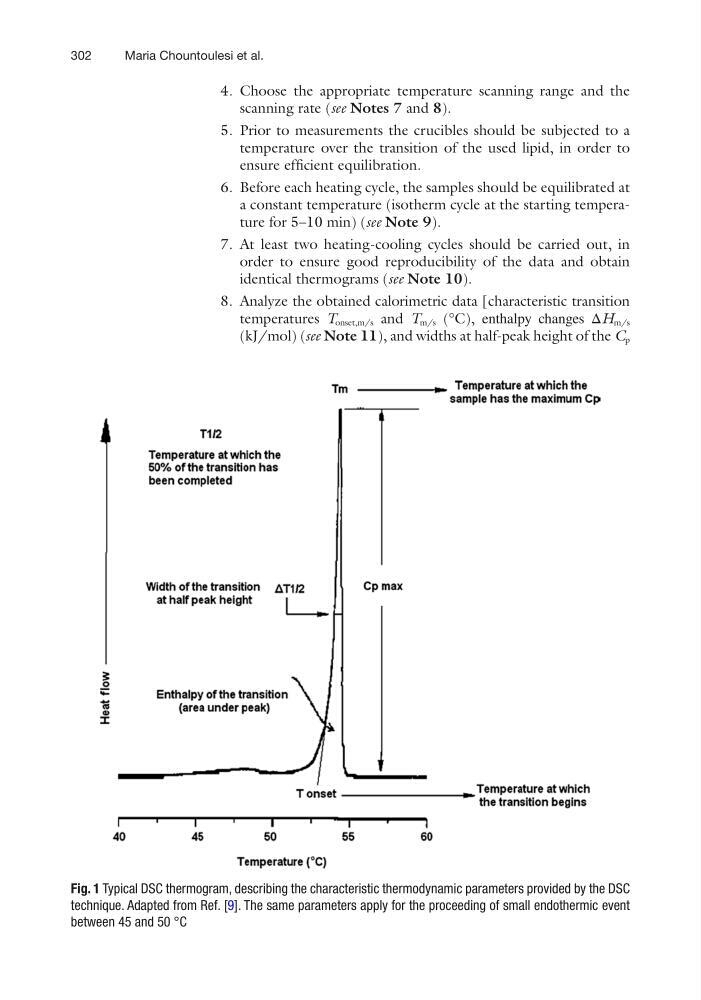
8. Analyze the obtained calorimetric data [characteristic transition
temperatures T onset,m/s and T m/s (°C), enthalpy changes ΔH m/s
(kJ/mol) (see Note 11), and widths at half-peak height of the C p
Fig. 1 Typical DSC thermogram, describing the characteristic thermodynamic parameters provided by the DSC
technique. Adapted from Ref. [9]. The same parameters apply for the proceeding of small endothermic event
between 45 and 50 °C
Maria Chountoulesi et al.
4. Choose the appropriate temperature scanning range and the
scanning rate (see Notes 7 and 8).
5. Prior to measurements the crucibles should be subjected to a
temperature over the transition of the used lipid, in order to
ensure efficient equilibration.
6. Before each heating cycle, the samples should be equilibrated at
a constant temperature (isotherm cycle at the starting temperature for 5–10 min) (see Note 9).
7. At least two heating-cooling cycles should be carried out, in
order to ensure good reproducibility of the data and obtain
identical thermograms (see Note 10).
8. Analyze the obtained calorimetric data [characteristic transition
temperatures T onset,m/s and T m/s (°C), enthalpy changes ΔH m/s
(kJ/mol) (see Note 11), and widths at half-peak height of the C p
Fig. 1 Typical DSC thermogram, describing the characteristic thermodynamic parameters provided by the DSC
technique. Adapted from Ref. [9]. The same parameters apply for the proceeding of small endothermic event
between 45 and 50 °C
Maria Chountoulesi et al.