

288
interaction and the oxidation behavior of the complex can be
studied by adding CD solution at different concentrations to a
starting solution of the free drug. The interpretation of the data
must take into account that cyclodextrin can be adsorbed on the
surface of the electrode depending on solution composition; thus
Nernstian diffusion controlled waves and adsorptive pre-waves or
post-waves must be carefully assigned in cyclic voltammograms
before evaluating reaction mechanism [8].
Keeping this in mind, two main behaviors can be observed,
based on redox properties and stability of the complex:
Subsequently, the CD-oxidized drug complex may dissociate,
depending on its stability. The products of oxidation can differ
depending on the geometry of the cavity inside the CD macromolecule and relative position of the drug inside it. Some electroactive
sites of the drug molecule can be hindered in the CD cavity and
become unavailable to the surface of the electrode. If cyclodextrin
as a host works as a proton donor to the guest molecule, and this
proton donation is involved in a redox process, the oxidation pathway of the complex can be different from that on the free molecule
[27]. CD can also allow reduction of the drug compound when
protonation is needed [28], or stabilize the electrogenerated radical in the cavity [29]. If electroactive sites of the drug molecule are
not hindered by the cavity, the oxidation process can result in the
same products as those obtained for the free molecule. This was
the case of a quercetin-2HP-β-CD inclusion complex, where quercetin retained the same oxidation profile as observed for its native
state (Fig. 1) [30]. Moreover, some intermediates, which are difficult to identify due to their short life or fast-following reactions in
solution, can be stabilized in the hydrophobic cyclodextrin cavity.
This was observed for a semiquinone derivative of quercetin, which
was only identified in CD complexes [30].
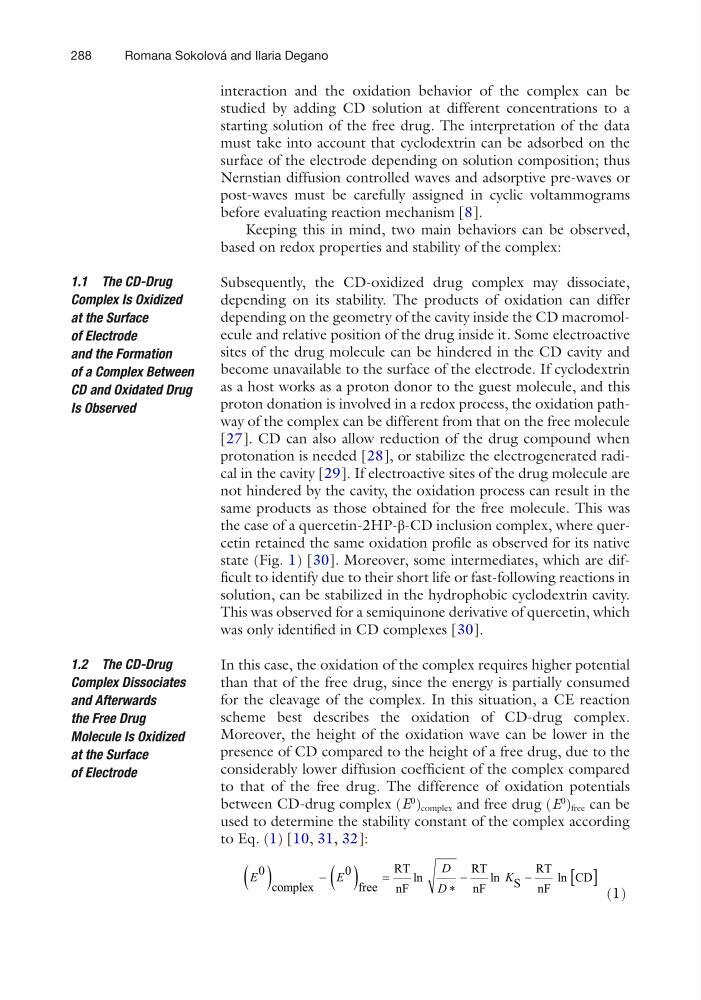
In this case, the oxidation of the complex requires higher potential
than that of the free drug, since the energy is partially consumed
for the cleavage of the complex. In this situation, a CE reaction
scheme best describes the oxidation of CD-drug complex.
Moreover, the height of the oxidation wave can be lower in the
presence of CD compared to the height of a free drug, due to the
considerably lower diffusion coefficient of the complex compared
to that of the free drug. The difference of oxidation potentials
between CD-drug complex (E
0
) complex and free drug (E
0
) free can be
used to determine the stability constant of the complex according
to Eq. (1) [10, 31, 32]:
E
E
D
D
K
0
0
( )
( )
[ ]
−
=
∗
−
−
complex
free
RT
nF
RT
nF
S
RT
nF
CD
ln
ln
ln
(1)
1.1 The CD-Drug
Complex Is Oxidized
at the Surface
of Electrode
and the Formation
of a Complex Between
CD and Oxidated Drug
Is Observed
1.2 The CD-Drug
Complex Dissociates
and Afterwards
the Free Drug
Molecule Is Oxidized
at the Surface
of Electrode
Romana Sokolová and Ilaria Degano
interaction and the oxidation behavior of the complex can be
studied by adding CD solution at different concentrations to a
starting solution of the free drug. The interpretation of the data
must take into account that cyclodextrin can be adsorbed on the
surface of the electrode depending on solution composition; thus
Nernstian diffusion controlled waves and adsorptive pre-waves or
post-waves must be carefully assigned in cyclic voltammograms
before evaluating reaction mechanism [8].
Keeping this in mind, two main behaviors can be observed,
based on redox properties and stability of the complex:
Subsequently, the CD-oxidized drug complex may dissociate,
depending on its stability. The products of oxidation can differ
depending on the geometry of the cavity inside the CD macromolecule and relative position of the drug inside it. Some electroactive
sites of the drug molecule can be hindered in the CD cavity and
become unavailable to the surface of the electrode. If cyclodextrin
as a host works as a proton donor to the guest molecule, and this
proton donation is involved in a redox process, the oxidation pathway of the complex can be different from that on the free molecule
[27]. CD can also allow reduction of the drug compound when
protonation is needed [28], or stabilize the electrogenerated radical in the cavity [29]. If electroactive sites of the drug molecule are
not hindered by the cavity, the oxidation process can result in the
same products as those obtained for the free molecule. This was
the case of a quercetin-2HP-β-CD inclusion complex, where quercetin retained the same oxidation profile as observed for its native
state (Fig. 1) [30]. Moreover, some intermediates, which are difficult to identify due to their short life or fast-following reactions in
solution, can be stabilized in the hydrophobic cyclodextrin cavity.
This was observed for a semiquinone derivative of quercetin, which
was only identified in CD complexes [30].
In this case, the oxidation of the complex requires higher potential
than that of the free drug, since the energy is partially consumed
for the cleavage of the complex. In this situation, a CE reaction
scheme best describes the oxidation of CD-drug complex.
Moreover, the height of the oxidation wave can be lower in the
presence of CD compared to the height of a free drug, due to the
considerably lower diffusion coefficient of the complex compared
to that of the free drug. The difference of oxidation potentials
between CD-drug complex (E
0
) complex and free drug (E
0
) free can be
used to determine the stability constant of the complex according
to Eq. (1) [10, 31, 32]:
E
E
D
D
K
0
0
( )
( )
[ ]
−
=
∗
−
−
complex
free
RT
nF
RT
nF
S
RT
nF
CD
ln
ln
ln
(1)
1.1 The CD-Drug
Complex Is Oxidized
at the Surface
of Electrode
and the Formation
of a Complex Between
CD and Oxidated Drug
Is Observed
1.2 The CD-Drug
Complex Dissociates
and Afterwards
the Free Drug
Molecule Is Oxidized
at the Surface
of Electrode
Romana Sokolová and Ilaria Degano