

263
topically to relieve the symptoms of superficial candidiasis, dermatophytosis, pityriasis versicolor, and skin infections. Polymeric
nanosponges were an alternative carrier for EN that improved
retention onto the skin, through topical hydrogel formulation
[68]. Another example is nelfinavir mesylate (NFV), a BCS class II
protease inhibitor with low bioavailability, used to treat human
immunodeficiency virus (HIV) infections. CDNS showed the ability to enhance the solubility of NFV [69].
Itraconazole is a broad-spectrum triazole antifungal agent. It is
a BCS class II drug that has a limited dissolution rate and poor oral
Control
IMQ (5 μg/ml)
NS
IMQ-NS (5 μg/ml)
IMQ-NS (25 μg/ml)
0h
24h
48h
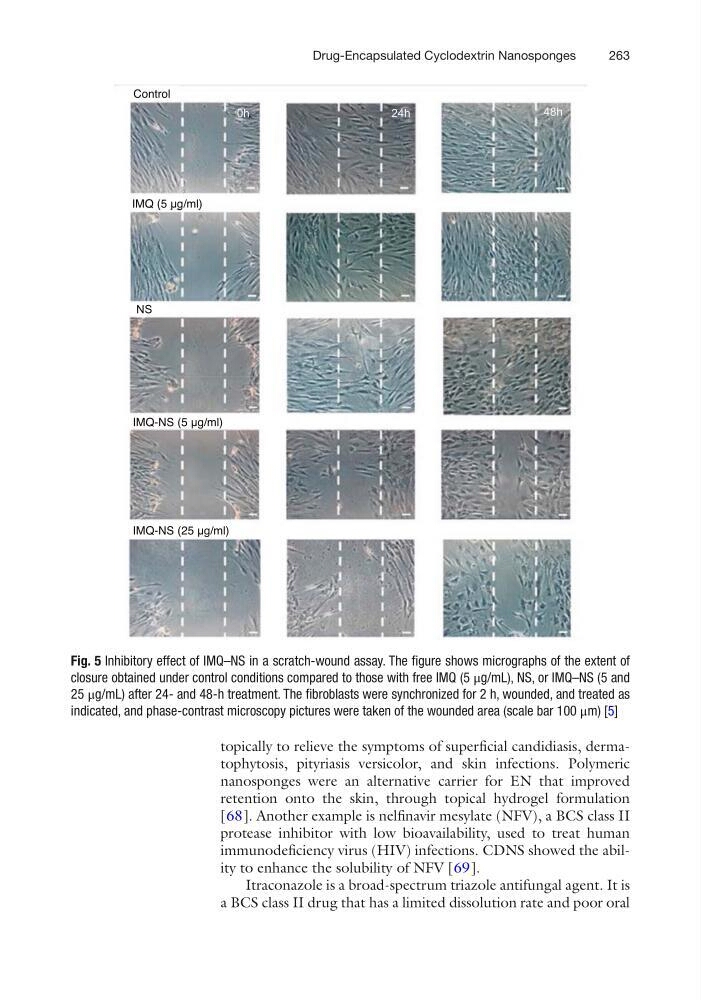
Fig. 5 Inhibitory effect of IMQ–NS in a scratch-wound assay. The figure shows micrographs of the extent of
closure obtained under control conditions compared to those with free IMQ (5 μg/mL), NS, or IMQ–NS (5 and
25 μg/mL) after 24- and 48-h treatment. The fibroblasts were synchronized for 2 h, wounded, and treated as
indicated, and phase-contrast microscopy pictures were taken of the wounded area (scale bar 100 μm) [5]
Drug-Encapsulated Cyclodextrin Nanosponges
topically to relieve the symptoms of superficial candidiasis, dermatophytosis, pityriasis versicolor, and skin infections. Polymeric
nanosponges were an alternative carrier for EN that improved
retention onto the skin, through topical hydrogel formulation
[68]. Another example is nelfinavir mesylate (NFV), a BCS class II
protease inhibitor with low bioavailability, used to treat human
immunodeficiency virus (HIV) infections. CDNS showed the ability to enhance the solubility of NFV [69].
Itraconazole is a broad-spectrum triazole antifungal agent. It is
a BCS class II drug that has a limited dissolution rate and poor oral
Control
IMQ (5 μg/ml)
NS
IMQ-NS (5 μg/ml)
IMQ-NS (25 μg/ml)
0h
24h
48h
Fig. 5 Inhibitory effect of IMQ–NS in a scratch-wound assay. The figure shows micrographs of the extent of
closure obtained under control conditions compared to those with free IMQ (5 μg/mL), NS, or IMQ–NS (5 and
25 μg/mL) after 24- and 48-h treatment. The fibroblasts were synchronized for 2 h, wounded, and treated as
indicated, and phase-contrast microscopy pictures were taken of the wounded area (scale bar 100 μm) [5]
Drug-Encapsulated Cyclodextrin Nanosponges