

261
ment of acyclovir-loaded NS formulations holds great potential for
their use in various administration routes [62].
Rilpivirine (RPV) is a BCS class II drug used for the treatment
of HIV infection. The drug has low aqueous solubility (0.0166 mg/
mL) and dissolution rate leading to low bioavailability (32%).
Binary and ternary complexes of RPV with β-CD, HP-β-CD,
β-CD nanosponges, and tocopherol polyethylene glycol succinate
were prepared, characterized, and compared by phase solubility,
saturation solubility in different media, in vitro dissolution, and in
vivo pharmacokinetic studies. Solubility studies indicated that both
binary and tertiary complexes were stable compared to RPV, and
the relative bioavailability of RPV was enhanced nearly two- to
threefold for ternary complexes. The increase in solubility and dissolution rate can explain the increased bioavailability for binary
and ternary complex nanosponges [63].
Efavirenz (EFA), a BCS class II drug, is a non-nucleoside
reverse transcriptase inhibitor which is chronically prescribed for
HIV patients. Carbonate β-CD NS was used to enhance the low
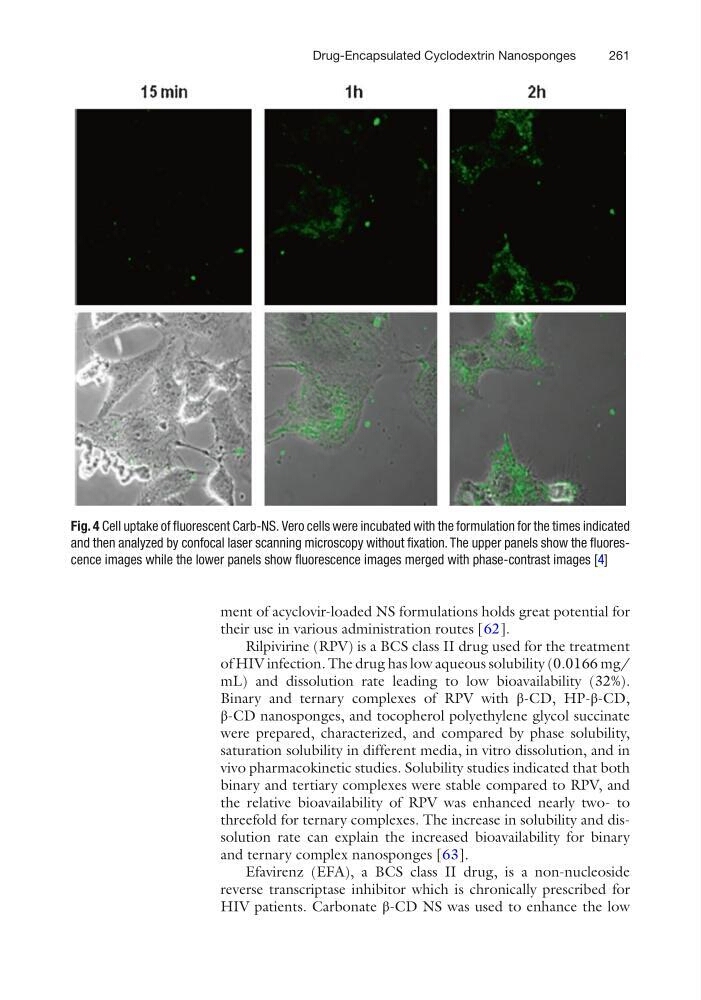
Fig. 4 Cell uptake of fluorescent Carb-NS. Vero cells were incubated with the formulation for the times indicated
and then analyzed by confocal laser scanning microscopy without fixation. The upper panels show the fluorescence images while the lower panels show fluorescence images merged with phase-contrast images [4]
Drug-Encapsulated Cyclodextrin Nanosponges
ment of acyclovir-loaded NS formulations holds great potential for
their use in various administration routes [62].
Rilpivirine (RPV) is a BCS class II drug used for the treatment
of HIV infection. The drug has low aqueous solubility (0.0166 mg/
mL) and dissolution rate leading to low bioavailability (32%).
Binary and ternary complexes of RPV with β-CD, HP-β-CD,
β-CD nanosponges, and tocopherol polyethylene glycol succinate
were prepared, characterized, and compared by phase solubility,
saturation solubility in different media, in vitro dissolution, and in
vivo pharmacokinetic studies. Solubility studies indicated that both
binary and tertiary complexes were stable compared to RPV, and
the relative bioavailability of RPV was enhanced nearly two- to
threefold for ternary complexes. The increase in solubility and dissolution rate can explain the increased bioavailability for binary
and ternary complex nanosponges [63].
Efavirenz (EFA), a BCS class II drug, is a non-nucleoside
reverse transcriptase inhibitor which is chronically prescribed for
HIV patients. Carbonate β-CD NS was used to enhance the low
Fig. 4 Cell uptake of fluorescent Carb-NS. Vero cells were incubated with the formulation for the times indicated
and then analyzed by confocal laser scanning microscopy without fixation. The upper panels show the fluorescence images while the lower panels show fluorescence images merged with phase-contrast images [4]
Drug-Encapsulated Cyclodextrin Nanosponges