

226
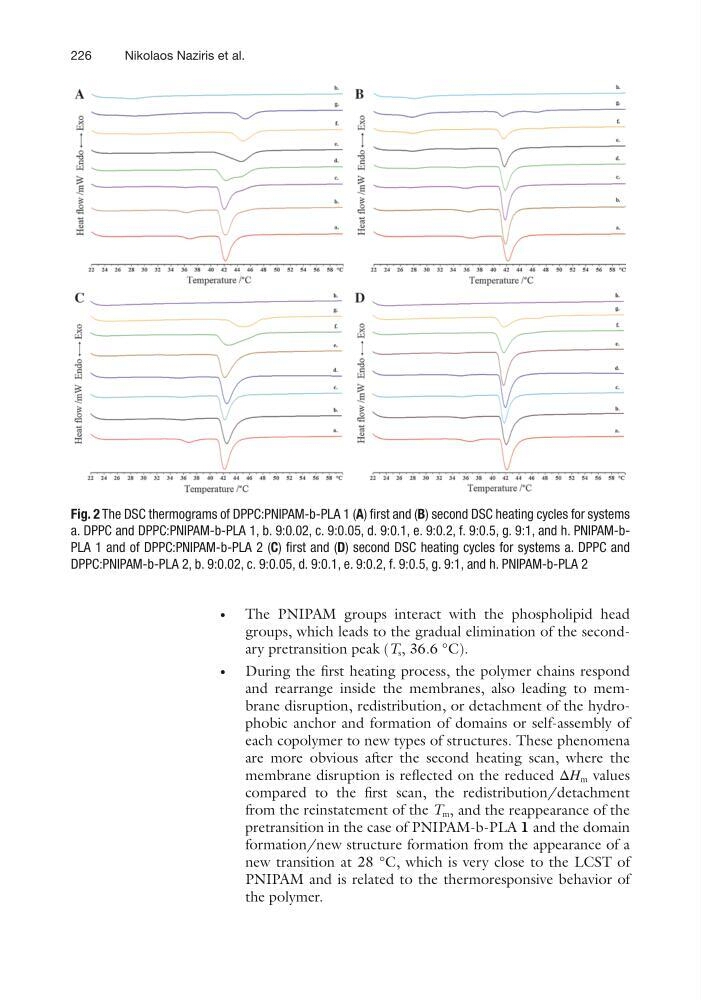
∙ The PNIPAM groups interact with the phospholipid head
groups, which leads to the gradual elimination of the secondary pretransition peak (T s , 36.6 °C).
∙ During the first heating process, the polymer chains respond
and rearrange inside the membranes, also leading to membrane disruption, redistribution, or detachment of the hydrophobic anchor and formation of domains or self-assembly of
each copolymer to new types of structures. These phenomena
are more obvious after the second heating scan, where the
membrane disruption is reflected on the reduced ΔΗ m values
compared to the first scan, the redistribution/detachment
from the reinstatement of the T m , and the reappearance of the
pretransition in the case of PNIPAM-b-PLA 1 and the domain
formation/new structure formation from the appearance of a
new transition at 28 °C, which is very close to the LCST of
PNIPAM and is related to the thermoresponsive behavior of
the polymer.
Fig. 2 The DSC thermograms of DPPC:PNIPAM-b-PLA 1 (A) first and (B) second DSC heating cycles for systems
a. DPPC and DPPC:PNIPAM-b-PLA 1, b. 9:0.02, c. 9:0.05, d. 9:0.1, e. 9:0.2, f. 9:0.5, g. 9:1, and h. PNIPAM-bPLA 1 and of DPPC:PNIPAM-b-PLA 2 (C) first and (D) second DSC heating cycles for systems a. DPPC and
DPPC:PNIPAM-b-PLA 2, b. 9:0.02, c. 9:0.05, d. 9:0.1, e. 9:0.2, f. 9:0.5, g. 9:1, and h. PNIPAM-b-PLA 2
Nikolaos Naziris et al.
∙ The PNIPAM groups interact with the phospholipid head
groups, which leads to the gradual elimination of the secondary pretransition peak (T s , 36.6 °C).
∙ During the first heating process, the polymer chains respond
and rearrange inside the membranes, also leading to membrane disruption, redistribution, or detachment of the hydrophobic anchor and formation of domains or self-assembly of
each copolymer to new types of structures. These phenomena
are more obvious after the second heating scan, where the
membrane disruption is reflected on the reduced ΔΗ m values
compared to the first scan, the redistribution/detachment
from the reinstatement of the T m , and the reappearance of the
pretransition in the case of PNIPAM-b-PLA 1 and the domain
formation/new structure formation from the appearance of a
new transition at 28 °C, which is very close to the LCST of
PNIPAM and is related to the thermoresponsive behavior of
the polymer.
Fig. 2 The DSC thermograms of DPPC:PNIPAM-b-PLA 1 (A) first and (B) second DSC heating cycles for systems
a. DPPC and DPPC:PNIPAM-b-PLA 1, b. 9:0.02, c. 9:0.05, d. 9:0.1, e. 9:0.2, f. 9:0.5, g. 9:1, and h. PNIPAM-bPLA 1 and of DPPC:PNIPAM-b-PLA 2 (C) first and (D) second DSC heating cycles for systems a. DPPC and
DPPC:PNIPAM-b-PLA 2, b. 9:0.02, c. 9:0.05, d. 9:0.1, e. 9:0.2, f. 9:0.5, g. 9:1, and h. PNIPAM-b-PLA 2
Nikolaos Naziris et al.