

191
ation is known, the user can estimate the concentrations of both
host and guest molecules in order to achieve an adequate C
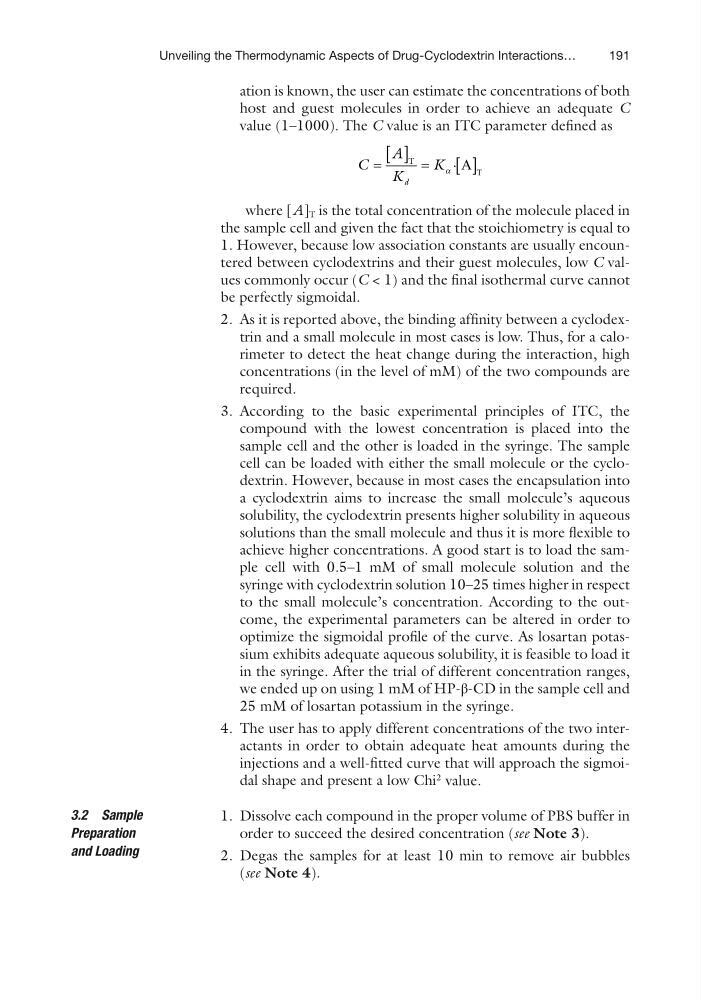
value (1–1000). The C value is an ITC parameter defined as
C
A
K
K
d
=
[ ] = [ ]
T
α · Α Τ
where [A] T is the total concentration of the molecule placed in
the sample cell and given the fact that the stoichiometry is equal to
1. However, because low association constants are usually encountered between cyclodextrins and their guest molecules, low C values commonly occur (C < 1) and the final isothermal curve cannot
be perfectly sigmoidal.
2. As it is reported above, the binding affinity between a cyclodextrin and a small molecule in most cases is low. Thus, for a calorimeter to detect the heat change during the interaction, high
concentrations (in the level of mM) of the two compounds are
required.
3. According to the basic experimental principles of ITC, the
compound with the lowest concentration is placed into the
sample cell and the other is loaded in the syringe. The sample
cell can be loaded with either the small molecule or the cyclodextrin. However, because in most cases the encapsulation into
a cyclodextrin aims to increase the small molecule’s aqueous
solubility, the cyclodextrin presents higher solubility in aqueous
solutions than the small molecule and thus it is more flexible to
achieve higher concentrations. A good start is to load the sample cell with 0.5–1 mM of small molecule solution and the
syringe with cyclodextrin solution 10–25 times higher in respect
to the small molecule’s concentration. According to the outcome, the experimental parameters can be altered in order to
optimize the sigmoidal profile of the curve. As losartan potassium exhibits adequate aqueous solubility, it is feasible to load it
in the syringe. After the trial of different concentration ranges,
we ended up on using 1 mM of HP-β-CD in the sample cell and
25 mM of losartan potassium in the syringe.
4. The user has to apply different concentrations of the two interactants in order to obtain adequate heat amounts during the
injections and a well-fitted curve that will approach the sigmoidal shape and present a low Chi
2
value.
1. Dissolve each compound in the proper volume of PBS buffer in
order to succeed the desired concentration (see Note 3).
2. Degas the samples for at least 10 min to remove air bubbles
(see Note 4).
3.2 Sample
Preparation
and Loading
Unveiling the Thermodynamic Aspects of Drug-Cyclodextrin Interactions…
ation is known, the user can estimate the concentrations of both
host and guest molecules in order to achieve an adequate C
value (1–1000). The C value is an ITC parameter defined as
C
A
K
K
d
=
[ ] = [ ]
T
α · Α Τ
where [A] T is the total concentration of the molecule placed in
the sample cell and given the fact that the stoichiometry is equal to
1. However, because low association constants are usually encountered between cyclodextrins and their guest molecules, low C values commonly occur (C < 1) and the final isothermal curve cannot
be perfectly sigmoidal.
2. As it is reported above, the binding affinity between a cyclodextrin and a small molecule in most cases is low. Thus, for a calorimeter to detect the heat change during the interaction, high
concentrations (in the level of mM) of the two compounds are
required.
3. According to the basic experimental principles of ITC, the
compound with the lowest concentration is placed into the
sample cell and the other is loaded in the syringe. The sample
cell can be loaded with either the small molecule or the cyclodextrin. However, because in most cases the encapsulation into
a cyclodextrin aims to increase the small molecule’s aqueous
solubility, the cyclodextrin presents higher solubility in aqueous
solutions than the small molecule and thus it is more flexible to
achieve higher concentrations. A good start is to load the sample cell with 0.5–1 mM of small molecule solution and the
syringe with cyclodextrin solution 10–25 times higher in respect
to the small molecule’s concentration. According to the outcome, the experimental parameters can be altered in order to
optimize the sigmoidal profile of the curve. As losartan potassium exhibits adequate aqueous solubility, it is feasible to load it
in the syringe. After the trial of different concentration ranges,
we ended up on using 1 mM of HP-β-CD in the sample cell and
25 mM of losartan potassium in the syringe.
4. The user has to apply different concentrations of the two interactants in order to obtain adequate heat amounts during the
injections and a well-fitted curve that will approach the sigmoidal shape and present a low Chi
2
value.
1. Dissolve each compound in the proper volume of PBS buffer in
order to succeed the desired concentration (see Note 3).
2. Degas the samples for at least 10 min to remove air bubbles
(see Note 4).
3.2 Sample
Preparation
and Loading
Unveiling the Thermodynamic Aspects of Drug-Cyclodextrin Interactions…