

189
power is called differential power (DP) and when no titrations are
being conducted it is stable representing the experiment’s baseline.
Upon the ligand injection into the sample cell and providing the
condition that the two molecules are able to interact, heat will be
absorbed or released leading to an increased temperature difference between the two cells. The calorimeter “translates” this temperature fluctuation as the less (in case of an exothermic reaction
where heat is released) or the additional (in case of an endothermic
reaction where heat is absorbed) power that must be provided in
order to keep the temperature difference constant and estimates
the heat as change in the enthalpy. Following the binding process
and as the molecule in the sample cell is getting saturated, the heat
fluctuations are shorter, reaching a final state where the small isotherms represent the heat changes due to the ligand dilution inside
the cell and not the heat of the interaction. By measuring the heat
differences, the calorimeter estimates the change in enthalpy (ΔH)
and the association constant (K α ). Providing that there are two
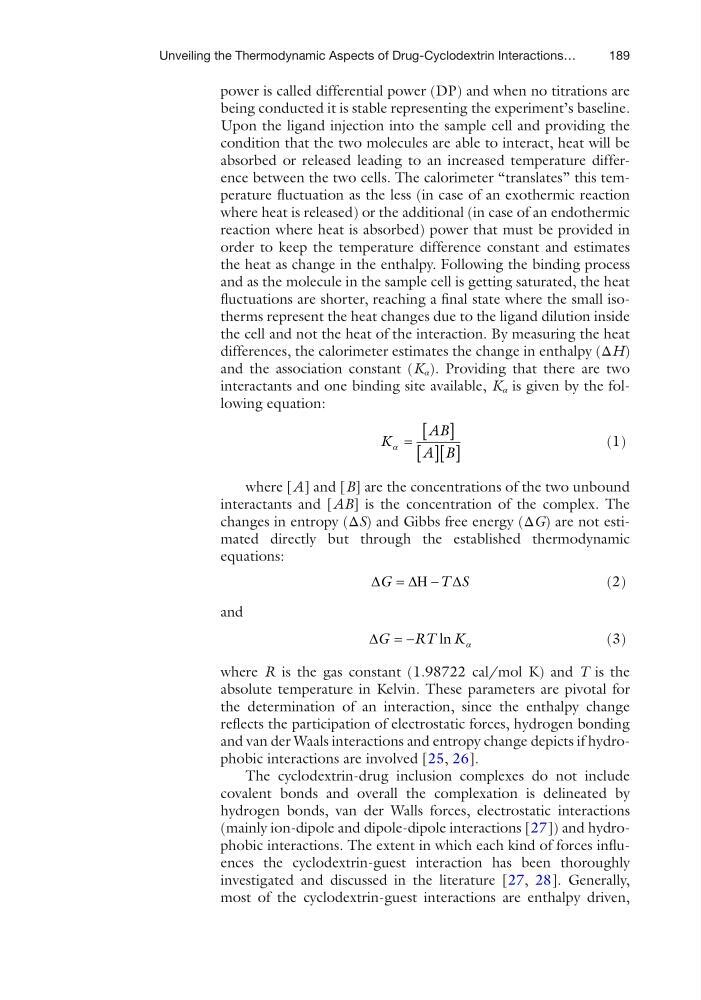
interactants and one binding site available, K α is given by the following equation:
K
AB
A B
α =
[ ]
[ ][ ]
(1)
where [A] and [B] are the concentrations of the two unbound
interactants and [AB] is the concentration of the complex. The
changes in entropy (ΔS) and Gibbs free energy (ΔG) are not estimated directly but through the established thermodynamic
equations:
∆
∆Η
∆
G
T S
=
−
(2)
and
∆G
RT K
= −
ln α
(3)
where R is the gas constant (1.98722 cal/mol K) and T is the
absolute temperature in Kelvin. These parameters are pivotal for
the determination of an interaction, since the enthalpy change
reflects the participation of electrostatic forces, hydrogen bonding
and van der Waals interactions and entropy change depicts if hydrophobic interactions are involved [25, 26].
The cyclodextrin-drug inclusion complexes do not include
covalent bonds and overall the complexation is delineated by
hydrogen bonds, van der Walls forces, electrostatic interactions
(mainly ion-dipole and dipole-dipole interactions [27]) and hydrophobic interactions. The extent in which each kind of forces influences the cyclodextrin-guest interaction has been thoroughly
investigated and discussed in the literature [27, 28]. Generally,
most of the cyclodextrin-guest interactions are enthalpy driven,
Unveiling the Thermodynamic Aspects of Drug-Cyclodextrin Interactions…
power is called differential power (DP) and when no titrations are
being conducted it is stable representing the experiment’s baseline.
Upon the ligand injection into the sample cell and providing the
condition that the two molecules are able to interact, heat will be
absorbed or released leading to an increased temperature difference between the two cells. The calorimeter “translates” this temperature fluctuation as the less (in case of an exothermic reaction
where heat is released) or the additional (in case of an endothermic
reaction where heat is absorbed) power that must be provided in
order to keep the temperature difference constant and estimates
the heat as change in the enthalpy. Following the binding process
and as the molecule in the sample cell is getting saturated, the heat
fluctuations are shorter, reaching a final state where the small isotherms represent the heat changes due to the ligand dilution inside
the cell and not the heat of the interaction. By measuring the heat
differences, the calorimeter estimates the change in enthalpy (ΔH)
and the association constant (K α ). Providing that there are two
interactants and one binding site available, K α is given by the following equation:
K
AB
A B
α =
[ ]
[ ][ ]
(1)
where [A] and [B] are the concentrations of the two unbound
interactants and [AB] is the concentration of the complex. The
changes in entropy (ΔS) and Gibbs free energy (ΔG) are not estimated directly but through the established thermodynamic
equations:
∆
∆Η
∆
G
T S
=
−
(2)
and
∆G
RT K
= −
ln α
(3)
where R is the gas constant (1.98722 cal/mol K) and T is the
absolute temperature in Kelvin. These parameters are pivotal for
the determination of an interaction, since the enthalpy change
reflects the participation of electrostatic forces, hydrogen bonding
and van der Waals interactions and entropy change depicts if hydrophobic interactions are involved [25, 26].
The cyclodextrin-drug inclusion complexes do not include
covalent bonds and overall the complexation is delineated by
hydrogen bonds, van der Walls forces, electrostatic interactions
(mainly ion-dipole and dipole-dipole interactions [27]) and hydrophobic interactions. The extent in which each kind of forces influences the cyclodextrin-guest interaction has been thoroughly
investigated and discussed in the literature [27, 28]. Generally,
most of the cyclodextrin-guest interactions are enthalpy driven,
Unveiling the Thermodynamic Aspects of Drug-Cyclodextrin Interactions…