

164
sample and reference, while the second uses two individual heaters,
allowing it to measure the change in power or energy that is
required for sample and reference to have the same temperature
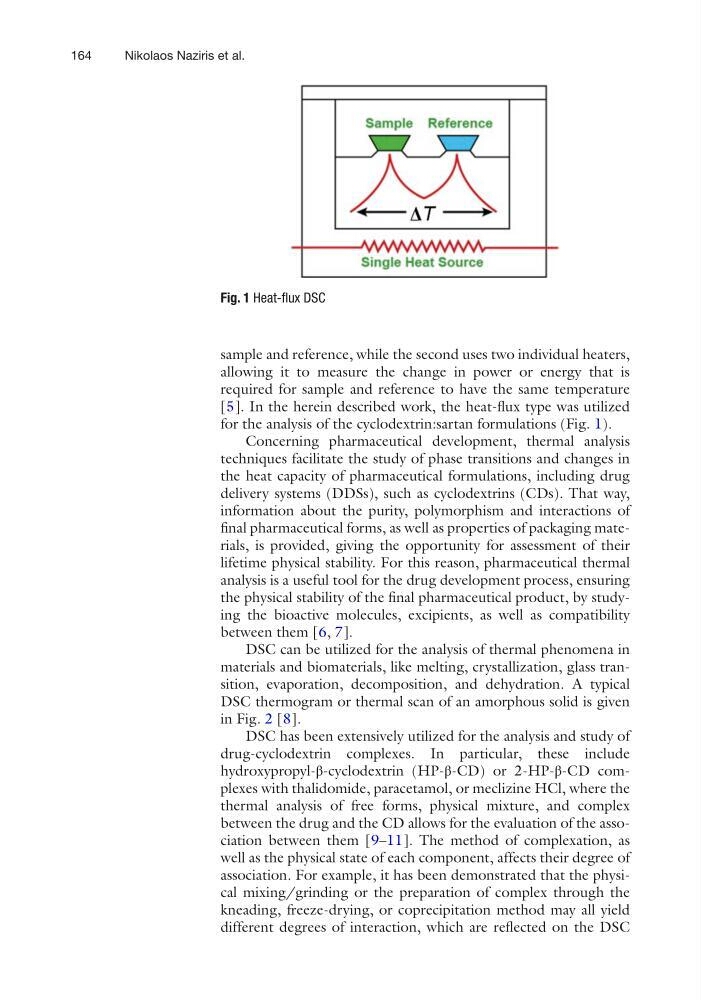
[5]. In the herein described work, the heat-flux type was utilized
for the analysis of the cyclodextrin:sartan formulations (Fig. 1).
Concerning pharmaceutical development, thermal analysis
techniques facilitate the study of phase transitions and changes in
the heat capacity of pharmaceutical formulations, including drug
delivery systems (DDSs), such as cyclodextrins (CDs). That way,
information about the purity, polymorphism and interactions of
final pharmaceutical forms, as well as properties of packaging materials, is provided, giving the opportunity for assessment of their
lifetime physical stability. For this reason, pharmaceutical thermal
analysis is a useful tool for the drug development process, ensuring
the physical stability of the final pharmaceutical product, by studying the bioactive molecules, excipients, as well as compatibility
between them [6, 7].
DSC can be utilized for the analysis of thermal phenomena in
materials and biomaterials, like melting, crystallization, glass transition, evaporation, decomposition, and dehydration. A typical
DSC thermogram or thermal scan of an amorphous solid is given
in Fig. 2 [8].
DSC has been extensively utilized for the analysis and study of
drug-cyclodextrin complexes. In particular, these include
hydroxypropyl-β-cyclodextrin (HP-β-CD) or 2-HP-β-CD complexes with thalidomide, paracetamol, or meclizine HCl, where the
thermal analysis of free forms, physical mixture, and complex
between the drug and the CD allows for the evaluation of the association between them [9–11]. The method of complexation, as
well as the physical state of each component, affects their degree of
association. For example, it has been demonstrated that the physical mixing/grinding or the preparation of complex through the
kneading, freeze-drying, or coprecipitation method may all yield
different degrees of interaction, which are reflected on the DSC
Fig. 1 Heat-flux DSC
Nikolaos Naziris et al.
sample and reference, while the second uses two individual heaters,
allowing it to measure the change in power or energy that is
required for sample and reference to have the same temperature
[5]. In the herein described work, the heat-flux type was utilized
for the analysis of the cyclodextrin:sartan formulations (Fig. 1).
Concerning pharmaceutical development, thermal analysis
techniques facilitate the study of phase transitions and changes in
the heat capacity of pharmaceutical formulations, including drug
delivery systems (DDSs), such as cyclodextrins (CDs). That way,
information about the purity, polymorphism and interactions of
final pharmaceutical forms, as well as properties of packaging materials, is provided, giving the opportunity for assessment of their
lifetime physical stability. For this reason, pharmaceutical thermal
analysis is a useful tool for the drug development process, ensuring
the physical stability of the final pharmaceutical product, by studying the bioactive molecules, excipients, as well as compatibility
between them [6, 7].
DSC can be utilized for the analysis of thermal phenomena in
materials and biomaterials, like melting, crystallization, glass transition, evaporation, decomposition, and dehydration. A typical
DSC thermogram or thermal scan of an amorphous solid is given
in Fig. 2 [8].
DSC has been extensively utilized for the analysis and study of
drug-cyclodextrin complexes. In particular, these include
hydroxypropyl-β-cyclodextrin (HP-β-CD) or 2-HP-β-CD complexes with thalidomide, paracetamol, or meclizine HCl, where the
thermal analysis of free forms, physical mixture, and complex
between the drug and the CD allows for the evaluation of the association between them [9–11]. The method of complexation, as
well as the physical state of each component, affects their degree of
association. For example, it has been demonstrated that the physical mixing/grinding or the preparation of complex through the
kneading, freeze-drying, or coprecipitation method may all yield
different degrees of interaction, which are reflected on the DSC
Fig. 1 Heat-flux DSC
Nikolaos Naziris et al.