

147
9. Benzene is used in order to azeotropically remove traces of
water.
10. The solution in the ampoules will be used as the macroinitiator.
11. The dissolution of the monomer takes place in another specially designed custom made glass apparatus containing the
macroinitiator equipped with a breakseal.
12. Custom-made 100 mL glass reactor.
13. The triblock copolymer is precipitated in cold ether and dried
in vacuo. The amount of polymer obtained is 2.95 g (96%).
14. Adjust the pH by adding drops of concentrated HCl, 1 day
each. The amount of polymer obtained is 2.40 g (88%).
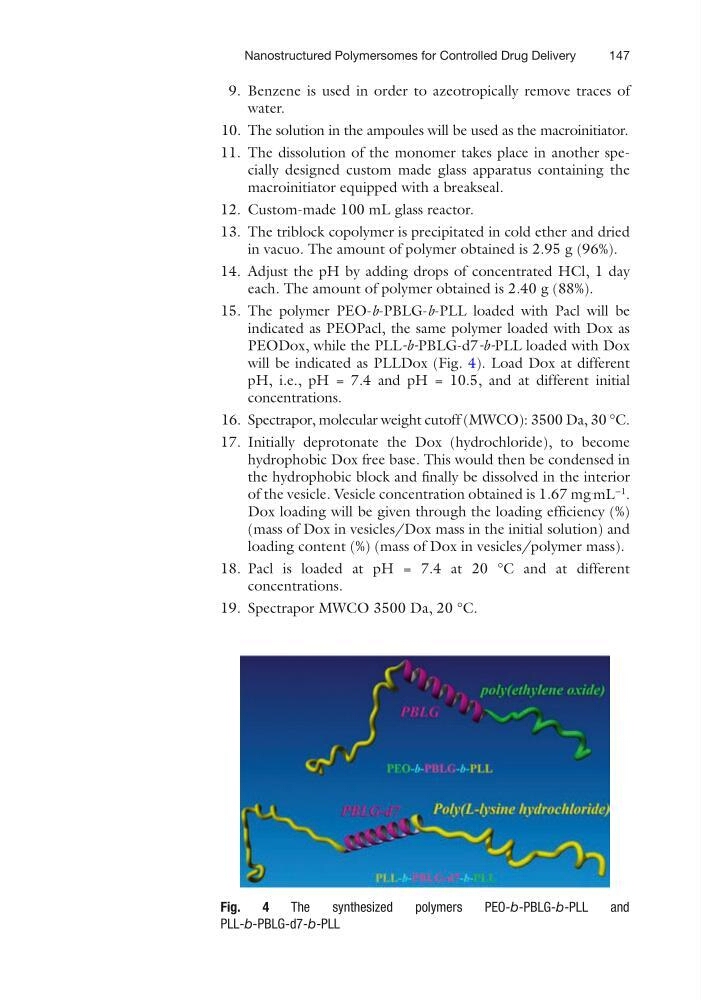
15. The polymer PEO-b-PBLG-b-PLL loaded with Pacl will be
indicated as PEOPacl, the same polymer loaded with Dox as
PEODox, while the PLL-b-PBLG-d7-b-PLL loaded with Dox
will be indicated as PLLDox (Fig. 4). Load Dox at different
pH, i.e., pH = 7.4 and pH = 10.5, and at different initial
concentrations.
16. Spectrapor, molecular weight cutoff (MWCO): 3500 Da, 30 °C.
17. Initially deprotonate the Dox (hydrochloride), to become
hydrophobic Dox free base. This would then be condensed in
the hydrophobic block and finally be dissolved in the interior
of the vesicle. Vesicle concentration obtained is 1.67 mg
.
mL
−1
.
Dox loading will be given through the loading efficiency (%)
(mass of Dox in vesicles/Dox mass in the initial solution) and
loading content (%) (mass of Dox in vesicles/polymer mass).
18. Pacl is loaded at pH = 7.4 at 20 °C and at different
concentrations.
19. Spectrapor MWCO 3500 Da, 20 °C.
Fig.
4
The
synthesized
polymers
PEO-b-PBLG-b-PLL
and
PLL-b-PBLG-d7-b-PLL
Nanostructured Polymersomes for Controlled Drug Delivery
9. Benzene is used in order to azeotropically remove traces of
water.
10. The solution in the ampoules will be used as the macroinitiator.
11. The dissolution of the monomer takes place in another specially designed custom made glass apparatus containing the
macroinitiator equipped with a breakseal.
12. Custom-made 100 mL glass reactor.
13. The triblock copolymer is precipitated in cold ether and dried
in vacuo. The amount of polymer obtained is 2.95 g (96%).
14. Adjust the pH by adding drops of concentrated HCl, 1 day
each. The amount of polymer obtained is 2.40 g (88%).
15. The polymer PEO-b-PBLG-b-PLL loaded with Pacl will be
indicated as PEOPacl, the same polymer loaded with Dox as
PEODox, while the PLL-b-PBLG-d7-b-PLL loaded with Dox
will be indicated as PLLDox (Fig. 4). Load Dox at different
pH, i.e., pH = 7.4 and pH = 10.5, and at different initial
concentrations.
16. Spectrapor, molecular weight cutoff (MWCO): 3500 Da, 30 °C.
17. Initially deprotonate the Dox (hydrochloride), to become
hydrophobic Dox free base. This would then be condensed in
the hydrophobic block and finally be dissolved in the interior
of the vesicle. Vesicle concentration obtained is 1.67 mg
.
mL
−1
.
Dox loading will be given through the loading efficiency (%)
(mass of Dox in vesicles/Dox mass in the initial solution) and
loading content (%) (mass of Dox in vesicles/polymer mass).
18. Pacl is loaded at pH = 7.4 at 20 °C and at different
concentrations.
19. Spectrapor MWCO 3500 Da, 20 °C.
Fig.
4
The
synthesized
polymers
PEO-b-PBLG-b-PLL
and
PLL-b-PBLG-d7-b-PLL
Nanostructured Polymersomes for Controlled Drug Delivery