

128
liquid under the shear rate of the plunger. Upon injection in the
vicinity of cancer tissue, it immediately reforms into a hydrogel due
to the unique combination of its macromolecular architecture and
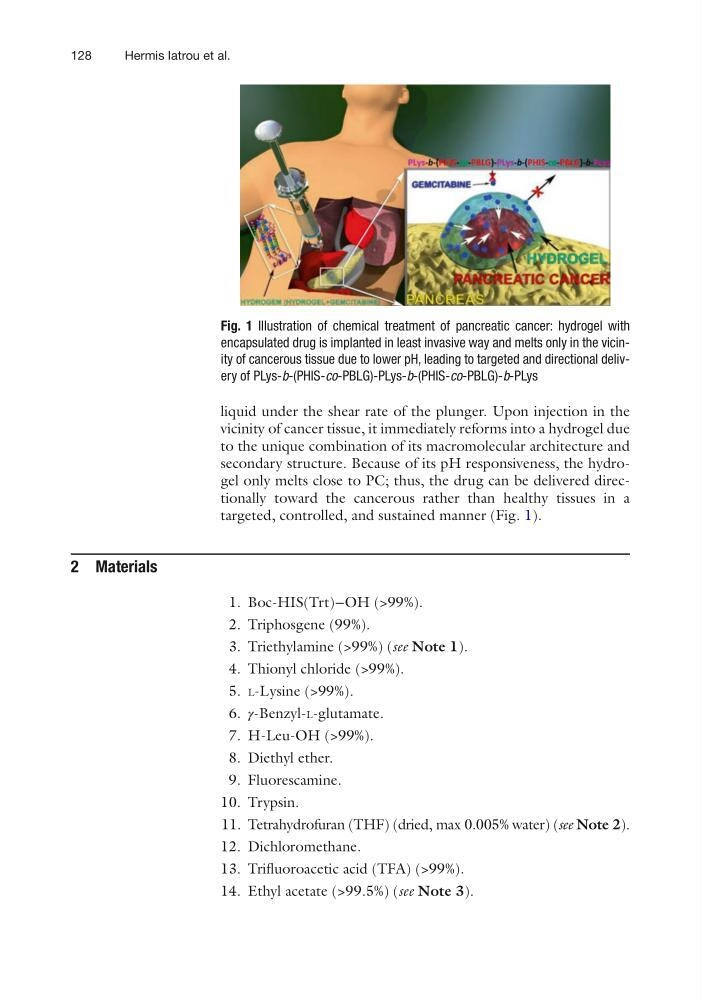
secondary structure. Because of its pH responsiveness, the hydrogel only melts close to PC; thus, the drug can be delivered directionally toward the cancerous rather than healthy tissues in a
targeted, controlled, and sustained manner (Fig. 1).
2 Materials
1. Boc-HIS(Trt)−OH (>99%).
2. Triphosgene (99%).
3. Triethylamine (>99%) (see Note 1).
4. Thionyl chloride (>99%).
5. l-Lysine (>99%).
6. γ-Benzyl-l-glutamate.
7. H-Leu-OH (>99%).
8. Diethyl ether.
9. Fluorescamine.
10. Trypsin.
11. Tetrahydrofuran (THF) (dried, max 0.005% water) (see Note 2).
12. Dichloromethane.
13. Trifluoroacetic acid (TFA) (>99%).
14. Ethyl acetate (>99.5%) (see Note 3).
Fig. 1 Illustration of chemical treatment of pancreatic cancer: hydrogel with
encapsulated drug is implanted in least invasive way and melts only in the vicinity of cancerous tissue due to lower pH, leading to targeted and directional delivery of PLys-b-(PHIS-co-PBLG)-PLys-b-(PHIS-co-PBLG)-b-PLys
Hermis Iatrou et al.
liquid under the shear rate of the plunger. Upon injection in the
vicinity of cancer tissue, it immediately reforms into a hydrogel due
to the unique combination of its macromolecular architecture and
secondary structure. Because of its pH responsiveness, the hydrogel only melts close to PC; thus, the drug can be delivered directionally toward the cancerous rather than healthy tissues in a
targeted, controlled, and sustained manner (Fig. 1).
2 Materials
1. Boc-HIS(Trt)−OH (>99%).
2. Triphosgene (99%).
3. Triethylamine (>99%) (see Note 1).
4. Thionyl chloride (>99%).
5. l-Lysine (>99%).
6. γ-Benzyl-l-glutamate.
7. H-Leu-OH (>99%).
8. Diethyl ether.
9. Fluorescamine.
10. Trypsin.
11. Tetrahydrofuran (THF) (dried, max 0.005% water) (see Note 2).
12. Dichloromethane.
13. Trifluoroacetic acid (TFA) (>99%).
14. Ethyl acetate (>99.5%) (see Note 3).
Fig. 1 Illustration of chemical treatment of pancreatic cancer: hydrogel with
encapsulated drug is implanted in least invasive way and melts only in the vicinity of cancerous tissue due to lower pH, leading to targeted and directional delivery of PLys-b-(PHIS-co-PBLG)-PLys-b-(PHIS-co-PBLG)-b-PLys
Hermis Iatrou et al.