

2
One of the most remarkable features of CDs is their tendency
to form solid inclusion complexes with a wide variety of solid, liquid and gaseous compounds through the process of molecular
complexation. The formed complexes are called host–guest type of
complexes. Such type of complexes involves a guest molecule
(drug) which is properly fitted into the lipophilic cavity of a host
(CD molecule) [4]. There is no breakage or formation of covalent
bonds during the formation of an inclusion complex
[5, 6]. When the CD is added to an aqueous solution, the polar
water molecules fit into the lipophilic cavity of the CD, but these
are immediately replaced by the more favored guest molecule,
which is less polar than the water molecules [7]. The main driving
force behind this complex formation is the replacement of highenthalpy water molecules with the guest moiety which adopts van
der Waals interactions, hydrogen bondings and charge transfer
interactions [6]. The ratio in which host and guest molecules bind
together is generally 1:1 [5], even though in many cases complexes
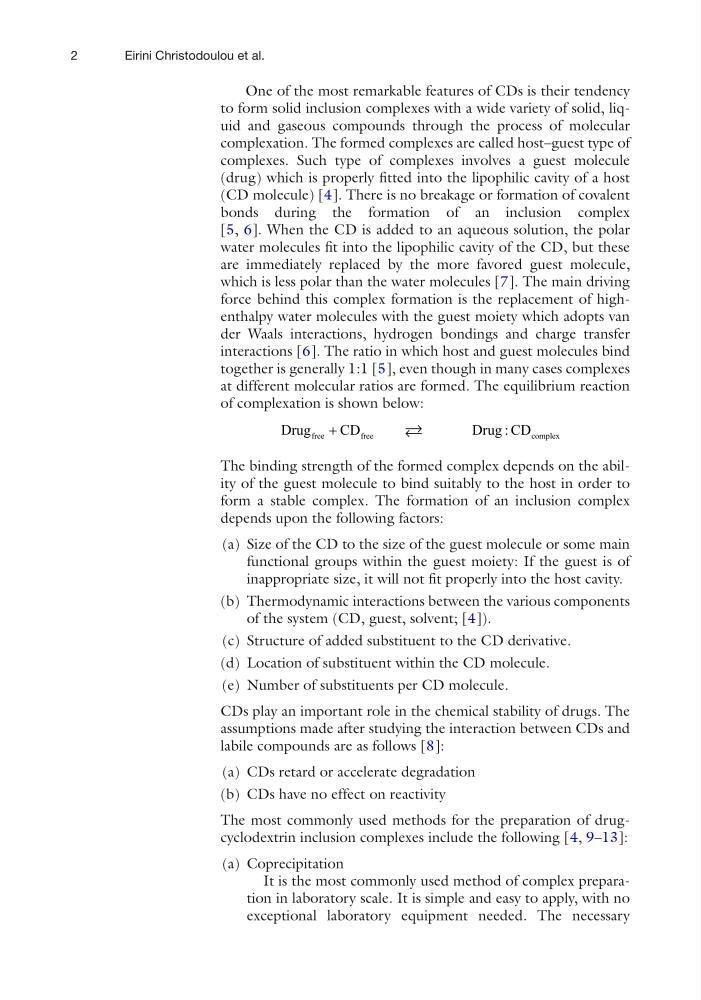
at different molecular ratios are formed. The equilibrium reaction
of complexation is shown below:
Drug
CD
Drug CD
free
free
c omplex
+
:
The binding strength of the formed complex depends on the ability of the guest molecule to bind suitably to the host in order to
form a stable complex. The formation of an inclusion complex
depends upon the following factors:
(a) Size of the CD to the size of the guest molecule or some main
functional groups within the guest moiety: If the guest is of
inappropriate size, it will not fit properly into the host cavity.
(b) Thermodynamic interactions between the various components
of the system (CD, guest, solvent; [4]).
(c) Structure of added substituent to the CD derivative.
(d) Location of substituent within the CD molecule.
(e) Number of substituents per CD molecule.
CDs play an important role in the chemical stability of drugs. The
assumptions made after studying the interaction between CDs and
labile compounds are as follows [8]:
(a) CDs retard or accelerate degradation
(b) CDs have no effect on reactivity
The most commonly used methods for the preparation of drugcyclodextrin inclusion complexes include the following [4, 9–13]:
(a) Coprecipitation
It is the most commonly used method of complex preparation in laboratory scale. It is simple and easy to apply, with no
exceptional laboratory equipment needed. The necessary
Eirini Christodoulou et al.
One of the most remarkable features of CDs is their tendency
to form solid inclusion complexes with a wide variety of solid, liquid and gaseous compounds through the process of molecular
complexation. The formed complexes are called host–guest type of
complexes. Such type of complexes involves a guest molecule
(drug) which is properly fitted into the lipophilic cavity of a host
(CD molecule) [4]. There is no breakage or formation of covalent
bonds during the formation of an inclusion complex
[5, 6]. When the CD is added to an aqueous solution, the polar
water molecules fit into the lipophilic cavity of the CD, but these
are immediately replaced by the more favored guest molecule,
which is less polar than the water molecules [7]. The main driving
force behind this complex formation is the replacement of highenthalpy water molecules with the guest moiety which adopts van
der Waals interactions, hydrogen bondings and charge transfer
interactions [6]. The ratio in which host and guest molecules bind
together is generally 1:1 [5], even though in many cases complexes
at different molecular ratios are formed. The equilibrium reaction
of complexation is shown below:
Drug
CD
Drug CD
free
free
c omplex
+
:
The binding strength of the formed complex depends on the ability of the guest molecule to bind suitably to the host in order to
form a stable complex. The formation of an inclusion complex
depends upon the following factors:
(a) Size of the CD to the size of the guest molecule or some main
functional groups within the guest moiety: If the guest is of
inappropriate size, it will not fit properly into the host cavity.
(b) Thermodynamic interactions between the various components
of the system (CD, guest, solvent; [4]).
(c) Structure of added substituent to the CD derivative.
(d) Location of substituent within the CD molecule.
(e) Number of substituents per CD molecule.
CDs play an important role in the chemical stability of drugs. The
assumptions made after studying the interaction between CDs and
labile compounds are as follows [8]:
(a) CDs retard or accelerate degradation
(b) CDs have no effect on reactivity
The most commonly used methods for the preparation of drugcyclodextrin inclusion complexes include the following [4, 9–13]:
(a) Coprecipitation
It is the most commonly used method of complex preparation in laboratory scale. It is simple and easy to apply, with no
exceptional laboratory equipment needed. The necessary
Eirini Christodoulou et al.