

111
2 Materials
Within this protocol, the following platforms, software suites, and
programs were used:
1. The Cambridge Structural Database (CSD): A compound
library, which contains >1 million crystal structures of organic
small molecules (free access). The CSD was used to retrieve the
initial structure of IRB (https://www.ccdc.cam.ac.uk/solutions/csd-system/components/csd/).
2. PubChem (U.S. National Library of Medicine): A database of
chemical structures, which also contains biological activity
information (free access). PubChem was used for 2-HP-β-CD
structure retrieval (https://pubchem.ncbi.nlm.nih.gov/compound/HP-beta-CD).
3. ArgusLab: [15] Software for molecular docking applications
(free of charge). ArgusLab was used for the inclusion of IRB
into 2-HP-β-CD (http://www.arguslab.com/arguslab.com/
ArgusLab.html).
4. AMBER 16: [16] A suite, which contains a number of programs for computational applications to biomolecular systems
(license fee required). AMBER was used to perform MD simulations and molecular mechanics Poisson-Boltzmann surface
area (MM–PBSA) free energy calculations for IRB:2-β-CD
complexes. We note that AMBER operates on a Linux/Unix
environment. The unfamiliar user may consult relevant Unix
tutorials and can acquire AMBER documentation and instructions through http://ambermd.org/.
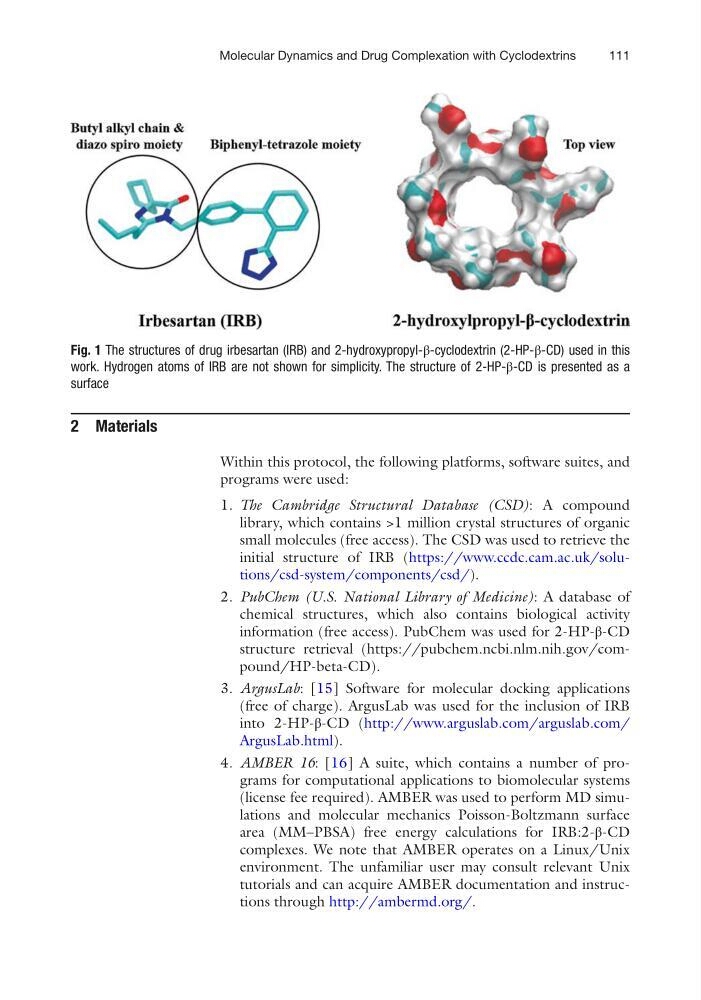
Fig. 1 The structures of drug irbesartan (IRB) and 2-hydroxypropyl-β-cyclodextrin (2-HP-β-CD) used in this
work. Hydrogen atoms of IRB are not shown for simplicity. The structure of 2-HP-β-CD is presented as a
surface
Molecular Dynamics and Drug Complexation with Cyclodextrins
2 Materials
Within this protocol, the following platforms, software suites, and
programs were used:
1. The Cambridge Structural Database (CSD): A compound
library, which contains >1 million crystal structures of organic
small molecules (free access). The CSD was used to retrieve the
initial structure of IRB (https://www.ccdc.cam.ac.uk/solutions/csd-system/components/csd/).
2. PubChem (U.S. National Library of Medicine): A database of
chemical structures, which also contains biological activity
information (free access). PubChem was used for 2-HP-β-CD
structure retrieval (https://pubchem.ncbi.nlm.nih.gov/compound/HP-beta-CD).
3. ArgusLab: [15] Software for molecular docking applications
(free of charge). ArgusLab was used for the inclusion of IRB
into 2-HP-β-CD (http://www.arguslab.com/arguslab.com/
ArgusLab.html).
4. AMBER 16: [16] A suite, which contains a number of programs for computational applications to biomolecular systems
(license fee required). AMBER was used to perform MD simulations and molecular mechanics Poisson-Boltzmann surface
area (MM–PBSA) free energy calculations for IRB:2-β-CD
complexes. We note that AMBER operates on a Linux/Unix
environment. The unfamiliar user may consult relevant Unix
tutorials and can acquire AMBER documentation and instructions through http://ambermd.org/.
Fig. 1 The structures of drug irbesartan (IRB) and 2-hydroxypropyl-β-cyclodextrin (2-HP-β-CD) used in this
work. Hydrogen atoms of IRB are not shown for simplicity. The structure of 2-HP-β-CD is presented as a
surface
Molecular Dynamics and Drug Complexation with Cyclodextrins