

101
evaluate its release kinetic models [16]. Silica-captopril formulations were tested and found to be attractive controlled-release systems, potentially offering better bioavailability and other benefits,
compared to the commercial formulation [17, 18].
It is noted by Wang et al. [1] that there is a lack of a comprehensive understanding of the compositions or structural characteristics of nanocarriers and this leads to limited designed ideas and
selectivity and makes it difficult to integrate advantages and achieve
optimal design. This notion triggered our interest to study the
interactions of captopril in SDS micelles using high-resolution
1
H
NMR spectroscopy and to provide some evidence on its molecular
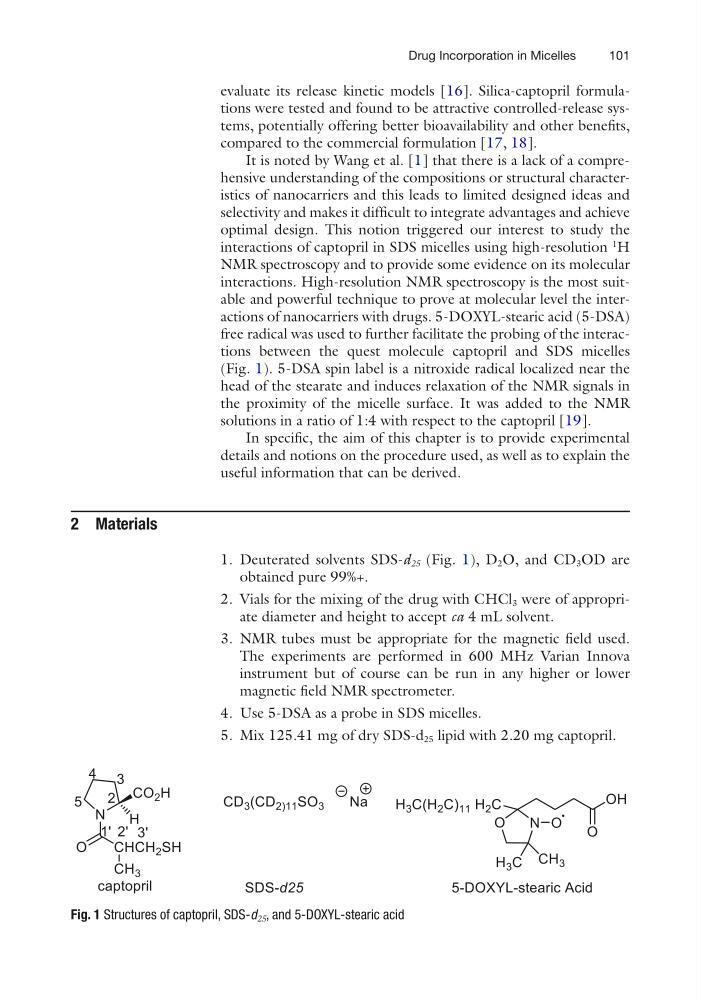
interactions. High-resolution NMR spectroscopy is the most suitable and powerful technique to prove at molecular level the interactions of nanocarriers with drugs. 5-DOXYL-stearic acid (5-DSA)
free radical was used to further facilitate the probing of the interactions between the quest molecule captopril and SDS micelles
(Fig. 1). 5-DSA spin label is a nitroxide radical localized near the
head of the stearate and induces relaxation of the NMR signals in
the proximity of the micelle surface. It was added to the NMR
solutions in a ratio of 1:4 with respect to the captopril [19].
In specific, the aim of this chapter is to provide experimental
details and notions on the procedure used, as well as to explain the
useful information that can be derived.
2 Materials
1. Deuterated solvents SDS-d 25 (Fig. 1), D 2 O, and CD 3 OD are
obtained pure 99%+.
2. Vials for the mixing of the drug with CHCl 3 were of appropriate diameter and height to accept ca 4 mL solvent.
3. NMR tubes must be appropriate for the magnetic field used.
The experiments are performed in 600 MHz Varian Innova
instrument but of course can be run in any higher or lower
magnetic field NMR spectrometer.
4. Use 5-DSA as a probe in SDS micelles.
5. Mix 125.41 mg of dry SDS-d 25 lipid with 2.20 mg captopril.
Fig. 1 Structures of captopril, SDS-d 25 , and 5-DOXYL-stearic acid
Drug Incorporation in Micelles
evaluate its release kinetic models [16]. Silica-captopril formulations were tested and found to be attractive controlled-release systems, potentially offering better bioavailability and other benefits,
compared to the commercial formulation [17, 18].
It is noted by Wang et al. [1] that there is a lack of a comprehensive understanding of the compositions or structural characteristics of nanocarriers and this leads to limited designed ideas and
selectivity and makes it difficult to integrate advantages and achieve
optimal design. This notion triggered our interest to study the
interactions of captopril in SDS micelles using high-resolution
1
H
NMR spectroscopy and to provide some evidence on its molecular
interactions. High-resolution NMR spectroscopy is the most suitable and powerful technique to prove at molecular level the interactions of nanocarriers with drugs. 5-DOXYL-stearic acid (5-DSA)
free radical was used to further facilitate the probing of the interactions between the quest molecule captopril and SDS micelles
(Fig. 1). 5-DSA spin label is a nitroxide radical localized near the
head of the stearate and induces relaxation of the NMR signals in
the proximity of the micelle surface. It was added to the NMR
solutions in a ratio of 1:4 with respect to the captopril [19].
In specific, the aim of this chapter is to provide experimental
details and notions on the procedure used, as well as to explain the
useful information that can be derived.
2 Materials
1. Deuterated solvents SDS-d 25 (Fig. 1), D 2 O, and CD 3 OD are
obtained pure 99%+.
2. Vials for the mixing of the drug with CHCl 3 were of appropriate diameter and height to accept ca 4 mL solvent.
3. NMR tubes must be appropriate for the magnetic field used.
The experiments are performed in 600 MHz Varian Innova
instrument but of course can be run in any higher or lower
magnetic field NMR spectrometer.
4. Use 5-DSA as a probe in SDS micelles.
5. Mix 125.41 mg of dry SDS-d 25 lipid with 2.20 mg captopril.
Fig. 1 Structures of captopril, SDS-d 25 , and 5-DOXYL-stearic acid
Drug Incorporation in Micelles