

Sustainable Campuses as Living Labs for Sustainable …
91
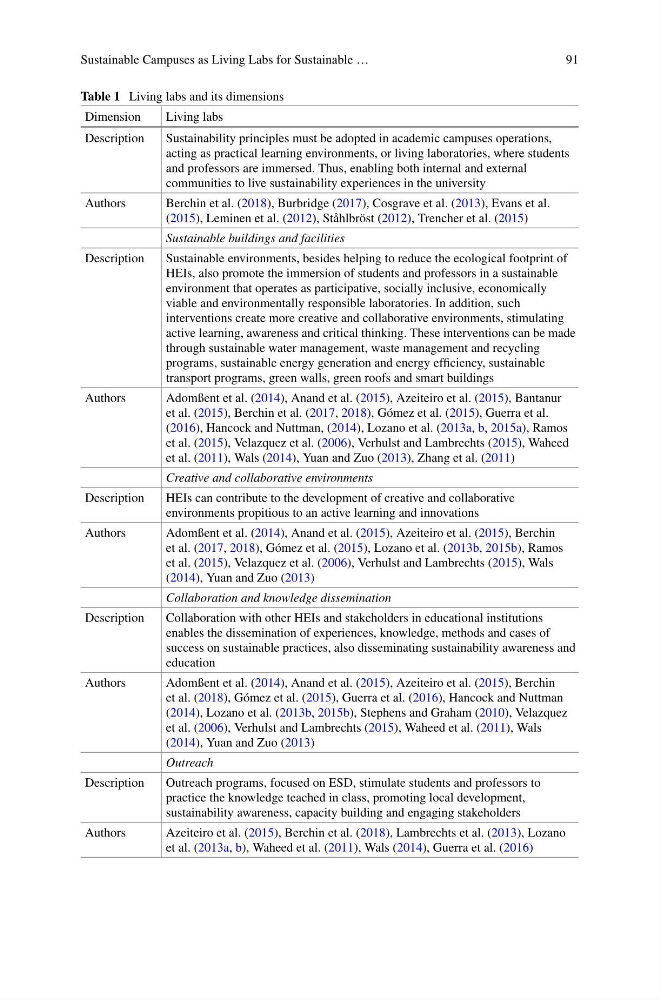
Table 1 Living labs and its dimensions
Dimension
Living labs
Description
Sustainability principles must be adopted in academic campuses operations,
acting as practical learning environments, or living laboratories, where students
and professors are immersed. Thus, enabling both internal and external
communities to live sustainability experiences in the university
Authors
Berchin et al. (2018), Burbridge (2017), Cosgrave et al. (2013), Evans et al.
(2015), Leminen et al. (2012), Ståhlbröst (2012), Trencher et al. (2015)
Sustainable buildings and facilities
Description
Sustainable environments, besides helping to reduce the ecological footprint of
HEIs, also promote the immersion of students and professors in a sustainable
environment that operates as participative, socially inclusive, economically
viable and environmentally responsible laboratories. In addition, such
interventions create more creative and collaborative environments, stimulating
active learning, awareness and critical thinking. These interventions can be made
through sustainable water management, waste management and recycling
programs, sustainable energy generation and energy efficiency, sustainable
transport programs, green walls, green roofs and smart buildings
Authors
Adomßent et al. (2014), Anand et al. (2015), Azeiteiro et al. (2015), Bantanur
et al. (2015), Berchin et al. (2017, 2018), Gómez et al. (2015), Guerra et al.
(2016), Hancock and Nuttman, (2014), Lozano et al. (2013a, b, 2015a), Ramos
et al. (2015), Velazquez et al. (2006), Verhulst and Lambrechts (2015), Waheed
et al. (2011), Wals (2014), Yuan and Zuo (2013), Zhang et al. (2011)
Creative and collaborative environments
Description
HEIs can contribute to the development of creative and collaborative
environments propitious to an active learning and innovations
Authors
Adomßent et al. (2014), Anand et al. (2015), Azeiteiro et al. (2015), Berchin
et al. (2017, 2018), Gómez et al. (2015), Lozano et al. (2013b, 2015b), Ramos
et al. (2015), Velazquez et al. (2006), Verhulst and Lambrechts (2015), Wals
(2014), Yuan and Zuo (2013)
Collaboration and knowledge dissemination
Description
Collaboration with other HEIs and stakeholders in educational institutions
enables the dissemination of experiences, knowledge, methods and cases of
success on sustainable practices, also disseminating sustainability awareness and
education
Authors
Adomßent et al. (2014), Anand et al. (2015), Azeiteiro et al. (2015), Berchin
et al. (2018), Gómez et al. (2015), Guerra et al. (2016), Hancock and Nuttman
(2014), Lozano et al. (2013b, 2015b), Stephens and Graham (2010), Velazquez
et al. (2006), Verhulst and Lambrechts (2015), Waheed et al. (2011), Wals
(2014), Yuan and Zuo (2013)
Outreach
Description
Outreach programs, focused on ESD, stimulate students and professors to
practice the knowledge teached in class, promoting local development,
sustainability awareness, capacity building and engaging stakeholders
Authors
Azeiteiro et al. (2015), Berchin et al. (2018), Lambrechts et al. (2013), Lozano
et al. (2013a, b), Waheed et al. (2011), Wals (2014), Guerra et al. (2016)
91
Table 1 Living labs and its dimensions
Dimension
Living labs
Description
Sustainability principles must be adopted in academic campuses operations,
acting as practical learning environments, or living laboratories, where students
and professors are immersed. Thus, enabling both internal and external
communities to live sustainability experiences in the university
Authors
Berchin et al. (2018), Burbridge (2017), Cosgrave et al. (2013), Evans et al.
(2015), Leminen et al. (2012), Ståhlbröst (2012), Trencher et al. (2015)
Sustainable buildings and facilities
Description
Sustainable environments, besides helping to reduce the ecological footprint of
HEIs, also promote the immersion of students and professors in a sustainable
environment that operates as participative, socially inclusive, economically
viable and environmentally responsible laboratories. In addition, such
interventions create more creative and collaborative environments, stimulating
active learning, awareness and critical thinking. These interventions can be made
through sustainable water management, waste management and recycling
programs, sustainable energy generation and energy efficiency, sustainable
transport programs, green walls, green roofs and smart buildings
Authors
Adomßent et al. (2014), Anand et al. (2015), Azeiteiro et al. (2015), Bantanur
et al. (2015), Berchin et al. (2017, 2018), Gómez et al. (2015), Guerra et al.
(2016), Hancock and Nuttman, (2014), Lozano et al. (2013a, b, 2015a), Ramos
et al. (2015), Velazquez et al. (2006), Verhulst and Lambrechts (2015), Waheed
et al. (2011), Wals (2014), Yuan and Zuo (2013), Zhang et al. (2011)
Creative and collaborative environments
Description
HEIs can contribute to the development of creative and collaborative
environments propitious to an active learning and innovations
Authors
Adomßent et al. (2014), Anand et al. (2015), Azeiteiro et al. (2015), Berchin
et al. (2017, 2018), Gómez et al. (2015), Lozano et al. (2013b, 2015b), Ramos
et al. (2015), Velazquez et al. (2006), Verhulst and Lambrechts (2015), Wals
(2014), Yuan and Zuo (2013)
Collaboration and knowledge dissemination
Description
Collaboration with other HEIs and stakeholders in educational institutions
enables the dissemination of experiences, knowledge, methods and cases of
success on sustainable practices, also disseminating sustainability awareness and
education
Authors
Adomßent et al. (2014), Anand et al. (2015), Azeiteiro et al. (2015), Berchin
et al. (2018), Gómez et al. (2015), Guerra et al. (2016), Hancock and Nuttman
(2014), Lozano et al. (2013b, 2015b), Stephens and Graham (2010), Velazquez
et al. (2006), Verhulst and Lambrechts (2015), Waheed et al. (2011), Wals
(2014), Yuan and Zuo (2013)
Outreach
Description
Outreach programs, focused on ESD, stimulate students and professors to
practice the knowledge teached in class, promoting local development,
sustainability awareness, capacity building and engaging stakeholders
Authors
Azeiteiro et al. (2015), Berchin et al. (2018), Lambrechts et al. (2013), Lozano
et al. (2013a, b), Waheed et al. (2011), Wals (2014), Guerra et al. (2016)