

Assessment of Sustainability Elements in Forestry Department …
841
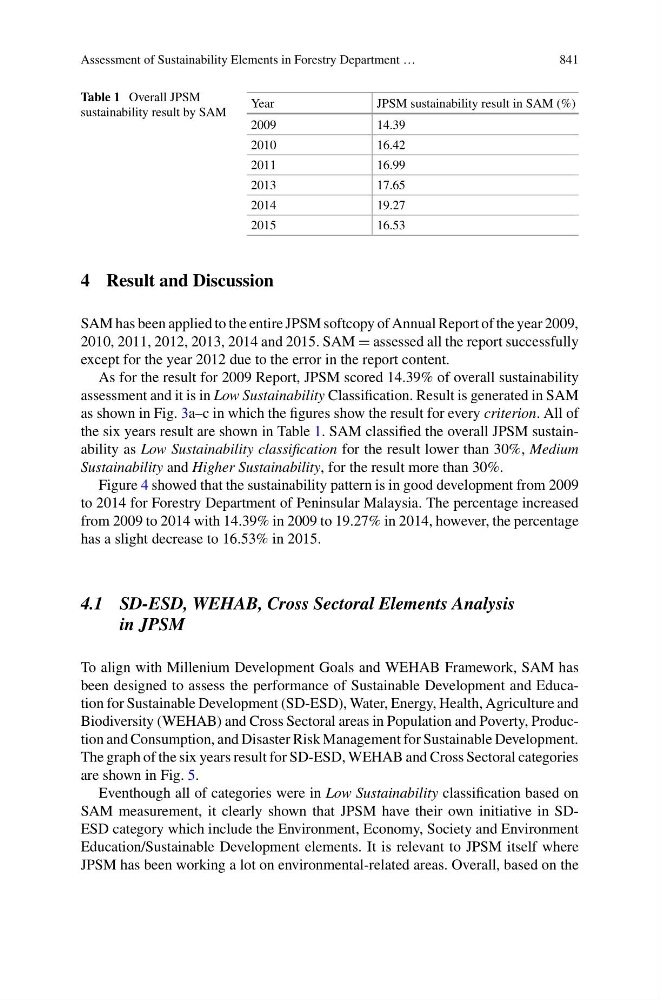
Table 1 Overall JPSM
sustainability result by SAM
Year
JPSM sustainability result in SAM (%)
2009
14.39
2010
16.42
2011
16.99
2013
17.65
2014
19.27
2015
16.53
4 Result and Discussion
SAM has been applied to the entire JPSM softcopy of Annual Report of the year 2009,
2010, 2011, 2012, 2013, 2014 and 2015. SAM = assessed all the report successfully
except for the year 2012 due to the error in the report content.
As for the result for 2009 Report, JPSM scored 14.39% of overall sustainability
assessment and it is in Low Sustainability Classification. Result is generated in SAM
as shown in Fig. 3a–c in which the figures show the result for every criterion. All of
the six years result are shown in Table 1. SAM classified the overall JPSM sustainability as Low Sustainability classification for the result lower than 30%, Medium
Sustainability and Higher Sustainability, for the result more than 30%.
Figure 4 showed that the sustainability pattern is in good development from 2009
to 2014 for Forestry Department of Peninsular Malaysia. The percentage increased
from 2009 to 2014 with 14.39% in 2009 to 19.27% in 2014, however, the percentage
has a slight decrease to 16.53% in 2015.
4.1 SD-ESD, WEHAB, Cross Sectoral Elements Analysis
in JPSM
To align with Millenium Development Goals and WEHAB Framework, SAM has
been designed to assess the performance of Sustainable Development and Education for Sustainable Development (SD-ESD), Water, Energy, Health, Agriculture and
Biodiversity (WEHAB) and Cross Sectoral areas in Population and Poverty, Production and Consumption, and Disaster Risk Management for Sustainable Development.
The graph of the six years result for SD-ESD, WEHAB and Cross Sectoral categories
are shown in Fig. 5.
Eventhough all of categories were in Low Sustainability classification based on
SAM measurement, it clearly shown that JPSM have their own initiative in SDESD category which include the Environment, Economy, Society and Environment
Education/Sustainable Development elements. It is relevant to JPSM itself where
JPSM has been working a lot on environmental-related areas. Overall, based on the