

826
C. Faé et al.
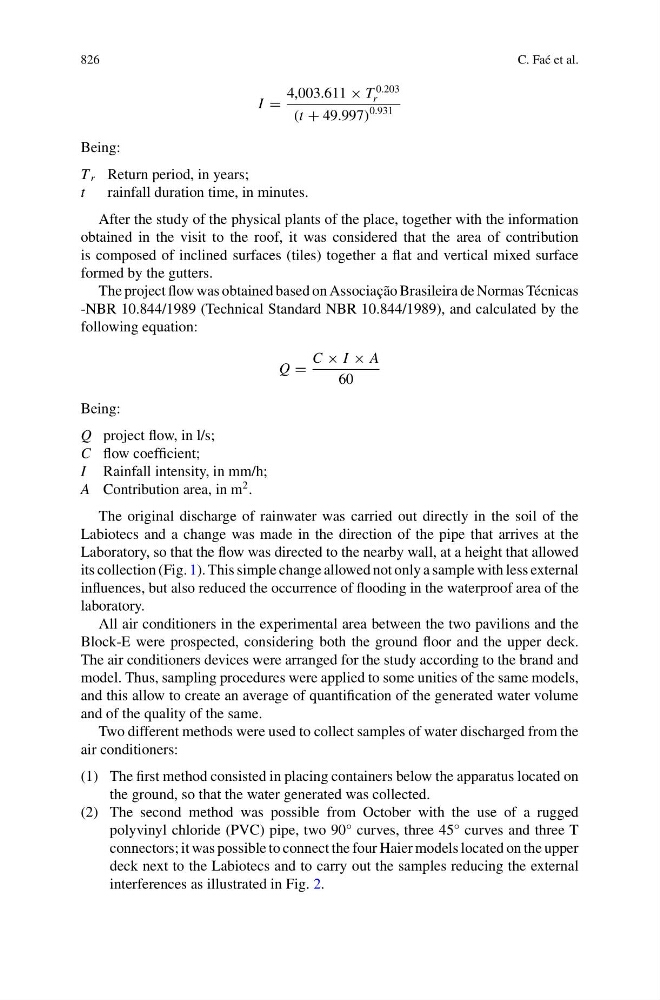
I =
4,003.611 × T
0.203
r
(t + 49.997)
0.931
Being:
T r Return period, in years;
t
rainfall duration time, in minutes.
After the study of the physical plants of the place, together with the information
obtained in the visit to the roof, it was considered that the area of contribution
is composed of inclined surfaces (tiles) together a flat and vertical mixed surface
formed by the gutters.
The project flow was obtained based on Associação Brasileira de Normas Técnicas
-NBR 10.844/1989 (Technical Standard NBR 10.844/1989), and calculated by the
following equation:
Q =
C × I × A
60
Being:
Q project flow, in l/s;
C flow coefficient;
I Rainfall intensity, in mm/h;
A Contribution area, in m
2 .
The original discharge of rainwater was carried out directly in the soil of the
Labiotecs and a change was made in the direction of the pipe that arrives at the
Laboratory, so that the flow was directed to the nearby wall, at a height that allowed
its collection (Fig. 1). This simple change allowed not only a sample with less external
influences, but also reduced the occurrence of flooding in the waterproof area of the
laboratory.
All air conditioners in the experimental area between the two pavilions and the
Block-E were prospected, considering both the ground floor and the upper deck.
The air conditioners devices were arranged for the study according to the brand and
model. Thus, sampling procedures were applied to some unities of the same models,
and this allow to create an average of quantification of the generated water volume
and of the quality of the same.
Two different methods were used to collect samples of water discharged from the
air conditioners:
(1) The first method consisted in placing containers below the apparatus located on
the ground, so that the water generated was collected.
(2) The second method was possible from October with the use of a rugged
polyvinyl chloride (PVC) pipe, two 90° curves, three 45° curves and three T
connectors; it was possible to connect the four Haier models located on the upper
deck next to the Labiotecs and to carry out the samples reducing the external
interferences as illustrated in Fig. 2.