

A Survey of Laboratory Practice on Water Scarcity: Conservation …
771
Table 6 Responses of the lab
user
Description
Yes
No
Practice in daily life?
140 (81.87) 31 (18.13)
Knowing the process
163 (95.32) 8 (4.68)
Know the different
164 (95.91) 7 (4.09)
100 mL need 4 L water
43 (25.15)
128 (74.85)
Do you think is a waste?
149 (87.13) 22 (12.87)
Collected for general washing
and plant watering
36 (21.30)
133(78.70)
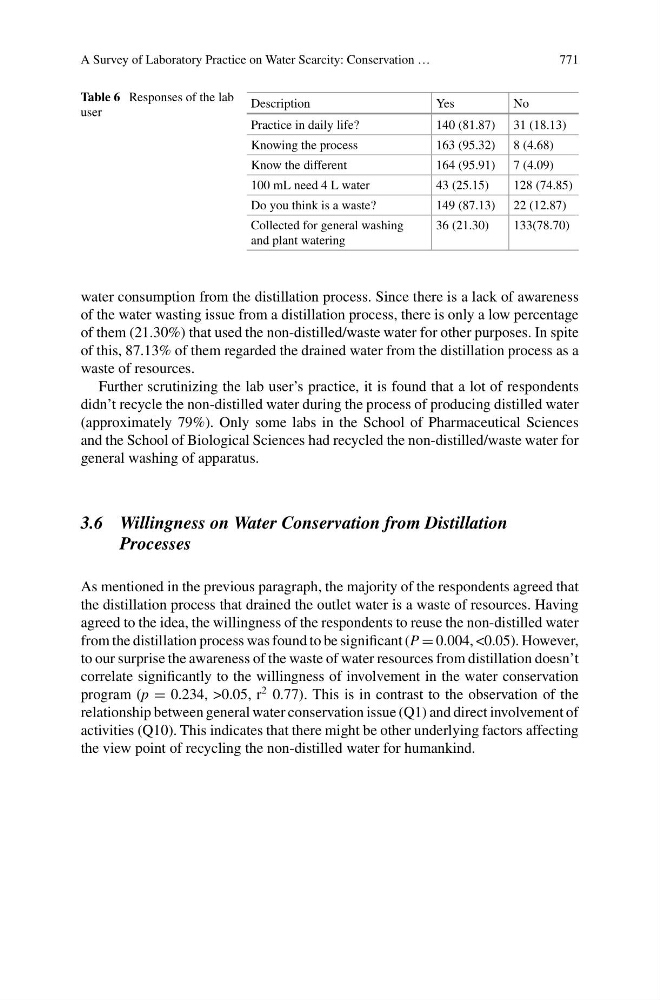
water consumption from the distillation process. Since there is a lack of awareness
of the water wasting issue from a distillation process, there is only a low percentage
of them (21.30%) that used the non-distilled/waste water for other purposes. In spite
of this, 87.13% of them regarded the drained water from the distillation process as a
waste of resources.
Further scrutinizing the lab user’s practice, it is found that a lot of respondents
didn’t recycle the non-distilled water during the process of producing distilled water
(approximately 79%). Only some labs in the School of Pharmaceutical Sciences
and the School of Biological Sciences had recycled the non-distilled/waste water for
general washing of apparatus.
3.6 Willingness on Water Conservation from Distillation
Processes
As mentioned in the previous paragraph, the majority of the respondents agreed that
the distillation process that drained the outlet water is a waste of resources. Having
agreed to the idea, the willingness of the respondents to reuse the non-distilled water
from the distillation process was found to be significant (P = 0.004, <0.05). However,
to our surprise the awareness of the waste of water resources from distillation doesn’t
correlate significantly to the willingness of involvement in the water conservation
program (p = 0.234, >0.05, r
2 0.77). This is in contrast to the observation of the
relationship between general water conservation issue (Q1) and direct involvement of
activities (Q10). This indicates that there might be other underlying factors affecting
the view point of recycling the non-distilled water for humankind.