

720
S. L. Galván et al.
Table 1 Protocol for the research of the case study
Research questions
How did the waste management plan begin at the universities studied?
How was the source separation of waste implemented in the campus?
How are the results of the implementation of the source separation of
waste monitored at each university?
Which are the similarities and differences in the implementation of the
source separation of waste between the different universities studied?
What are the conclusions which may be drawn from this comparison?
Unit of analysis
Implementation process of a SWMP at a university campus
Timeline
The literature review began in 2010 when one of the authors began her
teaching task at the UNGS. In 2012, she began to study the
implementation of the SWMP. The SWMP was implemented in the
campus in 2013 and monitored for three years. The case was analyzed
and compared with others between 2016 and 2017
Information sources
The information referring to the SWMP implemented at the UNGS was
generated by us, since we promoted the initiative
The information concerning the other universities was obtained from
documents, such as strategic plans, documents of environmental policy,
documents of adhesion to institutional networks, web sites, and works
reported in scientific journals (Armijo de Vega et al. 2008; Barros et al.
2013; Buenrostro 2010; Castillo and Luzardo 2013)
Proof of validity
Interviews by mail
Table 2 Universities selected for the study and acronyms of references used
University/faculty
Acronym
Country
Nomenclature
Universidad Nacional de General Sarmiento
(Buenos Aires province)
UNGS
Argentina
UNGS
Universidad Nacional de Cuyo (Mendoza province) UNCUYO
Argentina
UA
Instituto de Ingeniería of the Universidad
Autónoma de Baja California, Campus Mexicali
UABC
Mexico
UM
Facultad de Ciencias Físicas y Matemáticas of the
Universidad de Chile
FCFM
Chile
UCh
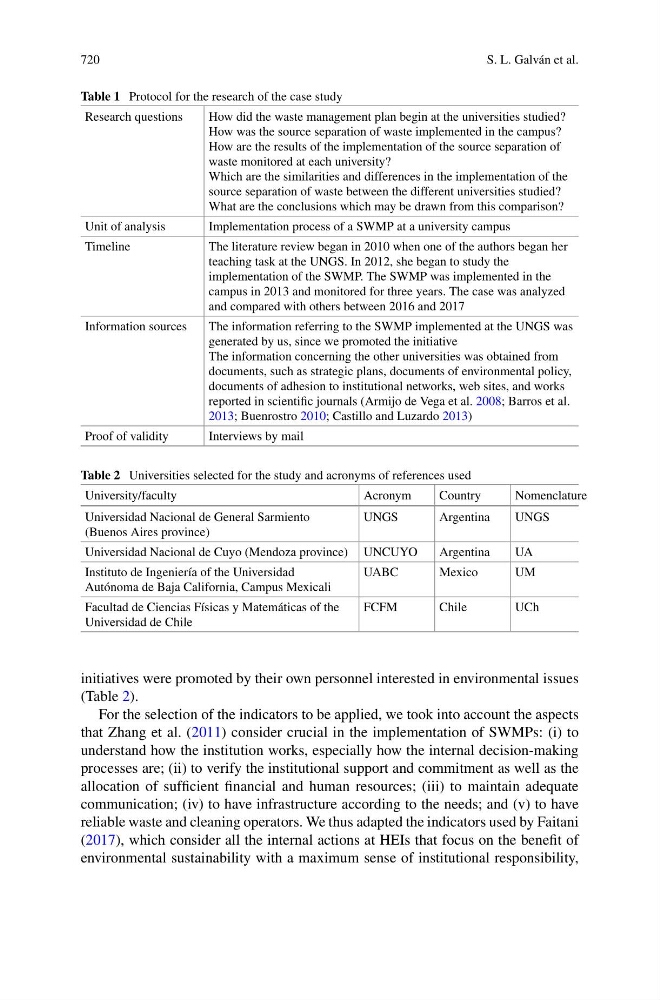
initiatives were promoted by their own personnel interested in environmental issues
(Table 2).
For the selection of the indicators to be applied, we took into account the aspects
that Zhang et al. (2011) consider crucial in the implementation of SWMPs: (i) to
understand how the institution works, especially how the internal decision-making
processes are; (ii) to verify the institutional support and commitment as well as the
allocation of sufficient financial and human resources; (iii) to maintain adequate
communication; (iv) to have infrastructure according to the needs; and (v) to have
reliable waste and cleaning operators. We thus adapted the indicators used by Faitani
(2017), which consider all the internal actions at HEIs that focus on the benefit of
environmental sustainability with a maximum sense of institutional responsibility,