

Post-occupancy Evaluation Focused on Accessibility: Experience …
709
of respondents, the questionnaire will be repeated in 2018 and the following years,
both online and in person, because awareness is a permanent process. At the same
time, the rotation of students and campus goers requires lifelong and continuing
education to remove physical and attitudinal barriers to access and permanence of
persons with disabilities in higher education.
9.2 Results of the Walkthrough with the Visually Impaired
The guided walkthrough to verify the accessibility of the visually impaired was
carried out in January 2018, with a group of thirteen people. It was compounded
with four architects of the Architecture and Urbanism course (Laburb), a project
engineer, two professionals from the service sector student (Saes), an instructor; two
visual disable people and blind people members of the Association of Passo-fundense
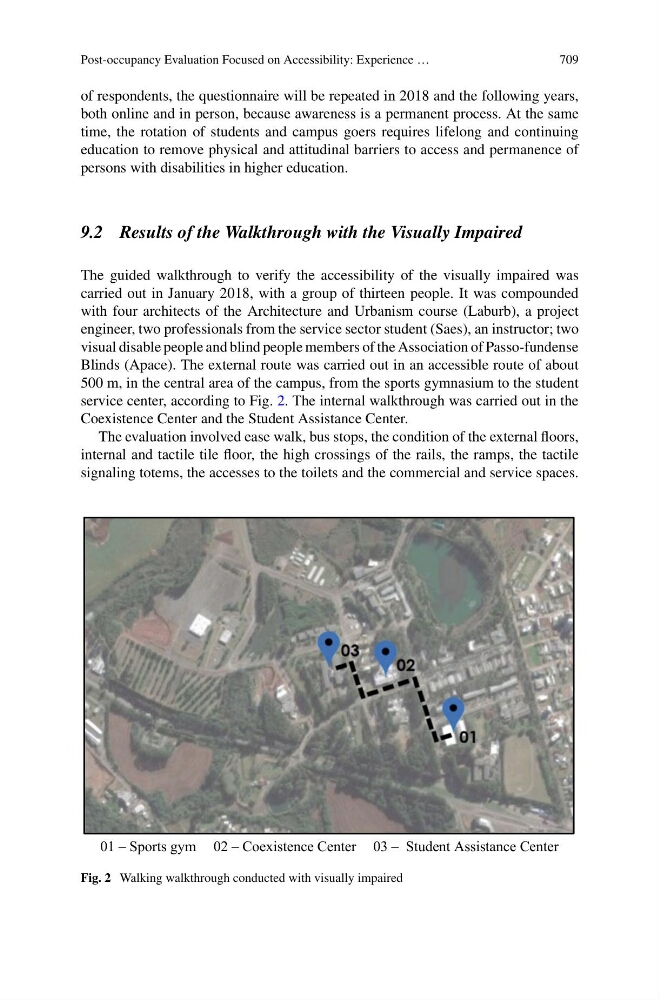
Blinds (Apace). The external route was carried out in an accessible route of about
500 m, in the central area of the campus, from the sports gymnasium to the student
service center, according to Fig. 2. The internal walkthrough was carried out in the
Coexistence Center and the Student Assistance Center.
The evaluation involved ease walk, bus stops, the condition of the external floors,
internal and tactile tile floor, the high crossings of the rails, the ramps, the tactile
signaling totems, the accesses to the toilets and the commercial and service spaces.
01 – Sports gym 02 – Coexistence Center 03 – Student Assistance Center
Fig. 2 Walking walkthrough conducted with visually impaired