

58
L. L. Brandli et al.
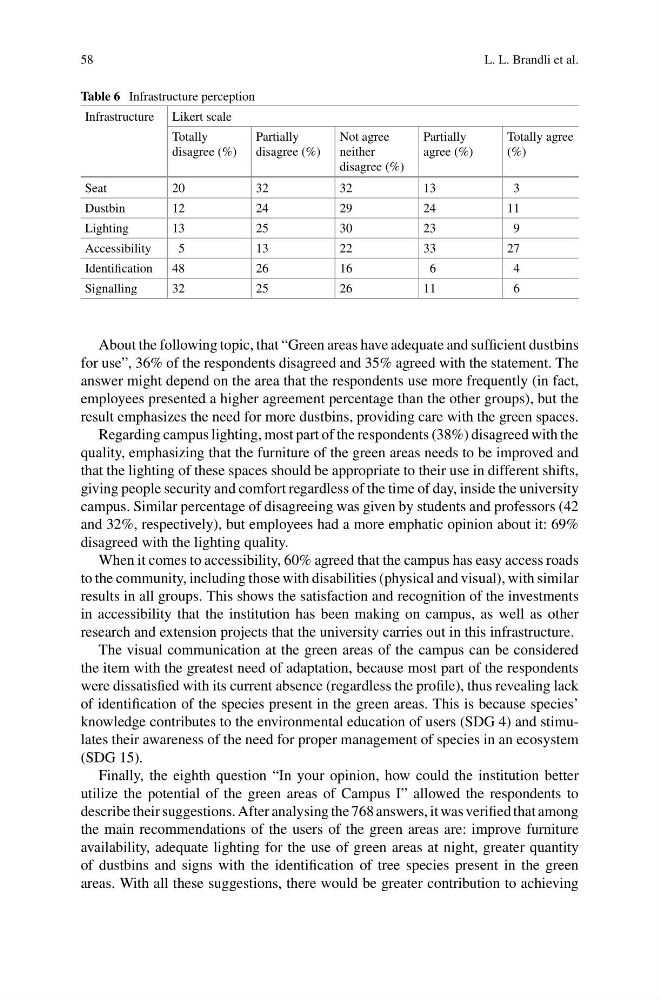
Table 6 Infrastructure perception
Infrastructure Likert scale
Totally
disagree (%)
Partially
disagree (%)
Not agree
neither
disagree (%)
Partially
agree (%)
Totally agree
(%)
Seat
20
32
32
13
3
Dustbin
12
24
29
24
11
Lighting
13
25
30
23
9
Accessibility
5
13
22
33
27
Identification
48
26
16
6
4
Signalling
32
25
26
11
6
About the following topic, that “Green areas have adequate and sufficient dustbins
for use”, 36% of the respondents disagreed and 35% agreed with the statement. The
answer might depend on the area that the respondents use more frequently (in fact,
employees presented a higher agreement percentage than the other groups), but the
result emphasizes the need for more dustbins, providing care with the green spaces.
Regarding campus lighting, most part of the respondents (38%) disagreed with the
quality, emphasizing that the furniture of the green areas needs to be improved and
that the lighting of these spaces should be appropriate to their use in different shifts,
giving people security and comfort regardless of the time of day, inside the university
campus. Similar percentage of disagreeing was given by students and professors (42
and 32%, respectively), but employees had a more emphatic opinion about it: 69%
disagreed with the lighting quality.
When it comes to accessibility, 60% agreed that the campus has easy access roads
to the community, including those with disabilities (physical and visual), with similar
results in all groups. This shows the satisfaction and recognition of the investments
in accessibility that the institution has been making on campus, as well as other
research and extension projects that the university carries out in this infrastructure.
The visual communication at the green areas of the campus can be considered
the item with the greatest need of adaptation, because most part of the respondents
were dissatisfied with its current absence (regardless the profile), thus revealing lack
of identification of the species present in the green areas. This is because species’
knowledge contributes to the environmental education of users (SDG 4) and stimulates their awareness of the need for proper management of species in an ecosystem
(SDG 15).
Finally, the eighth question “In your opinion, how could the institution better
utilize the potential of the green areas of Campus I” allowed the respondents to
describe their suggestions. After analysing the 768 answers, it was verified that among
the main recommendations of the users of the green areas are: improve furniture
availability, adequate lighting for the use of green areas at night, greater quantity
of dustbins and signs with the identification of tree species present in the green
areas. With all these suggestions, there would be greater contribution to achieving
L. L. Brandli et al.
Table 6 Infrastructure perception
Infrastructure Likert scale
Totally
disagree (%)
Partially
disagree (%)
Not agree
neither
disagree (%)
Partially
agree (%)
Totally agree
(%)
Seat
20
32
32
13
3
Dustbin
12
24
29
24
11
Lighting
13
25
30
23
9
Accessibility
5
13
22
33
27
Identification
48
26
16
6
4
Signalling
32
25
26
11
6
About the following topic, that “Green areas have adequate and sufficient dustbins
for use”, 36% of the respondents disagreed and 35% agreed with the statement. The
answer might depend on the area that the respondents use more frequently (in fact,
employees presented a higher agreement percentage than the other groups), but the
result emphasizes the need for more dustbins, providing care with the green spaces.
Regarding campus lighting, most part of the respondents (38%) disagreed with the
quality, emphasizing that the furniture of the green areas needs to be improved and
that the lighting of these spaces should be appropriate to their use in different shifts,
giving people security and comfort regardless of the time of day, inside the university
campus. Similar percentage of disagreeing was given by students and professors (42
and 32%, respectively), but employees had a more emphatic opinion about it: 69%
disagreed with the lighting quality.
When it comes to accessibility, 60% agreed that the campus has easy access roads
to the community, including those with disabilities (physical and visual), with similar
results in all groups. This shows the satisfaction and recognition of the investments
in accessibility that the institution has been making on campus, as well as other
research and extension projects that the university carries out in this infrastructure.
The visual communication at the green areas of the campus can be considered
the item with the greatest need of adaptation, because most part of the respondents
were dissatisfied with its current absence (regardless the profile), thus revealing lack
of identification of the species present in the green areas. This is because species’
knowledge contributes to the environmental education of users (SDG 4) and stimulates their awareness of the need for proper management of species in an ecosystem
(SDG 15).
Finally, the eighth question “In your opinion, how could the institution better
utilize the potential of the green areas of Campus I” allowed the respondents to
describe their suggestions. After analysing the 768 answers, it was verified that among
the main recommendations of the users of the green areas are: improve furniture
availability, adequate lighting for the use of green areas at night, greater quantity
of dustbins and signs with the identification of tree species present in the green
areas. With all these suggestions, there would be greater contribution to achieving