

652
D. Schostok
1 Introduction
In line with the pluralistic definition of the management concept in economics,
1
sustainability management can be considered from three central perspectives: a
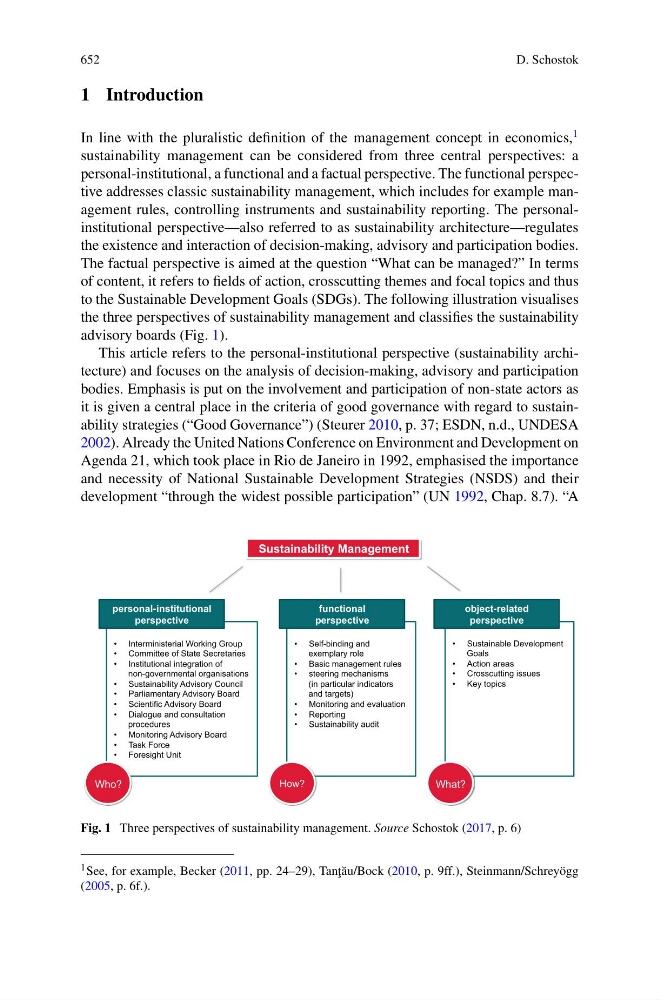
personal-institutional, a functional and a factual perspective. The functional perspective addresses classic sustainability management, which includes for example management rules, controlling instruments and sustainability reporting. The personalinstitutional perspective—also referred to as sustainability architecture—regulates
the existence and interaction of decision-making, advisory and participation bodies.
The factual perspective is aimed at the question “What can be managed?” In terms
of content, it refers to fields of action, crosscutting themes and focal topics and thus
to the Sustainable Development Goals (SDGs). The following illustration visualises
the three perspectives of sustainability management and classifies the sustainability
advisory boards (Fig. 1).
This article refers to the personal-institutional perspective (sustainability architecture) and focuses on the analysis of decision-making, advisory and participation
bodies. Emphasis is put on the involvement and participation of non-state actors as
it is given a central place in the criteria of good governance with regard to sustainability strategies (“Good Governance”) (Steurer 2010, p. 37; ESDN, n.d., UNDESA
2002). Already the United Nations Conference on Environment and Development on
Agenda 21, which took place in Rio de Janeiro in 1992, emphasised the importance
and necessity of National Sustainable Development Strategies (NSDS) and their
development “through the widest possible participation” (UN 1992, Chap. 8.7). “A
• Interministerial Working Group
• Committee of State Secretaries
• Institutional integration of
non-governmental organisations
• Sustainability Advisory Council
• Parliamentary Advisory Board
• Scientific Advisory Board
• Dialogue and consultation
procedures
• Monitoring Advisory Board
• Task Force
• Foresight Unit
• Self-binding and
exemplary role
• Basic management rules
• steering mechanisms
(in particular indicators
and targets)
• Monitoring and evaluation
• Reporting
• Sustainability audit
• Sustainable Development
Goals
• Action areas
• Crosscutting issues
• Keytopics
personal-institutional
perspective
functional
perspective
object-related
perspective
Sustainability Management
Who?
How?
What?
Fig. 1 Three perspectives of sustainability management. Source Schostok (2017, p. 6)
1 See, for example, Becker (2011, pp. 24–29), Tan¸ t˘ au/Bock (2010, p. 9ff.), Steinmann/Schreyögg
(2005, p. 6f.).