

646
B. Giesenbauer and M. Tegeler
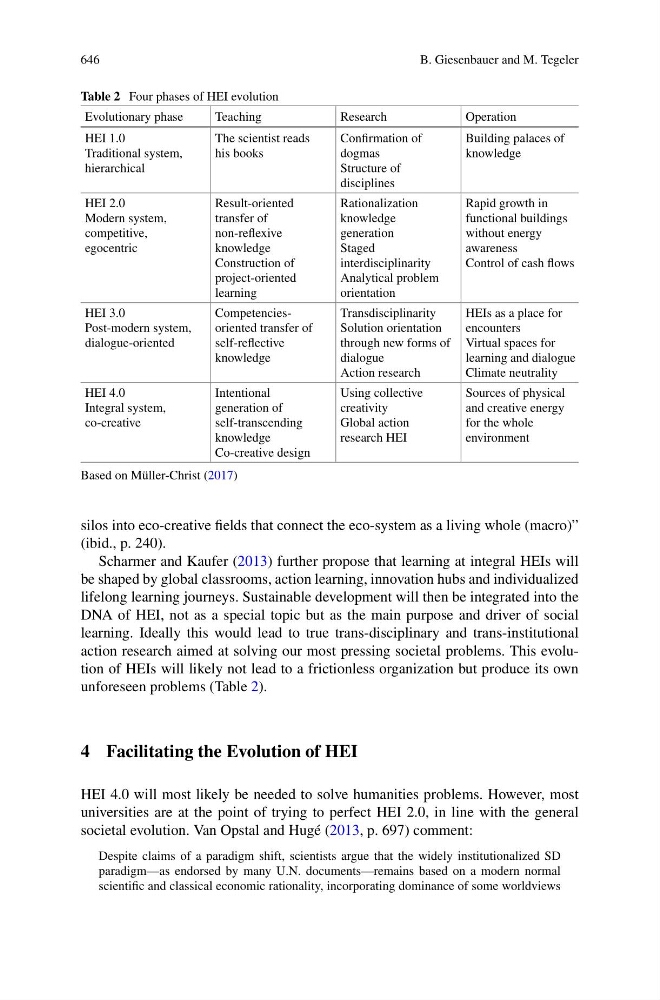
Table 2 Four phases of HEI evolution
Evolutionary phase
Teaching
Research
Operation
HEI 1.0
Traditional system,
hierarchical
The scientist reads
his books
Confirmation of
dogmas
Structure of
disciplines
Building palaces of
knowledge
HEI 2.0
Modern system,
competitive,
egocentric
Result-oriented
transfer of
non-reflexive
knowledge
Construction of
project-oriented
learning
Rationalization
knowledge
generation
Staged
interdisciplinarity
Analytical problem
orientation
Rapid growth in
functional buildings
without energy
awareness
Control of cash flows
HEI 3.0
Post-modern system,
dialogue-oriented
Competenciesoriented transfer of
self-reflective
knowledge
Transdisciplinarity
Solution orientation
through new forms of
dialogue
Action research
HEIs as a place for
encounters
Virtual spaces for
learning and dialogue
Climate neutrality
HEI 4.0
Integral system,
co-creative
Intentional
generation of
self-transcending
knowledge
Co-creative design
Using collective
creativity
Global action
research HEI
Sources of physical
and creative energy
for the whole
environment
Based on Müller-Christ (2017)
silos into eco-creative fields that connect the eco-system as a living whole (macro)”
(ibid., p. 240).
Scharmer and Kaufer (2013) further propose that learning at integral HEIs will
be shaped by global classrooms, action learning, innovation hubs and individualized
lifelong learning journeys. Sustainable development will then be integrated into the
DNA of HEI, not as a special topic but as the main purpose and driver of social
learning. Ideally this would lead to true trans-disciplinary and trans-institutional
action research aimed at solving our most pressing societal problems. This evolution of HEIs will likely not lead to a frictionless organization but produce its own
unforeseen problems (Table 2).
4 Facilitating the Evolution of HEI
HEI 4.0 will most likely be needed to solve humanities problems. However, most
universities are at the point of trying to perfect HEI 2.0, in line with the general
societal evolution. Van Opstal and Hugé (2013, p. 697) comment:
Despite claims of a paradigm shift, scientists argue that the widely institutionalized SD
paradigm—as endorsed by many U.N. documents—remains based on a modern normal
scientific and classical economic rationality, incorporating dominance of some worldviews