

562
J. Jodoin and J. Singer
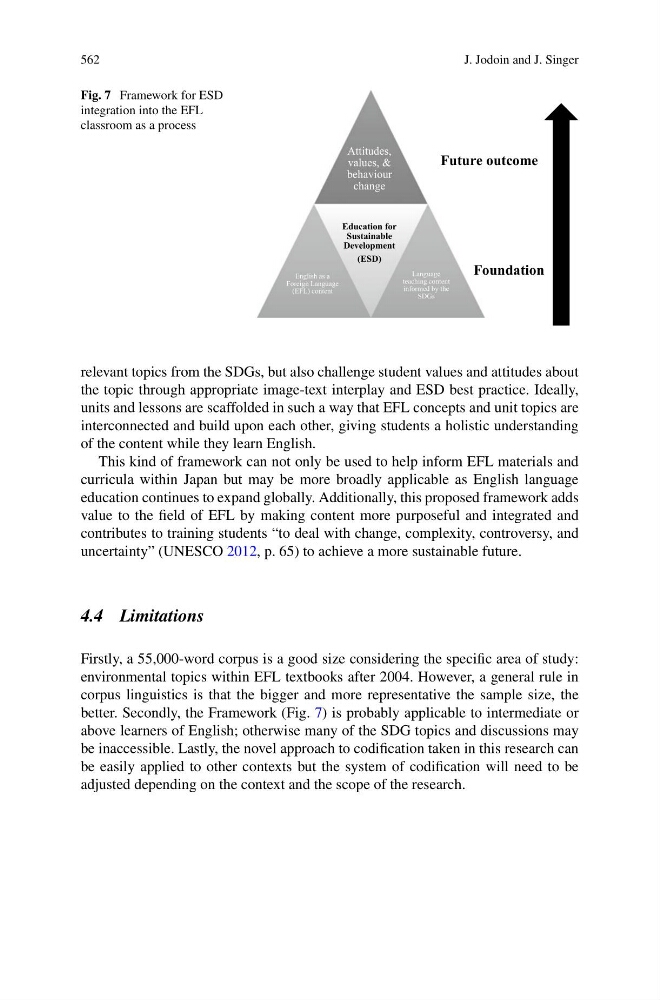
Fig. 7 Framework for ESD
integration into the EFL
classroom as a process
Attitudes,
values, &
behaviour
change
English as a
Foreign Language
(EFL) content
Education for
Sustainable
Development
(ESD)
Language
teaching content
informed by the
SDGs
Future outcome
Foundation
relevant topics from the SDGs, but also challenge student values and attitudes about
the topic through appropriate image-text interplay and ESD best practice. Ideally,
units and lessons are scaffolded in such a way that EFL concepts and unit topics are
interconnected and build upon each other, giving students a holistic understanding
of the content while they learn English.
This kind of framework can not only be used to help inform EFL materials and
curricula within Japan but may be more broadly applicable as English language
education continues to expand globally. Additionally, this proposed framework adds
value to the field of EFL by making content more purposeful and integrated and
contributes to training students “to deal with change, complexity, controversy, and
uncertainty” (UNESCO 2012, p. 65) to achieve a more sustainable future.
4.4 Limitations
Firstly, a 55,000-word corpus is a good size considering the specific area of study:
environmental topics within EFL textbooks after 2004. However, a general rule in
corpus linguistics is that the bigger and more representative the sample size, the
better. Secondly, the Framework (Fig. 7) is probably applicable to intermediate or
above learners of English; otherwise many of the SDG topics and discussions may
be inaccessible. Lastly, the novel approach to codification taken in this research can
be easily applied to other contexts but the system of codification will need to be
adjusted depending on the context and the scope of the research.
J. Jodoin and J. Singer
Fig. 7 Framework for ESD
integration into the EFL
classroom as a process
Attitudes,
values, &
behaviour
change
English as a
Foreign Language
(EFL) content
Education for
Sustainable
Development
(ESD)
Language
teaching content
informed by the
SDGs
Future outcome
Foundation
relevant topics from the SDGs, but also challenge student values and attitudes about
the topic through appropriate image-text interplay and ESD best practice. Ideally,
units and lessons are scaffolded in such a way that EFL concepts and unit topics are
interconnected and build upon each other, giving students a holistic understanding
of the content while they learn English.
This kind of framework can not only be used to help inform EFL materials and
curricula within Japan but may be more broadly applicable as English language
education continues to expand globally. Additionally, this proposed framework adds
value to the field of EFL by making content more purposeful and integrated and
contributes to training students “to deal with change, complexity, controversy, and
uncertainty” (UNESCO 2012, p. 65) to achieve a more sustainable future.
4.4 Limitations
Firstly, a 55,000-word corpus is a good size considering the specific area of study:
environmental topics within EFL textbooks after 2004. However, a general rule in
corpus linguistics is that the bigger and more representative the sample size, the
better. Secondly, the Framework (Fig. 7) is probably applicable to intermediate or
above learners of English; otherwise many of the SDG topics and discussions may
be inaccessible. Lastly, the novel approach to codification taken in this research can
be easily applied to other contexts but the system of codification will need to be
adjusted depending on the context and the scope of the research.