

Mainstreaming Education for Sustainable Development …
549
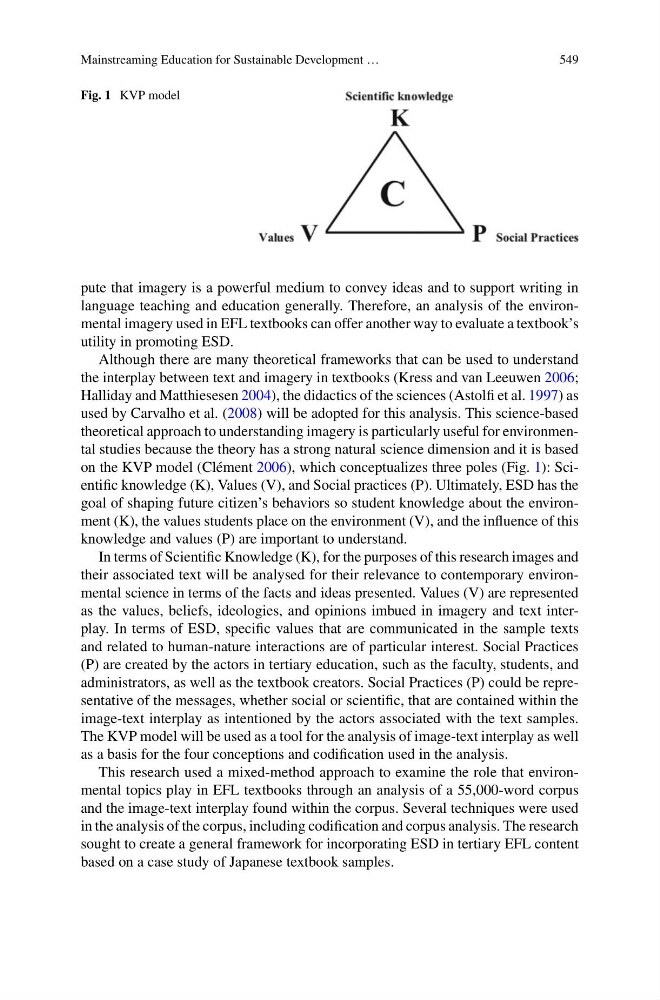
Fig. 1 KVP model
pute that imagery is a powerful medium to convey ideas and to support writing in
language teaching and education generally. Therefore, an analysis of the environmental imagery used in EFL textbooks can offer another way to evaluate a textbook’s
utility in promoting ESD.
Although there are many theoretical frameworks that can be used to understand
the interplay between text and imagery in textbooks (Kress and van Leeuwen 2006;
Halliday and Matthiesesen 2004), the didactics of the sciences (Astolfi et al. 1997) as
used by Carvalho et al. (2008) will be adopted for this analysis. This science-based
theoretical approach to understanding imagery is particularly useful for environmental studies because the theory has a strong natural science dimension and it is based
on the KVP model (Clément 2006), which conceptualizes three poles (Fig. 1): Scientific knowledge (K), Values (V), and Social practices (P). Ultimately, ESD has the
goal of shaping future citizen’s behaviors so student knowledge about the environment (K), the values students place on the environment (V), and the influence of this
knowledge and values (P) are important to understand.
In terms of Scientific Knowledge (K), for the purposes of this research images and
their associated text will be analysed for their relevance to contemporary environmental science in terms of the facts and ideas presented. Values (V) are represented
as the values, beliefs, ideologies, and opinions imbued in imagery and text interplay. In terms of ESD, specific values that are communicated in the sample texts
and related to human-nature interactions are of particular interest. Social Practices
(P) are created by the actors in tertiary education, such as the faculty, students, and
administrators, as well as the textbook creators. Social Practices (P) could be representative of the messages, whether social or scientific, that are contained within the
image-text interplay as intentioned by the actors associated with the text samples.
The KVP model will be used as a tool for the analysis of image-text interplay as well
as a basis for the four conceptions and codification used in the analysis.
This research used a mixed-method approach to examine the role that environmental topics play in EFL textbooks through an analysis of a 55,000-word corpus
and the image-text interplay found within the corpus. Several techniques were used
in the analysis of the corpus, including codification and corpus analysis. The research
sought to create a general framework for incorporating ESD in tertiary EFL content
based on a case study of Japanese textbook samples.
549
Fig. 1 KVP model
pute that imagery is a powerful medium to convey ideas and to support writing in
language teaching and education generally. Therefore, an analysis of the environmental imagery used in EFL textbooks can offer another way to evaluate a textbook’s
utility in promoting ESD.
Although there are many theoretical frameworks that can be used to understand
the interplay between text and imagery in textbooks (Kress and van Leeuwen 2006;
Halliday and Matthiesesen 2004), the didactics of the sciences (Astolfi et al. 1997) as
used by Carvalho et al. (2008) will be adopted for this analysis. This science-based
theoretical approach to understanding imagery is particularly useful for environmental studies because the theory has a strong natural science dimension and it is based
on the KVP model (Clément 2006), which conceptualizes three poles (Fig. 1): Scientific knowledge (K), Values (V), and Social practices (P). Ultimately, ESD has the
goal of shaping future citizen’s behaviors so student knowledge about the environment (K), the values students place on the environment (V), and the influence of this
knowledge and values (P) are important to understand.
In terms of Scientific Knowledge (K), for the purposes of this research images and
their associated text will be analysed for their relevance to contemporary environmental science in terms of the facts and ideas presented. Values (V) are represented
as the values, beliefs, ideologies, and opinions imbued in imagery and text interplay. In terms of ESD, specific values that are communicated in the sample texts
and related to human-nature interactions are of particular interest. Social Practices
(P) are created by the actors in tertiary education, such as the faculty, students, and
administrators, as well as the textbook creators. Social Practices (P) could be representative of the messages, whether social or scientific, that are contained within the
image-text interplay as intentioned by the actors associated with the text samples.
The KVP model will be used as a tool for the analysis of image-text interplay as well
as a basis for the four conceptions and codification used in the analysis.
This research used a mixed-method approach to examine the role that environmental topics play in EFL textbooks through an analysis of a 55,000-word corpus
and the image-text interplay found within the corpus. Several techniques were used
in the analysis of the corpus, including codification and corpus analysis. The research
sought to create a general framework for incorporating ESD in tertiary EFL content
based on a case study of Japanese textbook samples.