

Energy Sustainability at Universities and Its Contribution …
33
Table 3 Search strings used for the systematic review
Search string 1
“energy sustainability” (topic, abstract, title/abstract/keywords) AND
“universit*” (topic, abstract, title/abstract/keywords)
Search string 2
“energy efficiency” (topic, abstract, title/abstract/keywords) AND
“universit*” (topic, abstract, title/abstract/keywords)
Table 4 Selection criteria for the systematic review
Criterion
Inclusion
Exclusion
Time frame
2007–2017
Any study published before 2007
and after 2017
Language
English, Spanish or Portuguese
Any other language
Publication type
Peer-reviewed academic journal
(Articles)
Any other publication type (e.g.
books, contributions to edited
volumes, conference papers)
Research area
Energy, Engineering, environmental
science, social sciences
Any other research area
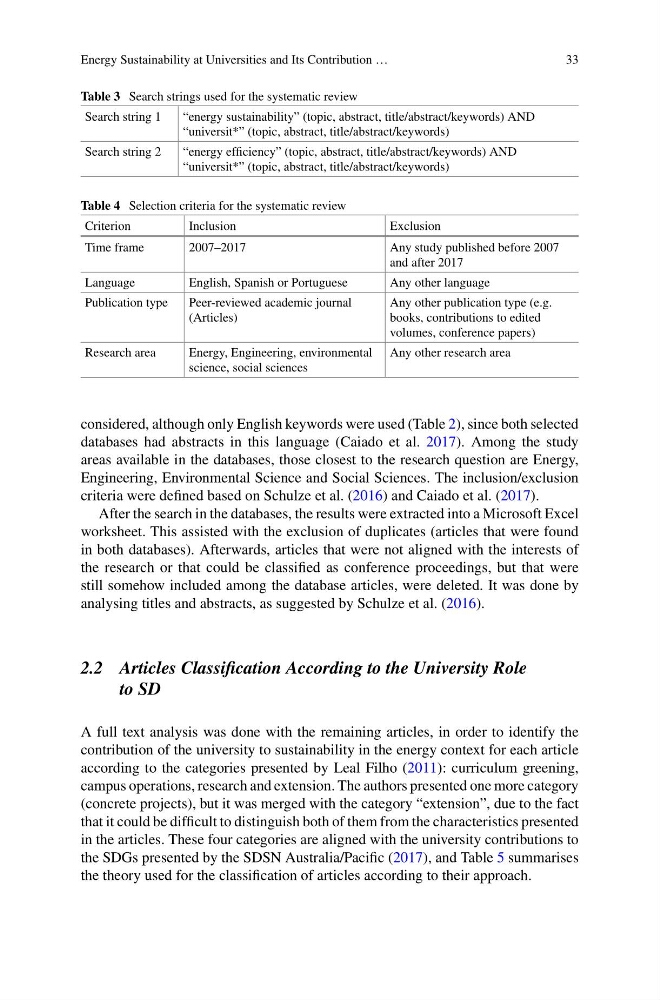
considered, although only English keywords were used (Table 2), since both selected
databases had abstracts in this language (Caiado et al. 2017). Among the study
areas available in the databases, those closest to the research question are Energy,
Engineering, Environmental Science and Social Sciences. The inclusion/exclusion
criteria were defined based on Schulze et al. (2016) and Caiado et al. (2017).
After the search in the databases, the results were extracted into a Microsoft Excel
worksheet. This assisted with the exclusion of duplicates (articles that were found
in both databases). Afterwards, articles that were not aligned with the interests of
the research or that could be classified as conference proceedings, but that were
still somehow included among the database articles, were deleted. It was done by
analysing titles and abstracts, as suggested by Schulze et al. (2016).
2.2 Articles Classification According to the University Role
to SD
A full text analysis was done with the remaining articles, in order to identify the
contribution of the university to sustainability in the energy context for each article
according to the categories presented by Leal Filho (2011): curriculum greening,
campus operations, research and extension. The authors presented one more category
(concrete projects), but it was merged with the category “extension”, due to the fact
that it could be difficult to distinguish both of them from the characteristics presented
in the articles. These four categories are aligned with the university contributions to
the SDGs presented by the SDSN Australia/Pacific (2017), and Table 5 summarises
the theory used for the classification of articles according to their approach.
33
Table 3 Search strings used for the systematic review
Search string 1
“energy sustainability” (topic, abstract, title/abstract/keywords) AND
“universit*” (topic, abstract, title/abstract/keywords)
Search string 2
“energy efficiency” (topic, abstract, title/abstract/keywords) AND
“universit*” (topic, abstract, title/abstract/keywords)
Table 4 Selection criteria for the systematic review
Criterion
Inclusion
Exclusion
Time frame
2007–2017
Any study published before 2007
and after 2017
Language
English, Spanish or Portuguese
Any other language
Publication type
Peer-reviewed academic journal
(Articles)
Any other publication type (e.g.
books, contributions to edited
volumes, conference papers)
Research area
Energy, Engineering, environmental
science, social sciences
Any other research area
considered, although only English keywords were used (Table 2), since both selected
databases had abstracts in this language (Caiado et al. 2017). Among the study
areas available in the databases, those closest to the research question are Energy,
Engineering, Environmental Science and Social Sciences. The inclusion/exclusion
criteria were defined based on Schulze et al. (2016) and Caiado et al. (2017).
After the search in the databases, the results were extracted into a Microsoft Excel
worksheet. This assisted with the exclusion of duplicates (articles that were found
in both databases). Afterwards, articles that were not aligned with the interests of
the research or that could be classified as conference proceedings, but that were
still somehow included among the database articles, were deleted. It was done by
analysing titles and abstracts, as suggested by Schulze et al. (2016).
2.2 Articles Classification According to the University Role
to SD
A full text analysis was done with the remaining articles, in order to identify the
contribution of the university to sustainability in the energy context for each article
according to the categories presented by Leal Filho (2011): curriculum greening,
campus operations, research and extension. The authors presented one more category
(concrete projects), but it was merged with the category “extension”, due to the fact
that it could be difficult to distinguish both of them from the characteristics presented
in the articles. These four categories are aligned with the university contributions to
the SDGs presented by the SDSN Australia/Pacific (2017), and Table 5 summarises
the theory used for the classification of articles according to their approach.