

30
A. L. Salvia and L. L. Brandli
human needs and promote economic growth (Holdren 2007). The investment in
research related to energy sustainability and efficiency is essential due to the current
reality of increased energy demand.
An important approach to energy is embedded in the Sustainable Development
Goals (SDGs). These goals are an integral part of Agenda 2030, which is a declaration
adopted by 193 member states of the United Nations and represents a global plan of
action to pursue sustainability in many areas, such as poverty, education, health and
climate change, amongst others. Goal 7 (SDG 7) addresses “Clean and Affordable
Energy” to ensure reliable, sustainable, modern and affordable access to energy for
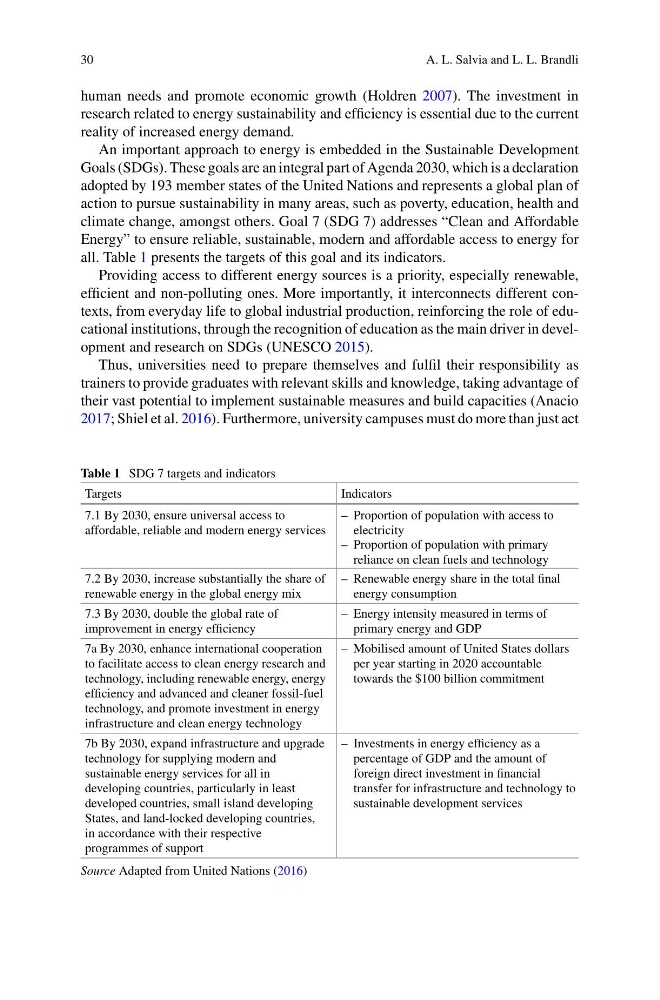
all. Table 1 presents the targets of this goal and its indicators.
Providing access to different energy sources is a priority, especially renewable,
efficient and non-polluting ones. More importantly, it interconnects different contexts, from everyday life to global industrial production, reinforcing the role of educational institutions, through the recognition of education as the main driver in development and research on SDGs (UNESCO 2015).
Thus, universities need to prepare themselves and fulfil their responsibility as
trainers to provide graduates with relevant skills and knowledge, taking advantage of
their vast potential to implement sustainable measures and build capacities (Anacio
2017; Shiel et al. 2016). Furthermore, university campuses must do more than just act
Table 1 SDG 7 targets and indicators
Targets
Indicators
7.1 By 2030, ensure universal access to
affordable, reliable and modern energy services
– Proportion of population with access to
electricity
– Proportion of population with primary
reliance on clean fuels and technology
7.2 By 2030, increase substantially the share of
renewable energy in the global energy mix
– Renewable energy share in the total final
energy consumption
7.3 By 2030, double the global rate of
improvement in energy efficiency
– Energy intensity measured in terms of
primary energy and GDP
7a By 2030, enhance international cooperation
to facilitate access to clean energy research and
technology, including renewable energy, energy
efficiency and advanced and cleaner fossil-fuel
technology, and promote investment in energy
infrastructure and clean energy technology
– Mobilised amount of United States dollars
per year starting in 2020 accountable
towards the $100 billion commitment
7b By 2030, expand infrastructure and upgrade
technology for supplying modern and
sustainable energy services for all in
developing countries, particularly in least
developed countries, small island developing
States, and land-locked developing countries,
in accordance with their respective
programmes of support
– Investments in energy efficiency as a
percentage of GDP and the amount of
foreign direct investment in financial
transfer for infrastructure and technology to
sustainable development services
Source Adapted from United Nations (2016)
A. L. Salvia and L. L. Brandli
human needs and promote economic growth (Holdren 2007). The investment in
research related to energy sustainability and efficiency is essential due to the current
reality of increased energy demand.
An important approach to energy is embedded in the Sustainable Development
Goals (SDGs). These goals are an integral part of Agenda 2030, which is a declaration
adopted by 193 member states of the United Nations and represents a global plan of
action to pursue sustainability in many areas, such as poverty, education, health and
climate change, amongst others. Goal 7 (SDG 7) addresses “Clean and Affordable
Energy” to ensure reliable, sustainable, modern and affordable access to energy for
all. Table 1 presents the targets of this goal and its indicators.
Providing access to different energy sources is a priority, especially renewable,
efficient and non-polluting ones. More importantly, it interconnects different contexts, from everyday life to global industrial production, reinforcing the role of educational institutions, through the recognition of education as the main driver in development and research on SDGs (UNESCO 2015).
Thus, universities need to prepare themselves and fulfil their responsibility as
trainers to provide graduates with relevant skills and knowledge, taking advantage of
their vast potential to implement sustainable measures and build capacities (Anacio
2017; Shiel et al. 2016). Furthermore, university campuses must do more than just act
Table 1 SDG 7 targets and indicators
Targets
Indicators
7.1 By 2030, ensure universal access to
affordable, reliable and modern energy services
– Proportion of population with access to
electricity
– Proportion of population with primary
reliance on clean fuels and technology
7.2 By 2030, increase substantially the share of
renewable energy in the global energy mix
– Renewable energy share in the total final
energy consumption
7.3 By 2030, double the global rate of
improvement in energy efficiency
– Energy intensity measured in terms of
primary energy and GDP
7a By 2030, enhance international cooperation
to facilitate access to clean energy research and
technology, including renewable energy, energy
efficiency and advanced and cleaner fossil-fuel
technology, and promote investment in energy
infrastructure and clean energy technology
– Mobilised amount of United States dollars
per year starting in 2020 accountable
towards the $100 billion commitment
7b By 2030, expand infrastructure and upgrade
technology for supplying modern and
sustainable energy services for all in
developing countries, particularly in least
developed countries, small island developing
States, and land-locked developing countries,
in accordance with their respective
programmes of support
– Investments in energy efficiency as a
percentage of GDP and the amount of
foreign direct investment in financial
transfer for infrastructure and technology to
sustainable development services
Source Adapted from United Nations (2016)