

390
A. P. Pessotto et al.
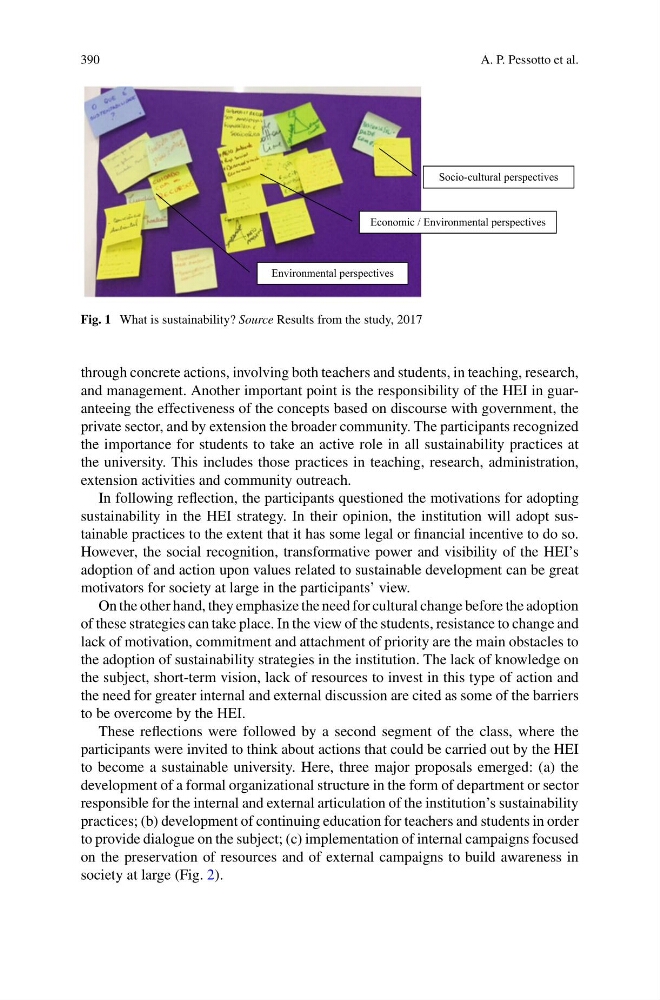
Environmental perspectives
Economic / Environmental perspectives
Socio-cultural perspectives
Fig. 1 What is sustainability? Source Results from the study, 2017
through concrete actions, involving both teachers and students, in teaching, research,
and management. Another important point is the responsibility of the HEI in guaranteeing the effectiveness of the concepts based on discourse with government, the
private sector, and by extension the broader community. The participants recognized
the importance for students to take an active role in all sustainability practices at
the university. This includes those practices in teaching, research, administration,
extension activities and community outreach.
In following reflection, the participants questioned the motivations for adopting
sustainability in the HEI strategy. In their opinion, the institution will adopt sustainable practices to the extent that it has some legal or financial incentive to do so.
However, the social recognition, transformative power and visibility of the HEI’s
adoption of and action upon values related to sustainable development can be great
motivators for society at large in the participants’ view.
On the other hand, they emphasize the need for cultural change before the adoption
of these strategies can take place. In the view of the students, resistance to change and
lack of motivation, commitment and attachment of priority are the main obstacles to
the adoption of sustainability strategies in the institution. The lack of knowledge on
the subject, short-term vision, lack of resources to invest in this type of action and
the need for greater internal and external discussion are cited as some of the barriers
to be overcome by the HEI.
These reflections were followed by a second segment of the class, where the
participants were invited to think about actions that could be carried out by the HEI
to become a sustainable university. Here, three major proposals emerged: (a) the
development of a formal organizational structure in the form of department or sector
responsible for the internal and external articulation of the institution’s sustainability
practices; (b) development of continuing education for teachers and students in order
to provide dialogue on the subject; (c) implementation of internal campaigns focused
on the preservation of resources and of external campaigns to build awareness in
society at large (Fig. 2).
A. P. Pessotto et al.
Environmental perspectives
Economic / Environmental perspectives
Socio-cultural perspectives
Fig. 1 What is sustainability? Source Results from the study, 2017
through concrete actions, involving both teachers and students, in teaching, research,
and management. Another important point is the responsibility of the HEI in guaranteeing the effectiveness of the concepts based on discourse with government, the
private sector, and by extension the broader community. The participants recognized
the importance for students to take an active role in all sustainability practices at
the university. This includes those practices in teaching, research, administration,
extension activities and community outreach.
In following reflection, the participants questioned the motivations for adopting
sustainability in the HEI strategy. In their opinion, the institution will adopt sustainable practices to the extent that it has some legal or financial incentive to do so.
However, the social recognition, transformative power and visibility of the HEI’s
adoption of and action upon values related to sustainable development can be great
motivators for society at large in the participants’ view.
On the other hand, they emphasize the need for cultural change before the adoption
of these strategies can take place. In the view of the students, resistance to change and
lack of motivation, commitment and attachment of priority are the main obstacles to
the adoption of sustainability strategies in the institution. The lack of knowledge on
the subject, short-term vision, lack of resources to invest in this type of action and
the need for greater internal and external discussion are cited as some of the barriers
to be overcome by the HEI.
These reflections were followed by a second segment of the class, where the
participants were invited to think about actions that could be carried out by the HEI
to become a sustainable university. Here, three major proposals emerged: (a) the
development of a formal organizational structure in the form of department or sector
responsible for the internal and external articulation of the institution’s sustainability
practices; (b) development of continuing education for teachers and students in order
to provide dialogue on the subject; (c) implementation of internal campaigns focused
on the preservation of resources and of external campaigns to build awareness in
society at large (Fig. 2).