

388
A. P. Pessotto et al.
Table 2 Some factors that influence attitudes toward sustainability
Knowledge
Information on the meaning of sustainability and its implications
Background
The nature of their training generally influences an individual’s degree of
receptivity to sustainability
Experience
Previous experience with environmental and social issues facilitates
understanding of the role of sustainability
Perception
The integrated view of environmental, political and economic elements allows
for a broader perception of sustainability
Values
Unlike previous factors because of their high degree of complexity, an
individual’s values usually determine whether his or her attitudes are favorable
or not
Context
Sustainability is not only related to ecological factors per se, but also involves
consideration of economic, political and social issues. However, links with the
latter are often ignored by schools and universities
Source Adapted from Leal Filho (2000)
verance and dedication while maintaining a long-term perspective (Lozano et al.
2013a).
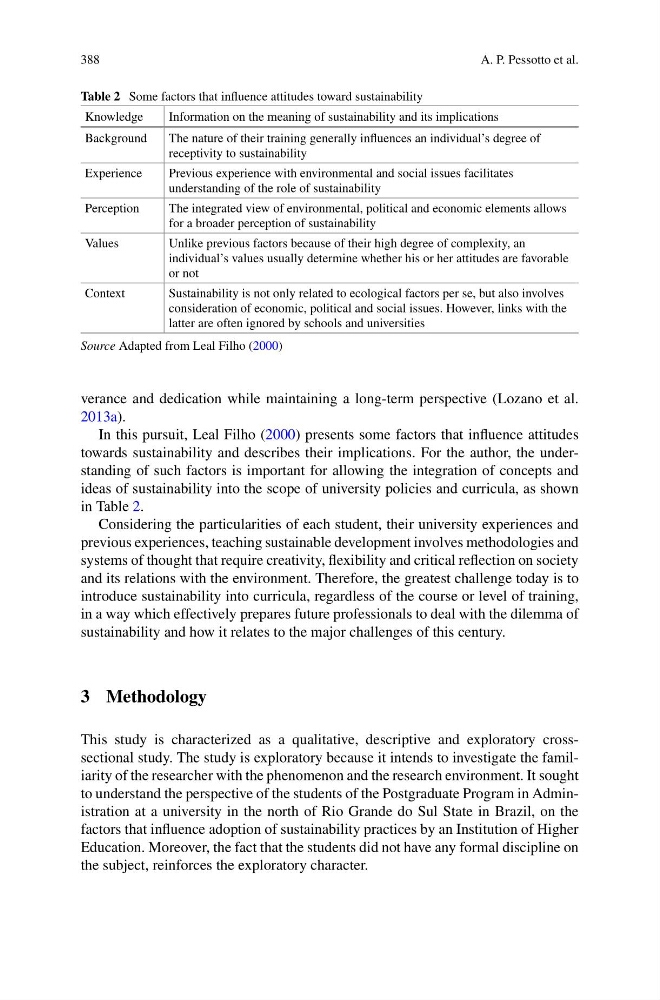
In this pursuit, Leal Filho (2000) presents some factors that influence attitudes
towards sustainability and describes their implications. For the author, the understanding of such factors is important for allowing the integration of concepts and
ideas of sustainability into the scope of university policies and curricula, as shown
in Table 2.
Considering the particularities of each student, their university experiences and
previous experiences, teaching sustainable development involves methodologies and
systems of thought that require creativity, flexibility and critical reflection on society
and its relations with the environment. Therefore, the greatest challenge today is to
introduce sustainability into curricula, regardless of the course or level of training,
in a way which effectively prepares future professionals to deal with the dilemma of
sustainability and how it relates to the major challenges of this century.
3 Methodology
This study is characterized as a qualitative, descriptive and exploratory crosssectional study. The study is exploratory because it intends to investigate the familiarity of the researcher with the phenomenon and the research environment. It sought
to understand the perspective of the students of the Postgraduate Program in Administration at a university in the north of Rio Grande do Sul State in Brazil, on the
factors that influence adoption of sustainability practices by an Institution of Higher
Education. Moreover, the fact that the students did not have any formal discipline on
the subject, reinforces the exploratory character.
A. P. Pessotto et al.
Table 2 Some factors that influence attitudes toward sustainability
Knowledge
Information on the meaning of sustainability and its implications
Background
The nature of their training generally influences an individual’s degree of
receptivity to sustainability
Experience
Previous experience with environmental and social issues facilitates
understanding of the role of sustainability
Perception
The integrated view of environmental, political and economic elements allows
for a broader perception of sustainability
Values
Unlike previous factors because of their high degree of complexity, an
individual’s values usually determine whether his or her attitudes are favorable
or not
Context
Sustainability is not only related to ecological factors per se, but also involves
consideration of economic, political and social issues. However, links with the
latter are often ignored by schools and universities
Source Adapted from Leal Filho (2000)
verance and dedication while maintaining a long-term perspective (Lozano et al.
2013a).
In this pursuit, Leal Filho (2000) presents some factors that influence attitudes
towards sustainability and describes their implications. For the author, the understanding of such factors is important for allowing the integration of concepts and
ideas of sustainability into the scope of university policies and curricula, as shown
in Table 2.
Considering the particularities of each student, their university experiences and
previous experiences, teaching sustainable development involves methodologies and
systems of thought that require creativity, flexibility and critical reflection on society
and its relations with the environment. Therefore, the greatest challenge today is to
introduce sustainability into curricula, regardless of the course or level of training,
in a way which effectively prepares future professionals to deal with the dilemma of
sustainability and how it relates to the major challenges of this century.
3 Methodology
This study is characterized as a qualitative, descriptive and exploratory crosssectional study. The study is exploratory because it intends to investigate the familiarity of the researcher with the phenomenon and the research environment. It sought
to understand the perspective of the students of the Postgraduate Program in Administration at a university in the north of Rio Grande do Sul State in Brazil, on the
factors that influence adoption of sustainability practices by an Institution of Higher
Education. Moreover, the fact that the students did not have any formal discipline on
the subject, reinforces the exploratory character.