

348
O. Ahel and K. Lingenau
with the Virtual Academy of Sustainability at the University of Bremen (hereafter
referred to as the Virtual Academy), and shows how digital learning and teaching can
be structured to contribute to ESD in higher education. In addition to presenting the
core mechanisms that drive this project, the information presented in the following
paragraphs are based on the observations by the five scientific associates involved
in the project, as well as on the results of interviews and questionnaire surveys with
participants in the learning environment facilitated by the Virtual Academy.
3.1 History, Strategy and Goals
The Virtual Academy is a third-party-funded project, supported by the German Federal Ministry of Education and Research. The mission of the Virtual Academy is to
combine the opportunities offered by digital transformation with the socio-political
imperative of providing ESD. Since its founding in 2011, the Virtual Academy is
producing and offering online courses about a variety of sustainability topics for
the broad European higher education community. Through these online courses, the
Virtual Academy is supporting other universities to satisfy the need to provide ESD
and therefore to work towards achievement of the goals of the DESD and the GAP
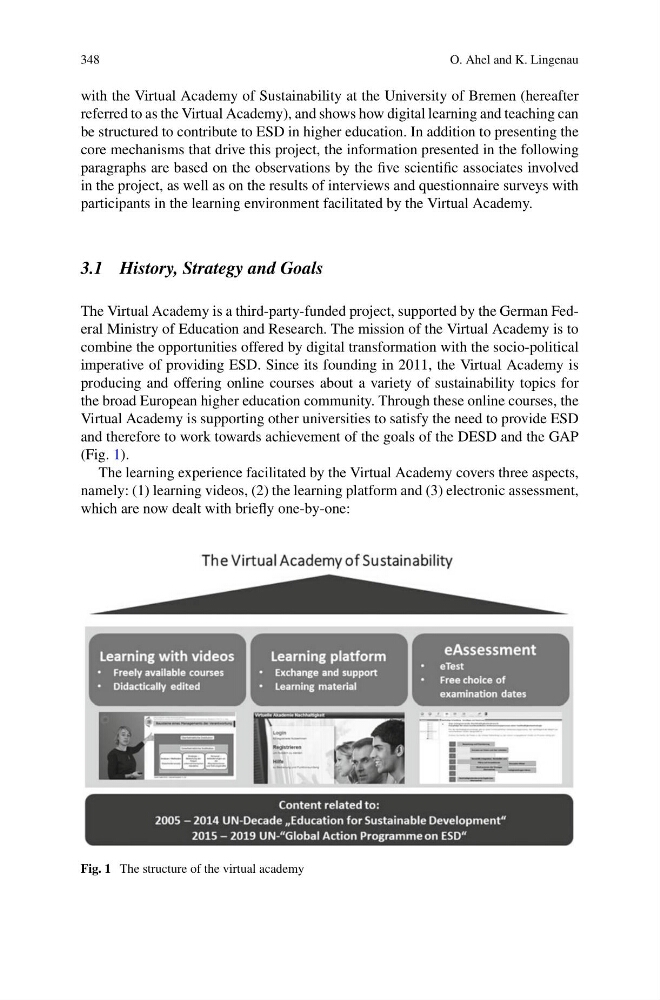
(Fig. 1).
The learning experience facilitated by the Virtual Academy covers three aspects,
namely: (1) learning videos, (2) the learning platform and (3) electronic assessment,
which are now dealt with briefly one-by-one:
Fig. 1 The structure of the virtual academy
O. Ahel and K. Lingenau
with the Virtual Academy of Sustainability at the University of Bremen (hereafter
referred to as the Virtual Academy), and shows how digital learning and teaching can
be structured to contribute to ESD in higher education. In addition to presenting the
core mechanisms that drive this project, the information presented in the following
paragraphs are based on the observations by the five scientific associates involved
in the project, as well as on the results of interviews and questionnaire surveys with
participants in the learning environment facilitated by the Virtual Academy.
3.1 History, Strategy and Goals
The Virtual Academy is a third-party-funded project, supported by the German Federal Ministry of Education and Research. The mission of the Virtual Academy is to
combine the opportunities offered by digital transformation with the socio-political
imperative of providing ESD. Since its founding in 2011, the Virtual Academy is
producing and offering online courses about a variety of sustainability topics for
the broad European higher education community. Through these online courses, the
Virtual Academy is supporting other universities to satisfy the need to provide ESD
and therefore to work towards achievement of the goals of the DESD and the GAP
(Fig. 1).
The learning experience facilitated by the Virtual Academy covers three aspects,
namely: (1) learning videos, (2) the learning platform and (3) electronic assessment,
which are now dealt with briefly one-by-one:
Fig. 1 The structure of the virtual academy