

326
L. Liu and L. Gao
2.2 Engagement in Sustainability Education at Universities
There has been a growing recognition of ESD as “an integral element of quality
education and a key enabler towards sustainable development” (UNESCO 2014, p. 9).
The GAP therefore sets goals for generation and upscaling of ESD actions. Robertson
(2014, p. 302) identifies three conceptual pillars of ESD: biophilia, bioregionalism
and experiential learning. She argues that since all human beings undergo certain
stages of cognitive development, these three pillars form elements of ESD that apply
at every stage of life, including higher education, where there is a need for critical
thinking and interdisciplinary vision to cope with the challenges posed by a complex
and interconnected world.
Universities play critical roles in driving global, national, and local knowledge
dissemination and innovation in the achievement of the SDGs. Meanwhile, engaging with the SDGs also benefits universities by demonstrating university impact,
reorienting SDG-related education and building civic and community partnerships
(SDSN 2016). To succeed in this, universities need to design curricula to integrate
sustainability into research and teaching. Three layers of student engagement can
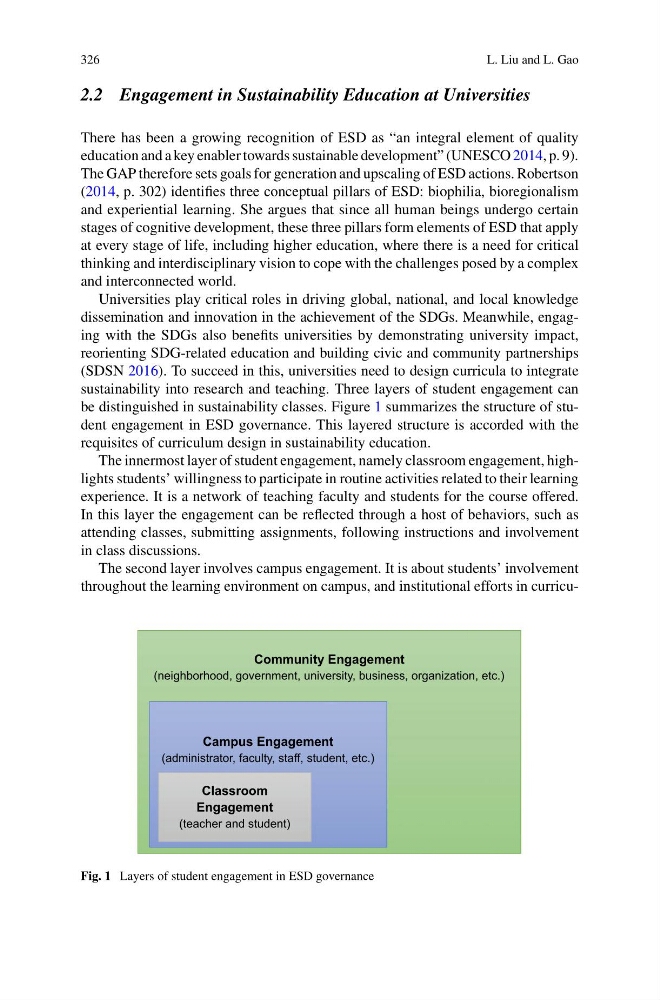
be distinguished in sustainability classes. Figure 1 summarizes the structure of student engagement in ESD governance. This layered structure is accorded with the
requisites of curriculum design in sustainability education.
The innermost layer of student engagement, namely classroom engagement, highlights students’ willingness to participate in routine activities related to their learning
experience. It is a network of teaching faculty and students for the course offered.
In this layer the engagement can be reflected through a host of behaviors, such as
attending classes, submitting assignments, following instructions and involvement
in class discussions.
The second layer involves campus engagement. It is about students’ involvement
throughout the learning environment on campus, and institutional efforts in curricuCommunity Engagement
(neighborhood, government, university, business, organization, etc.)
Campus Engagement
(administrator, faculty, staff, student, etc.)
Classroom
Engagement
(teacher and student)
Fig. 1 Layers of student engagement in ESD governance
L. Liu and L. Gao
2.2 Engagement in Sustainability Education at Universities
There has been a growing recognition of ESD as “an integral element of quality
education and a key enabler towards sustainable development” (UNESCO 2014, p. 9).
The GAP therefore sets goals for generation and upscaling of ESD actions. Robertson
(2014, p. 302) identifies three conceptual pillars of ESD: biophilia, bioregionalism
and experiential learning. She argues that since all human beings undergo certain
stages of cognitive development, these three pillars form elements of ESD that apply
at every stage of life, including higher education, where there is a need for critical
thinking and interdisciplinary vision to cope with the challenges posed by a complex
and interconnected world.
Universities play critical roles in driving global, national, and local knowledge
dissemination and innovation in the achievement of the SDGs. Meanwhile, engaging with the SDGs also benefits universities by demonstrating university impact,
reorienting SDG-related education and building civic and community partnerships
(SDSN 2016). To succeed in this, universities need to design curricula to integrate
sustainability into research and teaching. Three layers of student engagement can
be distinguished in sustainability classes. Figure 1 summarizes the structure of student engagement in ESD governance. This layered structure is accorded with the
requisites of curriculum design in sustainability education.
The innermost layer of student engagement, namely classroom engagement, highlights students’ willingness to participate in routine activities related to their learning
experience. It is a network of teaching faculty and students for the course offered.
In this layer the engagement can be reflected through a host of behaviors, such as
attending classes, submitting assignments, following instructions and involvement
in class discussions.
The second layer involves campus engagement. It is about students’ involvement
throughout the learning environment on campus, and institutional efforts in curricuCommunity Engagement
(neighborhood, government, university, business, organization, etc.)
Campus Engagement
(administrator, faculty, staff, student, etc.)
Classroom
Engagement
(teacher and student)
Fig. 1 Layers of student engagement in ESD governance