

EDS Integrated Approach for Sustainability (EDS-IA) …
285
2 EDS-IA Conceptual Framework: From a Linear
to a Cyclical and Multilevel Model
Traditional development models have mainly been linear and open, responding only
to short-term human needs and leading to a culture that degrades the environment. To
express a vision of society that breaks with this model, we propose a representation
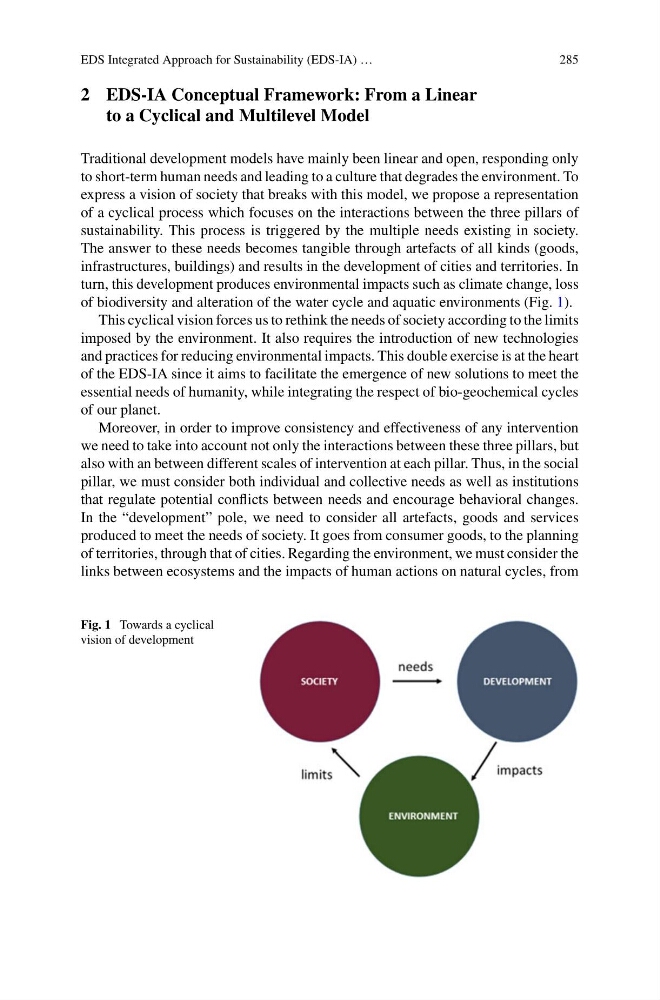
of a cyclical process which focuses on the interactions between the three pillars of
sustainability. This process is triggered by the multiple needs existing in society.
The answer to these needs becomes tangible through artefacts of all kinds (goods,
infrastructures, buildings) and results in the development of cities and territories. In
turn, this development produces environmental impacts such as climate change, loss
of biodiversity and alteration of the water cycle and aquatic environments (Fig. 1).
This cyclical vision forces us to rethink the needs of society according to the limits
imposed by the environment. It also requires the introduction of new technologies
and practices for reducing environmental impacts. This double exercise is at the heart
of the EDS-IA since it aims to facilitate the emergence of new solutions to meet the
essential needs of humanity, while integrating the respect of bio-geochemical cycles
of our planet.
Moreover, in order to improve consistency and effectiveness of any intervention
we need to take into account not only the interactions between these three pillars, but
also with an between different scales of intervention at each pillar. Thus, in the social
pillar, we must consider both individual and collective needs as well as institutions
that regulate potential conflicts between needs and encourage behavioral changes.
In the “development” pole, we need to consider all artefacts, goods and services
produced to meet the needs of society. It goes from consumer goods, to the planning
of territories, through that of cities. Regarding the environment, we must consider the
links between ecosystems and the impacts of human actions on natural cycles, from
Fig. 1 Towards a cyclical
vision of development
285
2 EDS-IA Conceptual Framework: From a Linear
to a Cyclical and Multilevel Model
Traditional development models have mainly been linear and open, responding only
to short-term human needs and leading to a culture that degrades the environment. To
express a vision of society that breaks with this model, we propose a representation
of a cyclical process which focuses on the interactions between the three pillars of
sustainability. This process is triggered by the multiple needs existing in society.
The answer to these needs becomes tangible through artefacts of all kinds (goods,
infrastructures, buildings) and results in the development of cities and territories. In
turn, this development produces environmental impacts such as climate change, loss
of biodiversity and alteration of the water cycle and aquatic environments (Fig. 1).
This cyclical vision forces us to rethink the needs of society according to the limits
imposed by the environment. It also requires the introduction of new technologies
and practices for reducing environmental impacts. This double exercise is at the heart
of the EDS-IA since it aims to facilitate the emergence of new solutions to meet the
essential needs of humanity, while integrating the respect of bio-geochemical cycles
of our planet.
Moreover, in order to improve consistency and effectiveness of any intervention
we need to take into account not only the interactions between these three pillars, but
also with an between different scales of intervention at each pillar. Thus, in the social
pillar, we must consider both individual and collective needs as well as institutions
that regulate potential conflicts between needs and encourage behavioral changes.
In the “development” pole, we need to consider all artefacts, goods and services
produced to meet the needs of society. It goes from consumer goods, to the planning
of territories, through that of cities. Regarding the environment, we must consider the
links between ecosystems and the impacts of human actions on natural cycles, from
Fig. 1 Towards a cyclical
vision of development