

Nurturing the Seeds of Sustainability Governance …
153
Table 1 Sustainable development goals
Goal 1. End poverty in all its forms everywhere
Goal 2. End hunger, achieve food security and
improved nutrition and promote sustainable
agriculture
Goal 3. Ensure healthy lives and promote
well-being for all at all ages
Goal 4. Ensure inclusive and equitable quality
education and promote lifelong learning
opportunities for all
Goal 5. Achieve gender equality and empower
all women and girls
Goal 6. Ensure availability and sustainable
management of water and sanitation for all
Goal 7. Ensure access to affordable, reliable,
sustainable and modern energy for all
Goal 8. Promote sustained, inclusive and
sustainable economic growth, full and
productive employment and decent work for all
Goal 9. Build resilient infrastructure, promote
inclusive and sustainable industrialization and
foster innovation
Goal 10. Reduce inequality within and among
countries
Goal 11. Make cities and human settlements
inclusive, safe, resilient and sustainable
Goal 12. Ensure sustainable consumption and
production patterns
Goal 13. Take urgent action to combat
climate change and its impacts
Goal 14. Conserve and sustainably use the
oceans, seas and marine resources for
sustainable development
Goal 15. Protect, restore and promote
sustainable use of terrestrial ecosystems,
sustainably manage forests, combat
desertification, and halt and reverse land
degradation and halt biodiversity loss
Goal 16. Promote peaceful and inclusive
societies for sustainable development, provide
access to justice for all and build effective,
accountable and inclusive institutions at all
levels
Goal 17. Strengthen the means of
implementation and revitalize the global
partnership for sustainable development
Source United Nations (2015)
sectors of the society and providing a suitable environment for development amidst
this troubled scenario.
During the time between Eco 92 and Rio+20, at least a positive change has
emerged with the raise in the awareness and practice of sustainability by companies: large international conventions, protocols and agreements were held. In 2000,
the UN launched a set of targets for government action to address inequality, poverty
and endemics. The Millennium Development Goals (MDGs) were supposed to be
met by 2015. By this time, during the Sustainable Development Summit, the UN
recognized there was a need to broaden the scope of the objectives, incorporating
a more holistic view about developmental problems. The Sustainable Development
Goals (SDGs) were developed, then, including new areas such as climate change,
economic inequality, innovation, sustainable consumption, peace and justice, among
other priorities, and proposed in an agenda established by 193 UN Member States
Agenda (United Nations 2015).
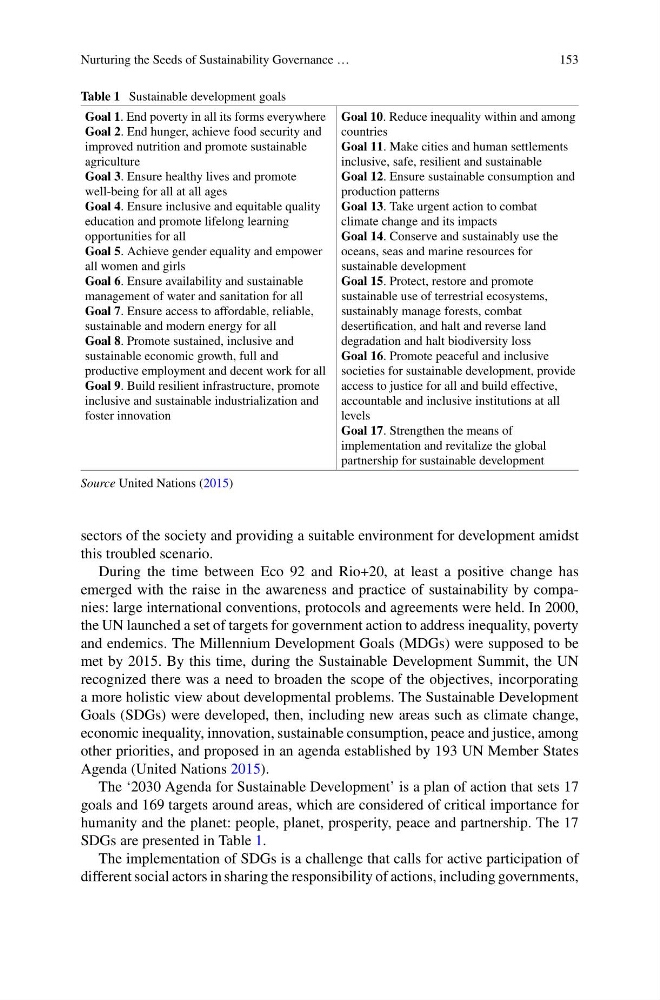
The ‘2030 Agenda for Sustainable Development’ is a plan of action that sets 17
goals and 169 targets around areas, which are considered of critical importance for
humanity and the planet: people, planet, prosperity, peace and partnership. The 17
SDGs are presented in Table 1.
The implementation of SDGs is a challenge that calls for active participation of
different social actors in sharing the responsibility of actions, including governments,
153
Table 1 Sustainable development goals
Goal 1. End poverty in all its forms everywhere
Goal 2. End hunger, achieve food security and
improved nutrition and promote sustainable
agriculture
Goal 3. Ensure healthy lives and promote
well-being for all at all ages
Goal 4. Ensure inclusive and equitable quality
education and promote lifelong learning
opportunities for all
Goal 5. Achieve gender equality and empower
all women and girls
Goal 6. Ensure availability and sustainable
management of water and sanitation for all
Goal 7. Ensure access to affordable, reliable,
sustainable and modern energy for all
Goal 8. Promote sustained, inclusive and
sustainable economic growth, full and
productive employment and decent work for all
Goal 9. Build resilient infrastructure, promote
inclusive and sustainable industrialization and
foster innovation
Goal 10. Reduce inequality within and among
countries
Goal 11. Make cities and human settlements
inclusive, safe, resilient and sustainable
Goal 12. Ensure sustainable consumption and
production patterns
Goal 13. Take urgent action to combat
climate change and its impacts
Goal 14. Conserve and sustainably use the
oceans, seas and marine resources for
sustainable development
Goal 15. Protect, restore and promote
sustainable use of terrestrial ecosystems,
sustainably manage forests, combat
desertification, and halt and reverse land
degradation and halt biodiversity loss
Goal 16. Promote peaceful and inclusive
societies for sustainable development, provide
access to justice for all and build effective,
accountable and inclusive institutions at all
levels
Goal 17. Strengthen the means of
implementation and revitalize the global
partnership for sustainable development
Source United Nations (2015)
sectors of the society and providing a suitable environment for development amidst
this troubled scenario.
During the time between Eco 92 and Rio+20, at least a positive change has
emerged with the raise in the awareness and practice of sustainability by companies: large international conventions, protocols and agreements were held. In 2000,
the UN launched a set of targets for government action to address inequality, poverty
and endemics. The Millennium Development Goals (MDGs) were supposed to be
met by 2015. By this time, during the Sustainable Development Summit, the UN
recognized there was a need to broaden the scope of the objectives, incorporating
a more holistic view about developmental problems. The Sustainable Development
Goals (SDGs) were developed, then, including new areas such as climate change,
economic inequality, innovation, sustainable consumption, peace and justice, among
other priorities, and proposed in an agenda established by 193 UN Member States
Agenda (United Nations 2015).
The ‘2030 Agenda for Sustainable Development’ is a plan of action that sets 17
goals and 169 targets around areas, which are considered of critical importance for
humanity and the planet: people, planet, prosperity, peace and partnership. The 17
SDGs are presented in Table 1.
The implementation of SDGs is a challenge that calls for active participation of
different social actors in sharing the responsibility of actions, including governments,