

Sustainable Campuses as Living Labs for Sustainable …
93
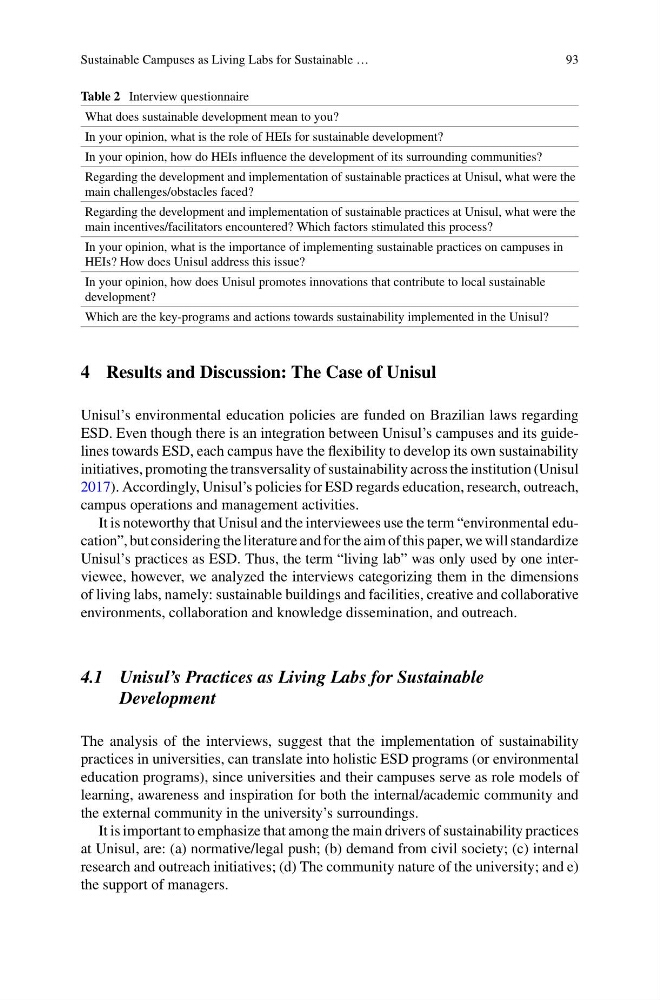
Table 2 Interview questionnaire
What does sustainable development mean to you?
In your opinion, what is the role of HEIs for sustainable development?
In your opinion, how do HEIs influence the development of its surrounding communities?
Regarding the development and implementation of sustainable practices at Unisul, what were the
main challenges/obstacles faced?
Regarding the development and implementation of sustainable practices at Unisul, what were the
main incentives/facilitators encountered? Which factors stimulated this process?
In your opinion, what is the importance of implementing sustainable practices on campuses in
HEIs? How does Unisul address this issue?
In your opinion, how does Unisul promotes innovations that contribute to local sustainable
development?
Which are the key-programs and actions towards sustainability implemented in the Unisul?
4 Results and Discussion: The Case of Unisul
Unisul’s environmental education policies are funded on Brazilian laws regarding
ESD. Even though there is an integration between Unisul’s campuses and its guidelines towards ESD, each campus have the flexibility to develop its own sustainability
initiatives, promoting the transversality of sustainability across the institution (Unisul
2017). Accordingly, Unisul’s policies for ESD regards education, research, outreach,
campus operations and management activities.
It is noteworthy that Unisul and the interviewees use the term “environmental education”, but considering the literature and for the aim of this paper, we will standardize
Unisul’s practices as ESD. Thus, the term “living lab” was only used by one interviewee, however, we analyzed the interviews categorizing them in the dimensions
of living labs, namely: sustainable buildings and facilities, creative and collaborative
environments, collaboration and knowledge dissemination, and outreach.
4.1 Unisul’s Practices as Living Labs for Sustainable
Development
The analysis of the interviews, suggest that the implementation of sustainability
practices in universities, can translate into holistic ESD programs (or environmental
education programs), since universities and their campuses serve as role models of
learning, awareness and inspiration for both the internal/academic community and
the external community in the university’s surroundings.
It is important to emphasize that among the main drivers of sustainability practices
at Unisul, are: (a) normative/legal push; (b) demand from civil society; (c) internal
research and outreach initiatives; (d) The community nature of the university; and e)
the support of managers.
93
Table 2 Interview questionnaire
What does sustainable development mean to you?
In your opinion, what is the role of HEIs for sustainable development?
In your opinion, how do HEIs influence the development of its surrounding communities?
Regarding the development and implementation of sustainable practices at Unisul, what were the
main challenges/obstacles faced?
Regarding the development and implementation of sustainable practices at Unisul, what were the
main incentives/facilitators encountered? Which factors stimulated this process?
In your opinion, what is the importance of implementing sustainable practices on campuses in
HEIs? How does Unisul address this issue?
In your opinion, how does Unisul promotes innovations that contribute to local sustainable
development?
Which are the key-programs and actions towards sustainability implemented in the Unisul?
4 Results and Discussion: The Case of Unisul
Unisul’s environmental education policies are funded on Brazilian laws regarding
ESD. Even though there is an integration between Unisul’s campuses and its guidelines towards ESD, each campus have the flexibility to develop its own sustainability
initiatives, promoting the transversality of sustainability across the institution (Unisul
2017). Accordingly, Unisul’s policies for ESD regards education, research, outreach,
campus operations and management activities.
It is noteworthy that Unisul and the interviewees use the term “environmental education”, but considering the literature and for the aim of this paper, we will standardize
Unisul’s practices as ESD. Thus, the term “living lab” was only used by one interviewee, however, we analyzed the interviews categorizing them in the dimensions
of living labs, namely: sustainable buildings and facilities, creative and collaborative
environments, collaboration and knowledge dissemination, and outreach.
4.1 Unisul’s Practices as Living Labs for Sustainable
Development
The analysis of the interviews, suggest that the implementation of sustainability
practices in universities, can translate into holistic ESD programs (or environmental
education programs), since universities and their campuses serve as role models of
learning, awareness and inspiration for both the internal/academic community and
the external community in the university’s surroundings.
It is important to emphasize that among the main drivers of sustainability practices
at Unisul, are: (a) normative/legal push; (b) demand from civil society; (c) internal
research and outreach initiatives; (d) The community nature of the university; and e)
the support of managers.