

70
R. M. Desu et al.
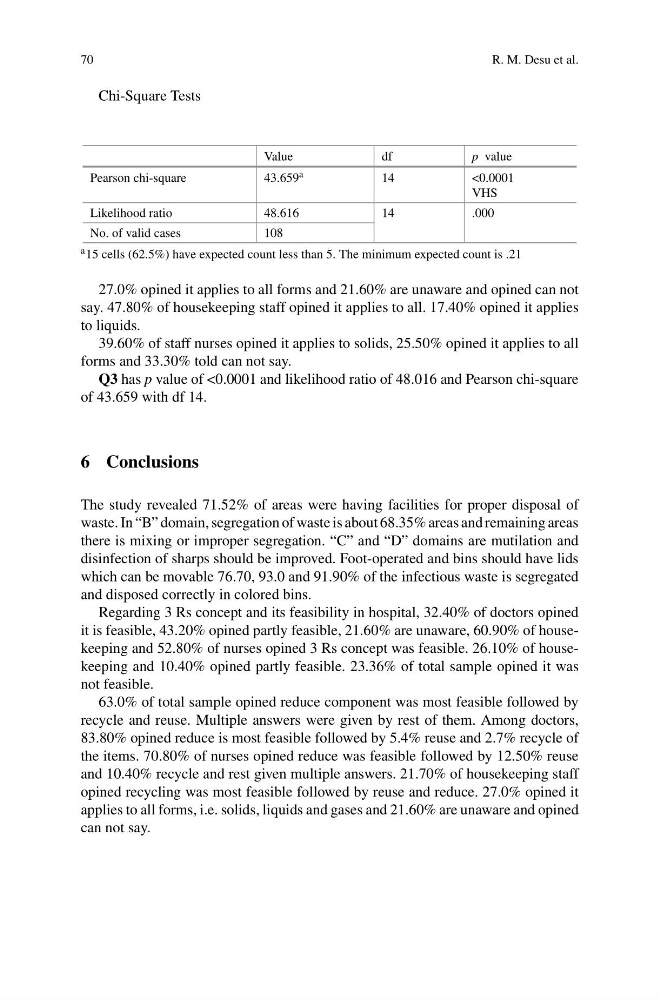
Chi-Square Tests
Value
df
p value
Pearson chi-square
43.659 a
14
<0.0001
VHS
Likelihood ratio
48.616
14
.000
No. of valid cases
108
a 15 cells (62.5%) have expected count less than 5. The minimum expected count is .21
27.0% opined it applies to all forms and 21.60% are unaware and opined can not
say. 47.80% of housekeeping staff opined it applies to all. 17.40% opined it applies
to liquids.
39.60% of staff nurses opined it applies to solids, 25.50% opined it applies to all
forms and 33.30% told can not say.
Q3 has p value of <0.0001 and likelihood ratio of 48.016 and Pearson chi-square
of 43.659 with df 14.
6 Conclusions
The study revealed 71.52% of areas were having facilities for proper disposal of
waste. In “B” domain, segregation of waste is about 68.35% areas and remaining areas
there is mixing or improper segregation. “C” and “D” domains are mutilation and
disinfection of sharps should be improved. Foot-operated and bins should have lids
which can be movable 76.70, 93.0 and 91.90% of the infectious waste is segregated
and disposed correctly in colored bins.
Regarding 3 Rs concept and its feasibility in hospital, 32.40% of doctors opined
it is feasible, 43.20% opined partly feasible, 21.60% are unaware, 60.90% of housekeeping and 52.80% of nurses opined 3 Rs concept was feasible. 26.10% of housekeeping and 10.40% opined partly feasible. 23.36% of total sample opined it was
not feasible.
63.0% of total sample opined reduce component was most feasible followed by
recycle and reuse. Multiple answers were given by rest of them. Among doctors,
83.80% opined reduce is most feasible followed by 5.4% reuse and 2.7% recycle of
the items. 70.80% of nurses opined reduce was feasible followed by 12.50% reuse
and 10.40% recycle and rest given multiple answers. 21.70% of housekeeping staff
opined recycling was most feasible followed by reuse and reduce. 27.0% opined it
applies to all forms, i.e. solids, liquids and gases and 21.60% are unaware and opined
can not say.
R. M. Desu et al.
Chi-Square Tests
Value
df
p value
Pearson chi-square
43.659 a
14
<0.0001
VHS
Likelihood ratio
48.616
14
.000
No. of valid cases
108
a 15 cells (62.5%) have expected count less than 5. The minimum expected count is .21
27.0% opined it applies to all forms and 21.60% are unaware and opined can not
say. 47.80% of housekeeping staff opined it applies to all. 17.40% opined it applies
to liquids.
39.60% of staff nurses opined it applies to solids, 25.50% opined it applies to all
forms and 33.30% told can not say.
Q3 has p value of <0.0001 and likelihood ratio of 48.016 and Pearson chi-square
of 43.659 with df 14.
6 Conclusions
The study revealed 71.52% of areas were having facilities for proper disposal of
waste. In “B” domain, segregation of waste is about 68.35% areas and remaining areas
there is mixing or improper segregation. “C” and “D” domains are mutilation and
disinfection of sharps should be improved. Foot-operated and bins should have lids
which can be movable 76.70, 93.0 and 91.90% of the infectious waste is segregated
and disposed correctly in colored bins.
Regarding 3 Rs concept and its feasibility in hospital, 32.40% of doctors opined
it is feasible, 43.20% opined partly feasible, 21.60% are unaware, 60.90% of housekeeping and 52.80% of nurses opined 3 Rs concept was feasible. 26.10% of housekeeping and 10.40% opined partly feasible. 23.36% of total sample opined it was
not feasible.
63.0% of total sample opined reduce component was most feasible followed by
recycle and reuse. Multiple answers were given by rest of them. Among doctors,
83.80% opined reduce is most feasible followed by 5.4% reuse and 2.7% recycle of
the items. 70.80% of nurses opined reduce was feasible followed by 12.50% reuse
and 10.40% recycle and rest given multiple answers. 21.70% of housekeeping staff
opined recycling was most feasible followed by reuse and reduce. 27.0% opined it
applies to all forms, i.e. solids, liquids and gases and 21.60% are unaware and opined
can not say.