

68
R. M. Desu et al.
Chi-Square Tests
Value
df
p value
Pearson chi-square
48.900 a
14
<0.0001
VHS
Likelihood ratio
48.037
14
.000
No. of valid cases
108
a 20 cells (83.3%) have expected count less than 5. The minimum expected count is .21
63.0% of total sample opined reduce component was most feasible followed by
recycle and reuse. Multiple answers were given by rest of them.
Among doctors, 83.80% opined reduce is most feasible followed by 5.4% reuse
and 2.7% recycle of the items. 70.80% of nurses opined reduce was feasible followed
by 12.50% reuse and 10.40% recycle and rest given multiple answers. 21.70% of
housekeeping staff opined recycling was most feasible followed by reuse and reduce.
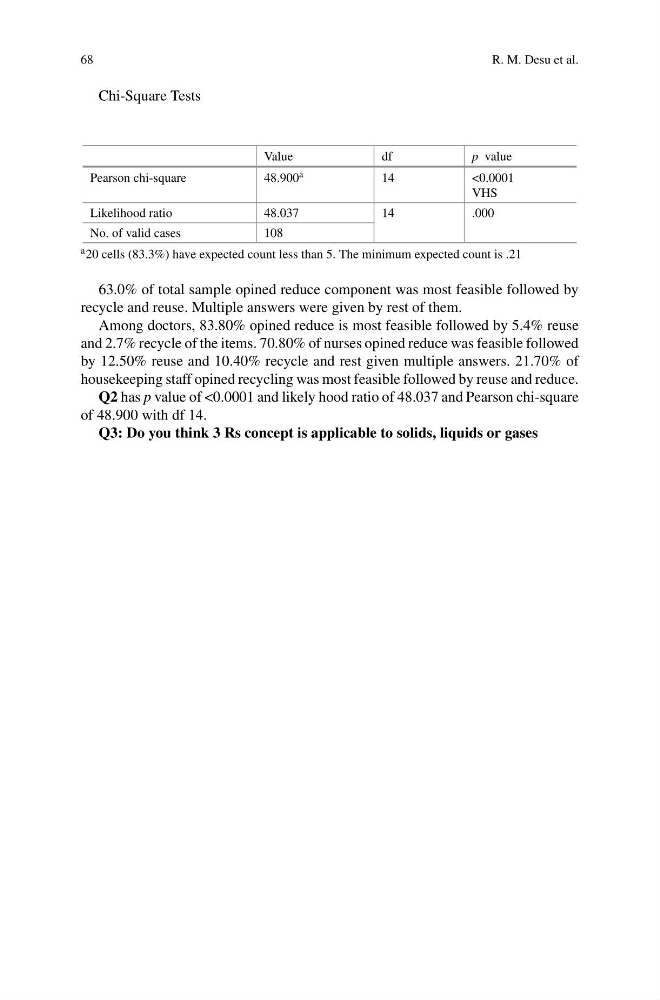
Q2 has p value of <0.0001 and likely hood ratio of 48.037 and Pearson chi-square
of 48.900 with df 14.
Q3: Do you think 3 Rs concept is applicable to solids, liquids or gases
R. M. Desu et al.
Chi-Square Tests
Value
df
p value
Pearson chi-square
48.900 a
14
<0.0001
VHS
Likelihood ratio
48.037
14
.000
No. of valid cases
108
a 20 cells (83.3%) have expected count less than 5. The minimum expected count is .21
63.0% of total sample opined reduce component was most feasible followed by
recycle and reuse. Multiple answers were given by rest of them.
Among doctors, 83.80% opined reduce is most feasible followed by 5.4% reuse
and 2.7% recycle of the items. 70.80% of nurses opined reduce was feasible followed
by 12.50% reuse and 10.40% recycle and rest given multiple answers. 21.70% of
housekeeping staff opined recycling was most feasible followed by reuse and reduce.
Q2 has p value of <0.0001 and likely hood ratio of 48.037 and Pearson chi-square
of 48.900 with df 14.
Q3: Do you think 3 Rs concept is applicable to solids, liquids or gases