

66
R. M. Desu et al.
Chi-Square Tests
Value
df
p value
Pearson chi-square
21.175 a
8
.007
SIG
Likelihood ratio
21.940
8
.005
No. of valid cases
108
a 7 cells (46.7%) have expected count less than 5. The minimum expected count is .21
Q1: Do you agree 3 Rs concept can be applied and practiced in hospital
setting?
32.40% of doctors opined it is feasible, 43.20% opined partly feasible and 21.60%
are unaware of the concept and replied can not say.
60.90% of housekeeping and 52.80% of nurses opined 3 Rs concept was feasible.
26.10% of house keeping and 10.40% of nurses opined that 3 “R” s concept was
partly feasible. 23.36% of total sample opined it was not feasible (Ahmadi 2007).
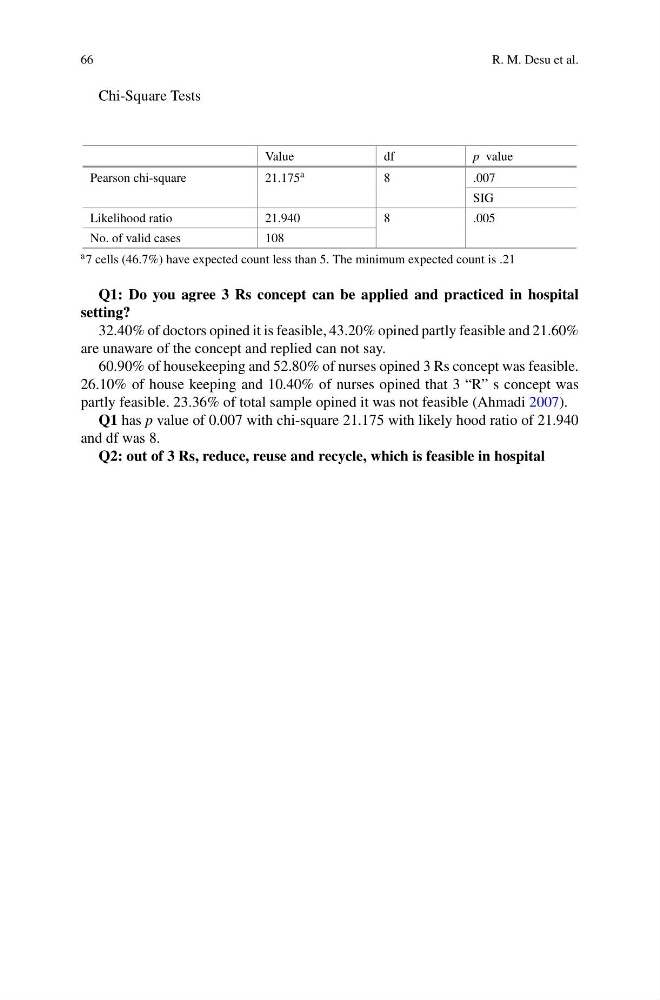
Q1 has p value of 0.007 with chi-square 21.175 with likely hood ratio of 21.940
and df was 8.
Q2: out of 3 Rs, reduce, reuse and recycle, which is feasible in hospital
R. M. Desu et al.
Chi-Square Tests
Value
df
p value
Pearson chi-square
21.175 a
8
.007
SIG
Likelihood ratio
21.940
8
.005
No. of valid cases
108
a 7 cells (46.7%) have expected count less than 5. The minimum expected count is .21
Q1: Do you agree 3 Rs concept can be applied and practiced in hospital
setting?
32.40% of doctors opined it is feasible, 43.20% opined partly feasible and 21.60%
are unaware of the concept and replied can not say.
60.90% of housekeeping and 52.80% of nurses opined 3 Rs concept was feasible.
26.10% of house keeping and 10.40% of nurses opined that 3 “R” s concept was
partly feasible. 23.36% of total sample opined it was not feasible (Ahmadi 2007).
Q1 has p value of 0.007 with chi-square 21.175 with likely hood ratio of 21.940
and df was 8.
Q2: out of 3 Rs, reduce, reuse and recycle, which is feasible in hospital