

52
P. D. Dey
(continued)
Programme
Opportunity for improving
sanitation
Focus on gender/women
Namami Gange
Program guidelines refer to
“…in situ sewage treatment
in open drains”
No specific mention of gender
Fourteenth Finance
Commission
The FFC recommends basic
grants to ULBs “…with the
purpose of providing
unconditional support for the
delivery of basic services that
includes water supply,
sanitation….”
No specific mention of gender
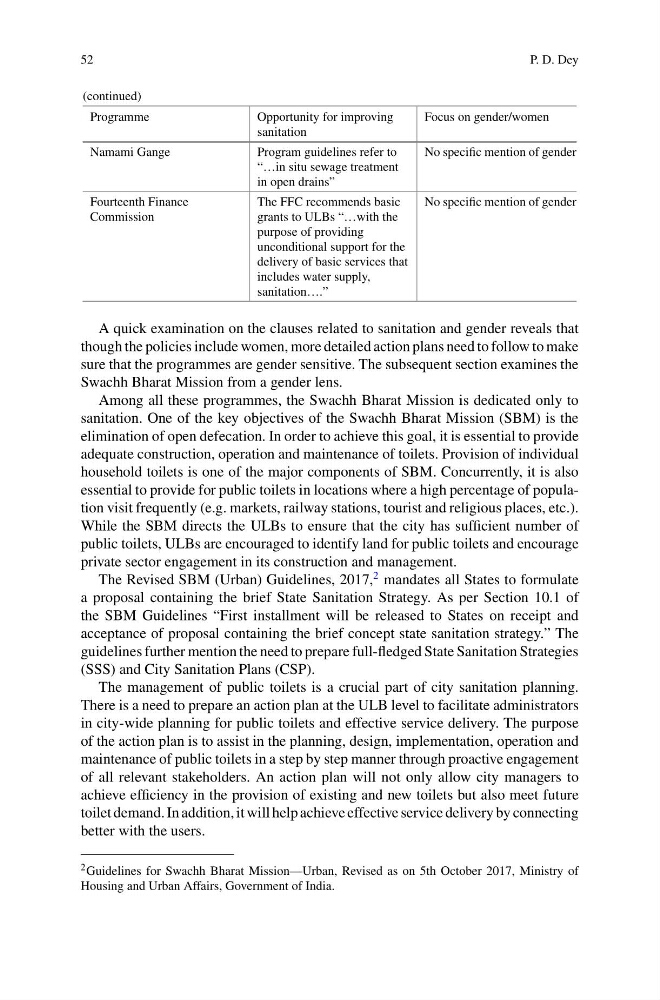
A quick examination on the clauses related to sanitation and gender reveals that
though the policies include women, more detailed action plans need to follow to make
sure that the programmes are gender sensitive. The subsequent section examines the
Swachh Bharat Mission from a gender lens.
Among all these programmes, the Swachh Bharat Mission is dedicated only to
sanitation. One of the key objectives of the Swachh Bharat Mission (SBM) is the
elimination of open defecation. In order to achieve this goal, it is essential to provide
adequate construction, operation and maintenance of toilets. Provision of individual
household toilets is one of the major components of SBM. Concurrently, it is also
essential to provide for public toilets in locations where a high percentage of population visit frequently (e.g. markets, railway stations, tourist and religious places, etc.).
While the SBM directs the ULBs to ensure that the city has sufficient number of
public toilets, ULBs are encouraged to identify land for public toilets and encourage
private sector engagement in its construction and management.
The Revised SBM (Urban) Guidelines, 2017,
2 mandates all States to formulate
a proposal containing the brief State Sanitation Strategy. As per Section 10.1 of
the SBM Guidelines “First installment will be released to States on receipt and
acceptance of proposal containing the brief concept state sanitation strategy.” The
guidelines further mention the need to prepare full-fledged State Sanitation Strategies
(SSS) and City Sanitation Plans (CSP).
The management of public toilets is a crucial part of city sanitation planning.
There is a need to prepare an action plan at the ULB level to facilitate administrators
in city-wide planning for public toilets and effective service delivery. The purpose
of the action plan is to assist in the planning, design, implementation, operation and
maintenance of public toilets in a step by step manner through proactive engagement
of all relevant stakeholders. An action plan will not only allow city managers to
achieve efficiency in the provision of existing and new toilets but also meet future
toilet demand. In addition, it will help achieve effective service delivery by connecting
better with the users.
2 Guidelines for Swachh Bharat Mission—Urban, Revised as on 5th October 2017, Ministry of
Housing and Urban Affairs, Government of India.
P. D. Dey
(continued)
Programme
Opportunity for improving
sanitation
Focus on gender/women
Namami Gange
Program guidelines refer to
“…in situ sewage treatment
in open drains”
No specific mention of gender
Fourteenth Finance
Commission
The FFC recommends basic
grants to ULBs “…with the
purpose of providing
unconditional support for the
delivery of basic services that
includes water supply,
sanitation….”
No specific mention of gender
A quick examination on the clauses related to sanitation and gender reveals that
though the policies include women, more detailed action plans need to follow to make
sure that the programmes are gender sensitive. The subsequent section examines the
Swachh Bharat Mission from a gender lens.
Among all these programmes, the Swachh Bharat Mission is dedicated only to
sanitation. One of the key objectives of the Swachh Bharat Mission (SBM) is the
elimination of open defecation. In order to achieve this goal, it is essential to provide
adequate construction, operation and maintenance of toilets. Provision of individual
household toilets is one of the major components of SBM. Concurrently, it is also
essential to provide for public toilets in locations where a high percentage of population visit frequently (e.g. markets, railway stations, tourist and religious places, etc.).
While the SBM directs the ULBs to ensure that the city has sufficient number of
public toilets, ULBs are encouraged to identify land for public toilets and encourage
private sector engagement in its construction and management.
The Revised SBM (Urban) Guidelines, 2017,
2 mandates all States to formulate
a proposal containing the brief State Sanitation Strategy. As per Section 10.1 of
the SBM Guidelines “First installment will be released to States on receipt and
acceptance of proposal containing the brief concept state sanitation strategy.” The
guidelines further mention the need to prepare full-fledged State Sanitation Strategies
(SSS) and City Sanitation Plans (CSP).
The management of public toilets is a crucial part of city sanitation planning.
There is a need to prepare an action plan at the ULB level to facilitate administrators
in city-wide planning for public toilets and effective service delivery. The purpose
of the action plan is to assist in the planning, design, implementation, operation and
maintenance of public toilets in a step by step manner through proactive engagement
of all relevant stakeholders. An action plan will not only allow city managers to
achieve efficiency in the provision of existing and new toilets but also meet future
toilet demand. In addition, it will help achieve effective service delivery by connecting
better with the users.
2 Guidelines for Swachh Bharat Mission—Urban, Revised as on 5th October 2017, Ministry of
Housing and Urban Affairs, Government of India.