

40
S. Bhattacharyya et al.
Table 1 Vulture population decline in India
S. No.
Vulture species
Decline rate
1.
White-rumped vulture (Gyps bengalensis)
99.7%
2.
Indian vulture (Gyps indicus)
97.4%
3.
Slender-billed vulture (Gyps tenuirostris)
97.4%
4.
Himalayan vulture (Gyps himalayensis)
Not significantly alarming
5.
Eurasian griffon (Gyps fulvus)
Not significantly alarming
crystal deposition (hyperuricemia) mainly in the spleen, liver, abdominal cavities
and thoracic.
The widespread availability and use of this drug by veterinarians are thus identified
as the main culprit to the sharp drop in vultures of India. A simulation model demonstrated that if only 1% of carcasses were contaminated by diclofenac, Indian vulture
populations would fall by (60–90) % annually, and a study of carcasses showed that
about 10% were contaminated (Koenig 2006; Markandya et al. 2008). Gyps species
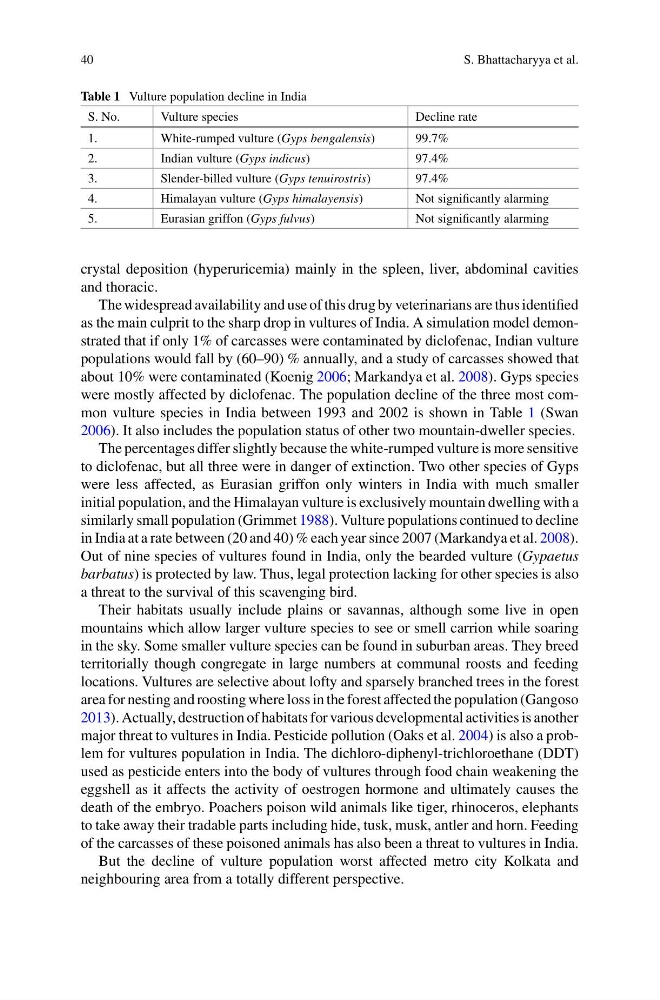
were mostly affected by diclofenac. The population decline of the three most common vulture species in India between 1993 and 2002 is shown in Table 1 (Swan
2006). It also includes the population status of other two mountain-dweller species.
The percentages differ slightly because the white-rumped vulture is more sensitive
to diclofenac, but all three were in danger of extinction. Two other species of Gyps
were less affected, as Eurasian griffon only winters in India with much smaller
initial population, and the Himalayan vulture is exclusively mountain dwelling with a
similarly small population (Grimmet 1988). Vulture populations continued to decline
in India at a rate between (20 and 40) % each year since 2007 (Markandya et al. 2008).
Out of nine species of vultures found in India, only the bearded vulture (Gypaetus
barbatus) is protected by law. Thus, legal protection lacking for other species is also
a threat to the survival of this scavenging bird.
Their habitats usually include plains or savannas, although some live in open
mountains which allow larger vulture species to see or smell carrion while soaring
in the sky. Some smaller vulture species can be found in suburban areas. They breed
territorially though congregate in large numbers at communal roosts and feeding
locations. Vultures are selective about lofty and sparsely branched trees in the forest
area for nesting and roosting where loss in the forest affected the population (Gangoso
2013). Actually, destruction of habitats for various developmental activities is another
major threat to vultures in India. Pesticide pollution (Oaks et al. 2004) is also a problem for vultures population in India. The dichloro-diphenyl-trichloroethane (DDT)
used as pesticide enters into the body of vultures through food chain weakening the
eggshell as it affects the activity of oestrogen hormone and ultimately causes the
death of the embryo. Poachers poison wild animals like tiger, rhinoceros, elephants
to take away their tradable parts including hide, tusk, musk, antler and horn. Feeding
of the carcasses of these poisoned animals has also been a threat to vultures in India.
But the decline of vulture population worst affected metro city Kolkata and
neighbouring area from a totally different perspective.
S. Bhattacharyya et al.
Table 1 Vulture population decline in India
S. No.
Vulture species
Decline rate
1.
White-rumped vulture (Gyps bengalensis)
99.7%
2.
Indian vulture (Gyps indicus)
97.4%
3.
Slender-billed vulture (Gyps tenuirostris)
97.4%
4.
Himalayan vulture (Gyps himalayensis)
Not significantly alarming
5.
Eurasian griffon (Gyps fulvus)
Not significantly alarming
crystal deposition (hyperuricemia) mainly in the spleen, liver, abdominal cavities
and thoracic.
The widespread availability and use of this drug by veterinarians are thus identified
as the main culprit to the sharp drop in vultures of India. A simulation model demonstrated that if only 1% of carcasses were contaminated by diclofenac, Indian vulture
populations would fall by (60–90) % annually, and a study of carcasses showed that
about 10% were contaminated (Koenig 2006; Markandya et al. 2008). Gyps species
were mostly affected by diclofenac. The population decline of the three most common vulture species in India between 1993 and 2002 is shown in Table 1 (Swan
2006). It also includes the population status of other two mountain-dweller species.
The percentages differ slightly because the white-rumped vulture is more sensitive
to diclofenac, but all three were in danger of extinction. Two other species of Gyps
were less affected, as Eurasian griffon only winters in India with much smaller
initial population, and the Himalayan vulture is exclusively mountain dwelling with a
similarly small population (Grimmet 1988). Vulture populations continued to decline
in India at a rate between (20 and 40) % each year since 2007 (Markandya et al. 2008).
Out of nine species of vultures found in India, only the bearded vulture (Gypaetus
barbatus) is protected by law. Thus, legal protection lacking for other species is also
a threat to the survival of this scavenging bird.
Their habitats usually include plains or savannas, although some live in open
mountains which allow larger vulture species to see or smell carrion while soaring
in the sky. Some smaller vulture species can be found in suburban areas. They breed
territorially though congregate in large numbers at communal roosts and feeding
locations. Vultures are selective about lofty and sparsely branched trees in the forest
area for nesting and roosting where loss in the forest affected the population (Gangoso
2013). Actually, destruction of habitats for various developmental activities is another
major threat to vultures in India. Pesticide pollution (Oaks et al. 2004) is also a problem for vultures population in India. The dichloro-diphenyl-trichloroethane (DDT)
used as pesticide enters into the body of vultures through food chain weakening the
eggshell as it affects the activity of oestrogen hormone and ultimately causes the
death of the embryo. Poachers poison wild animals like tiger, rhinoceros, elephants
to take away their tradable parts including hide, tusk, musk, antler and horn. Feeding
of the carcasses of these poisoned animals has also been a threat to vultures in India.
But the decline of vulture population worst affected metro city Kolkata and
neighbouring area from a totally different perspective.