

ITC’s Community-Based Solid Waste Management Strategy: A Case…
217
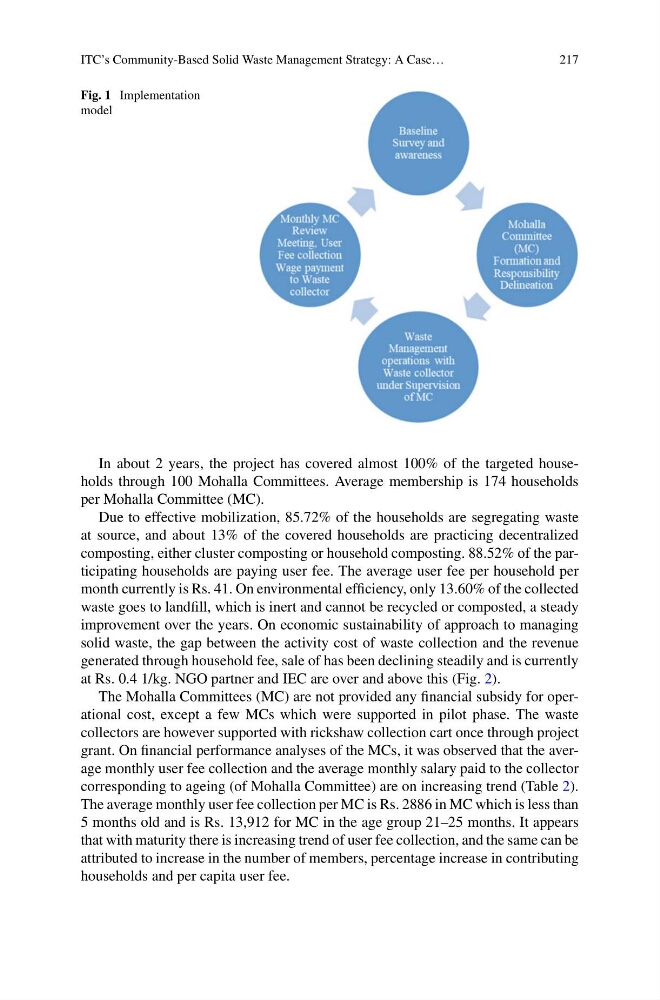
Fig. 1 Implementation
model
In about 2 years, the project has covered almost 100% of the targeted households through 100 Mohalla Committees. Average membership is 174 households
per Mohalla Committee (MC).
Due to effective mobilization, 85.72% of the households are segregating waste
at source, and about 13% of the covered households are practicing decentralized
composting, either cluster composting or household composting. 88.52% of the participating households are paying user fee. The average user fee per household per
month currently is Rs. 41. On environmental efficiency, only 13.60% of the collected
waste goes to landfill, which is inert and cannot be recycled or composted, a steady
improvement over the years. On economic sustainability of approach to managing
solid waste, the gap between the activity cost of waste collection and the revenue
generated through household fee, sale of has been declining steadily and is currently
at Rs. 0.4 1/kg. NGO partner and IEC are over and above this (Fig. 2).
The Mohalla Committees (MC) are not provided any financial subsidy for operational cost, except a few MCs which were supported in pilot phase. The waste
collectors are however supported with rickshaw collection cart once through project
grant. On financial performance analyses of the MCs, it was observed that the average monthly user fee collection and the average monthly salary paid to the collector
corresponding to ageing (of Mohalla Committee) are on increasing trend (Table 2).
The average monthly user fee collection per MC is Rs. 2886 in MC which is less than
5 months old and is Rs. 13,912 for MC in the age group 21–25 months. It appears
that with maturity there is increasing trend of user fee collection, and the same can be
attributed to increase in the number of members, percentage increase in contributing
households and per capita user fee.
217
Fig. 1 Implementation
model
In about 2 years, the project has covered almost 100% of the targeted households through 100 Mohalla Committees. Average membership is 174 households
per Mohalla Committee (MC).
Due to effective mobilization, 85.72% of the households are segregating waste
at source, and about 13% of the covered households are practicing decentralized
composting, either cluster composting or household composting. 88.52% of the participating households are paying user fee. The average user fee per household per
month currently is Rs. 41. On environmental efficiency, only 13.60% of the collected
waste goes to landfill, which is inert and cannot be recycled or composted, a steady
improvement over the years. On economic sustainability of approach to managing
solid waste, the gap between the activity cost of waste collection and the revenue
generated through household fee, sale of has been declining steadily and is currently
at Rs. 0.4 1/kg. NGO partner and IEC are over and above this (Fig. 2).
The Mohalla Committees (MC) are not provided any financial subsidy for operational cost, except a few MCs which were supported in pilot phase. The waste
collectors are however supported with rickshaw collection cart once through project
grant. On financial performance analyses of the MCs, it was observed that the average monthly user fee collection and the average monthly salary paid to the collector
corresponding to ageing (of Mohalla Committee) are on increasing trend (Table 2).
The average monthly user fee collection per MC is Rs. 2886 in MC which is less than
5 months old and is Rs. 13,912 for MC in the age group 21–25 months. It appears
that with maturity there is increasing trend of user fee collection, and the same can be
attributed to increase in the number of members, percentage increase in contributing
households and per capita user fee.