

166
P. Kowlesser
(Minghua et al. 2009; Kothari et al. 2014; United Nations 1994), SIDS are faced
with an ever-increasing amount of solid wastes that require management in an environmentally sound manner. Due to their limited financial and technical resources as
well as land scarcity, proper solid waste management in SIDS is an issue of even
more pressing concern (United Nations 1994). The objective of this article is to provide an overview of the status of waste management in SIDS, including policy and
legislation that exists therein, while also considering the solid waste management
system in Mauritius as a case study.
2 Status of Waste Generation and Management in SIDS
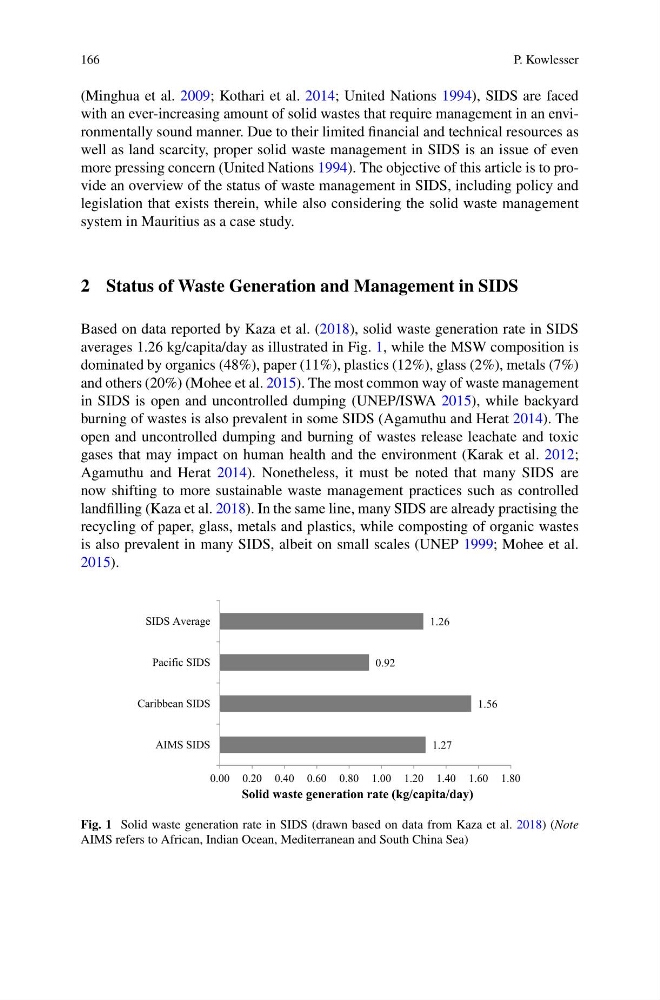
Based on data reported by Kaza et al. (2018), solid waste generation rate in SIDS
averages 1.26 kg/capita/day as illustrated in Fig. 1, while the MSW composition is
dominated by organics (48%), paper (11%), plastics (12%), glass (2%), metals (7%)
and others (20%) (Mohee et al. 2015). The most common way of waste management
in SIDS is open and uncontrolled dumping (UNEP/ISWA 2015), while backyard
burning of wastes is also prevalent in some SIDS (Agamuthu and Herat 2014). The
open and uncontrolled dumping and burning of wastes release leachate and toxic
gases that may impact on human health and the environment (Karak et al. 2012;
Agamuthu and Herat 2014). Nonetheless, it must be noted that many SIDS are
now shifting to more sustainable waste management practices such as controlled
landfilling (Kaza et al. 2018). In the same line, many SIDS are already practising the
recycling of paper, glass, metals and plastics, while composting of organic wastes
is also prevalent in many SIDS, albeit on small scales (UNEP 1999; Mohee et al.
2015).
1.27
1.56
0.92
1.26
0.00 0.20 0.40 0.60 0.80 1.00 1.20 1.40 1.60 1.80
AIMS SIDS
Caribbean SIDS
Pacific SIDS
SIDS Average
Solid waste generation rate (kg/capita/day)
Fig. 1 Solid waste generation rate in SIDS (drawn based on data from Kaza et al. 2018) (Note
AIMS refers to African, Indian Ocean, Mediterranean and South China Sea)
P. Kowlesser
(Minghua et al. 2009; Kothari et al. 2014; United Nations 1994), SIDS are faced
with an ever-increasing amount of solid wastes that require management in an environmentally sound manner. Due to their limited financial and technical resources as
well as land scarcity, proper solid waste management in SIDS is an issue of even
more pressing concern (United Nations 1994). The objective of this article is to provide an overview of the status of waste management in SIDS, including policy and
legislation that exists therein, while also considering the solid waste management
system in Mauritius as a case study.
2 Status of Waste Generation and Management in SIDS
Based on data reported by Kaza et al. (2018), solid waste generation rate in SIDS
averages 1.26 kg/capita/day as illustrated in Fig. 1, while the MSW composition is
dominated by organics (48%), paper (11%), plastics (12%), glass (2%), metals (7%)
and others (20%) (Mohee et al. 2015). The most common way of waste management
in SIDS is open and uncontrolled dumping (UNEP/ISWA 2015), while backyard
burning of wastes is also prevalent in some SIDS (Agamuthu and Herat 2014). The
open and uncontrolled dumping and burning of wastes release leachate and toxic
gases that may impact on human health and the environment (Karak et al. 2012;
Agamuthu and Herat 2014). Nonetheless, it must be noted that many SIDS are
now shifting to more sustainable waste management practices such as controlled
landfilling (Kaza et al. 2018). In the same line, many SIDS are already practising the
recycling of paper, glass, metals and plastics, while composting of organic wastes
is also prevalent in many SIDS, albeit on small scales (UNEP 1999; Mohee et al.
2015).
1.27
1.56
0.92
1.26
0.00 0.20 0.40 0.60 0.80 1.00 1.20 1.40 1.60 1.80
AIMS SIDS
Caribbean SIDS
Pacific SIDS
SIDS Average
Solid waste generation rate (kg/capita/day)
Fig. 1 Solid waste generation rate in SIDS (drawn based on data from Kaza et al. 2018) (Note
AIMS refers to African, Indian Ocean, Mediterranean and South China Sea)