

Ecoparks as a Model of Sustainable Solid Waste Management
147
6 Ecoparks: Case Study of Tirupati Municipality
Tirupati municipality is spread over an area of 27.44 km
2 and comprises 50 wards. In
Tirupati Municipal Corporation limits, there are nine big municipal parks, ten educational institutions (universities, colleges, and institutions), and five other public
places such as bus station, amenity complexes, etc., which are suitable to take up the
Ecoparks. Municipal Solid Waste that is collected by the method of house-to-house
collection using tricycles may be transported directly to the nearest public place/park
in that ward, thus reducing the necessity of transfer station and secondary transportation. The wastes, after segregation at source, are subjected to vermicomposting. A
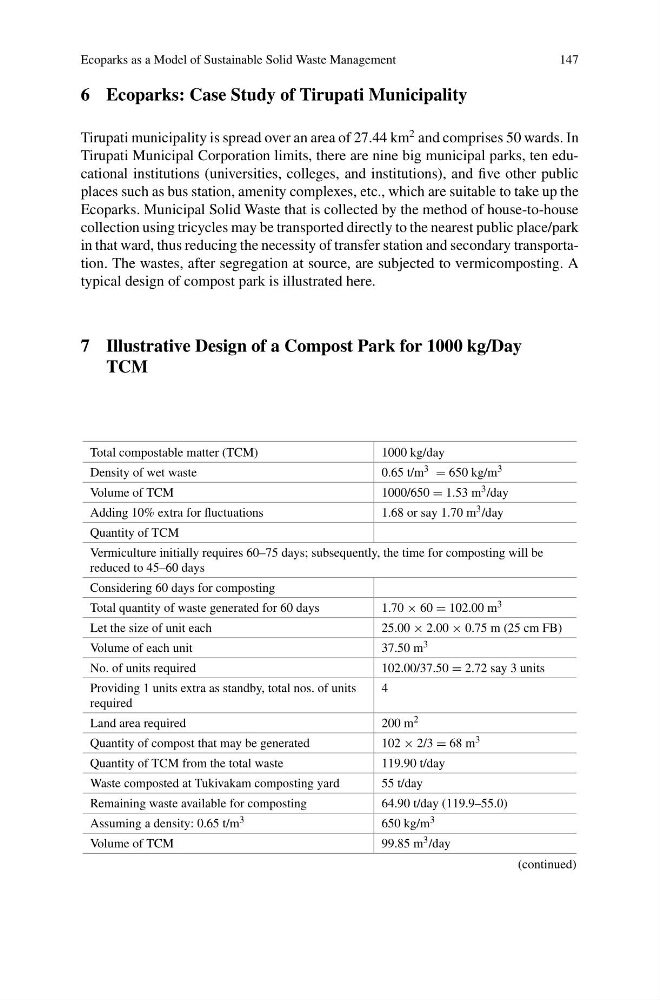
typical design of compost park is illustrated here.
7 Illustrative Design of a Compost Park for 1000 kg/Day
TCM
Total compostable matter (TCM)
1000 kg/day
Density of wet waste
0.65 t/m 3 = 650 kg/m 3
Volume of TCM
1000/650 = 1.53 m 3 /day
Adding 10% extra for fluctuations
1.68 or say 1.70 m 3 /day
Quantity of TCM
Vermiculture initially requires 60–75 days; subsequently, the time for composting will be
reduced to 45–60 days
Considering 60 days for composting
Total quantity of waste generated for 60 days
1.70 × 60 = 102.00 m 3
Let the size of unit each
25.00 × 2.00 × 0.75 m (25 cm FB)
Volume of each unit
37.50 m 3
No. of units required
102.00/37.50 = 2.72 say 3 units
Providing 1 units extra as standby, total nos. of units
required
4
Land area required
200 m 2
Quantity of compost that may be generated
102 × 2/3 = 68 m 3
Quantity of TCM from the total waste
119.90 t/day
Waste composted at Tukivakam composting yard
55 t/day
Remaining waste available for composting
64.90 t/day (119.9–55.0)
Assuming a density: 0.65 t/m 3
650 kg/m 3
Volume of TCM
99.85 m 3 /day
(continued)
147
6 Ecoparks: Case Study of Tirupati Municipality
Tirupati municipality is spread over an area of 27.44 km
2 and comprises 50 wards. In
Tirupati Municipal Corporation limits, there are nine big municipal parks, ten educational institutions (universities, colleges, and institutions), and five other public
places such as bus station, amenity complexes, etc., which are suitable to take up the
Ecoparks. Municipal Solid Waste that is collected by the method of house-to-house
collection using tricycles may be transported directly to the nearest public place/park
in that ward, thus reducing the necessity of transfer station and secondary transportation. The wastes, after segregation at source, are subjected to vermicomposting. A
typical design of compost park is illustrated here.
7 Illustrative Design of a Compost Park for 1000 kg/Day
TCM
Total compostable matter (TCM)
1000 kg/day
Density of wet waste
0.65 t/m 3 = 650 kg/m 3
Volume of TCM
1000/650 = 1.53 m 3 /day
Adding 10% extra for fluctuations
1.68 or say 1.70 m 3 /day
Quantity of TCM
Vermiculture initially requires 60–75 days; subsequently, the time for composting will be
reduced to 45–60 days
Considering 60 days for composting
Total quantity of waste generated for 60 days
1.70 × 60 = 102.00 m 3
Let the size of unit each
25.00 × 2.00 × 0.75 m (25 cm FB)
Volume of each unit
37.50 m 3
No. of units required
102.00/37.50 = 2.72 say 3 units
Providing 1 units extra as standby, total nos. of units
required
4
Land area required
200 m 2
Quantity of compost that may be generated
102 × 2/3 = 68 m 3
Quantity of TCM from the total waste
119.90 t/day
Waste composted at Tukivakam composting yard
55 t/day
Remaining waste available for composting
64.90 t/day (119.9–55.0)
Assuming a density: 0.65 t/m 3
650 kg/m 3
Volume of TCM
99.85 m 3 /day
(continued)