

96
A. Aich and S. K. Ghosh
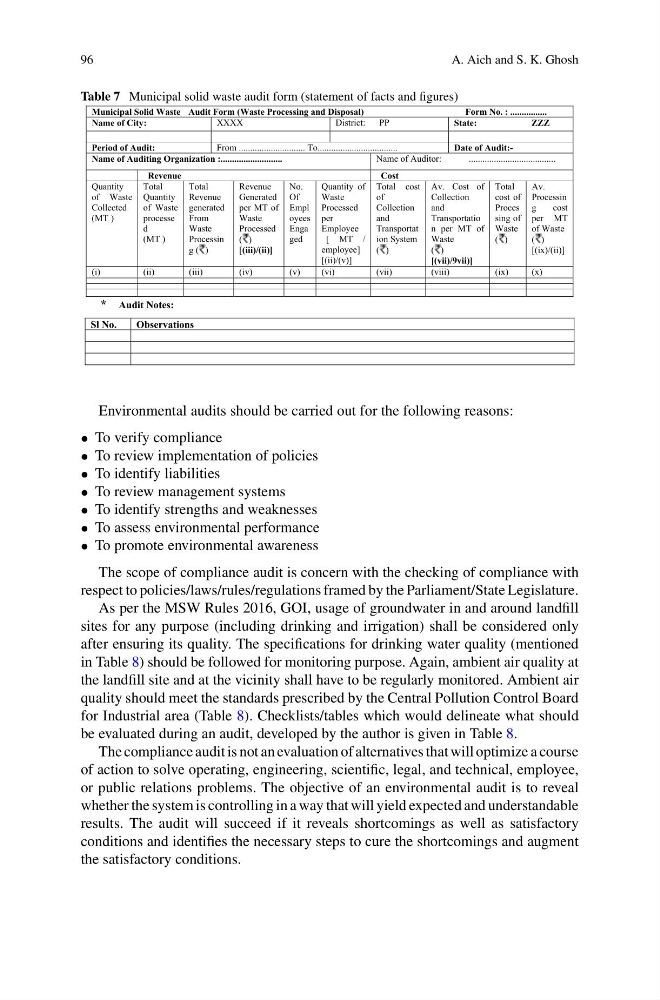
Table 7 Municipal solid waste audit form (statement of facts and figures)
Municipal Solid Waste Audit Form (Waste Processing and Disposal)
Form No. : ................
Name of City:
XXXX
District: PP
State:
ZZZ
Period of Audit:
From ............................. To...................................
Date of Audit:Name of Auditing Organization :...........................
Name of Auditor:
......................................
Revenue
Cost
Quantity
of Waste
Collected
(MT )
Total
Quantity
of Waste
processe
d
(MT )
Total
Revenue
generated
From
Waste
Processin
g ( )
Revenue
Generated
per MT of
Waste
Processed
( )
[(iii)/(ii)]
No.
Of
Empl
oyees
Enga
ged
Quantity of
Waste
Processed
per
Employee
[ MT /
employee]
[(ii)/(v)]
Total cost
of
Collection
and
Transportat
ion System
( )
Av. Cost of
Collection
and
Transportatio
n per MT of
Waste
( )
[(vii)/9vii)]
Total
cost of
Proces
sing of
Waste
( )
Av.
Processin
g
cost
per MT
of Waste
( )
[(ix)/(ii)]
(i)
(ii)
(iii)
(iv)
(v)
(vi)
(vii)
(viii)
(ix)
(x)
* Audit Notes:
Sl No.
Observations
Environmental audits should be carried out for the following reasons:
• To verify compliance
• To review implementation of policies
• To identify liabilities
• To review management systems
• To identify strengths and weaknesses
• To assess environmental performance
• To promote environmental awareness
The scope of compliance audit is concern with the checking of compliance with
respect to policies/laws/rules/regulations framed by the Parliament/State Legislature.
As per the MSW Rules 2016, GOI, usage of groundwater in and around landfill
sites for any purpose (including drinking and irrigation) shall be considered only
after ensuring its quality. The specifications for drinking water quality (mentioned
in Table 8) should be followed for monitoring purpose. Again, ambient air quality at
the landfill site and at the vicinity shall have to be regularly monitored. Ambient air
quality should meet the standards prescribed by the Central Pollution Control Board
for Industrial area (Table 8). Checklists/tables which would delineate what should
be evaluated during an audit, developed by the author is given in Table 8.
The compliance audit is not an evaluation of alternatives that will optimize a course
of action to solve operating, engineering, scientific, legal, and technical, employee,
or public relations problems. The objective of an environmental audit is to reveal
whether the system is controlling in a way that will yield expected and understandable
results. The audit will succeed if it reveals shortcomings as well as satisfactory
conditions and identifies the necessary steps to cure the shortcomings and augment
the satisfactory conditions.
A. Aich and S. K. Ghosh
Table 7 Municipal solid waste audit form (statement of facts and figures)
Municipal Solid Waste Audit Form (Waste Processing and Disposal)
Form No. : ................
Name of City:
XXXX
District: PP
State:
ZZZ
Period of Audit:
From ............................. To...................................
Date of Audit:Name of Auditing Organization :...........................
Name of Auditor:
......................................
Revenue
Cost
Quantity
of Waste
Collected
(MT )
Total
Quantity
of Waste
processe
d
(MT )
Total
Revenue
generated
From
Waste
Processin
g ( )
Revenue
Generated
per MT of
Waste
Processed
( )
[(iii)/(ii)]
No.
Of
Empl
oyees
Enga
ged
Quantity of
Waste
Processed
per
Employee
[ MT /
employee]
[(ii)/(v)]
Total cost
of
Collection
and
Transportat
ion System
( )
Av. Cost of
Collection
and
Transportatio
n per MT of
Waste
( )
[(vii)/9vii)]
Total
cost of
Proces
sing of
Waste
( )
Av.
Processin
g
cost
per MT
of Waste
( )
[(ix)/(ii)]
(i)
(ii)
(iii)
(iv)
(v)
(vi)
(vii)
(viii)
(ix)
(x)
* Audit Notes:
Sl No.
Observations
Environmental audits should be carried out for the following reasons:
• To verify compliance
• To review implementation of policies
• To identify liabilities
• To review management systems
• To identify strengths and weaknesses
• To assess environmental performance
• To promote environmental awareness
The scope of compliance audit is concern with the checking of compliance with
respect to policies/laws/rules/regulations framed by the Parliament/State Legislature.
As per the MSW Rules 2016, GOI, usage of groundwater in and around landfill
sites for any purpose (including drinking and irrigation) shall be considered only
after ensuring its quality. The specifications for drinking water quality (mentioned
in Table 8) should be followed for monitoring purpose. Again, ambient air quality at
the landfill site and at the vicinity shall have to be regularly monitored. Ambient air
quality should meet the standards prescribed by the Central Pollution Control Board
for Industrial area (Table 8). Checklists/tables which would delineate what should
be evaluated during an audit, developed by the author is given in Table 8.
The compliance audit is not an evaluation of alternatives that will optimize a course
of action to solve operating, engineering, scientific, legal, and technical, employee,
or public relations problems. The objective of an environmental audit is to reveal
whether the system is controlling in a way that will yield expected and understandable
results. The audit will succeed if it reveals shortcomings as well as satisfactory
conditions and identifies the necessary steps to cure the shortcomings and augment
the satisfactory conditions.