

94
A. Aich and S. K. Ghosh
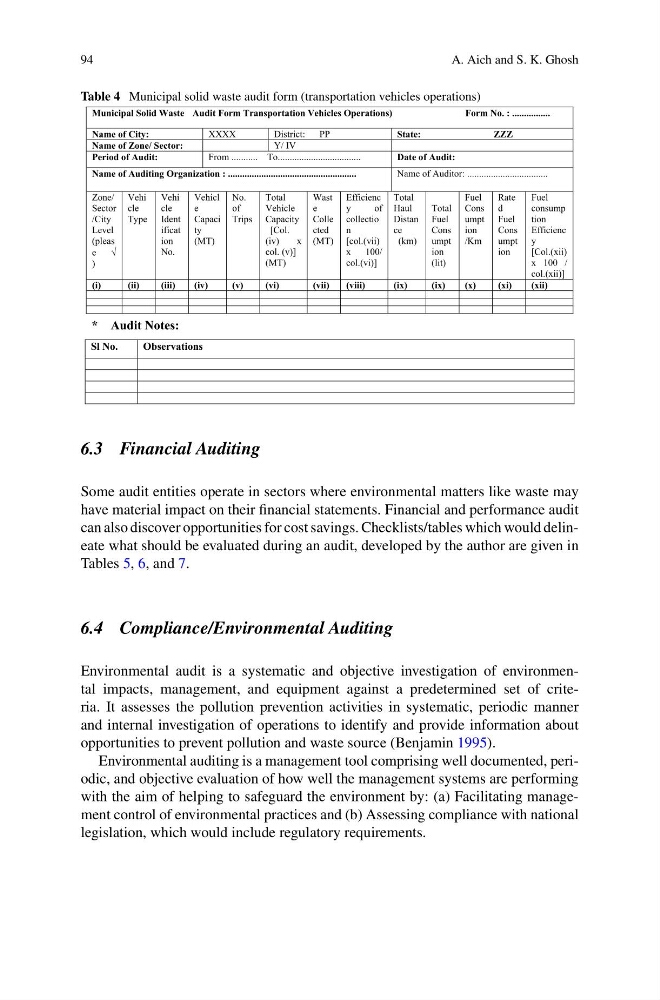
Table 4 Municipal solid waste audit form (transportation vehicles operations)
Municipal Solid Waste Audit Form Transportation Vehicles Operations)
Form No. : ................
Name of City:
XXXX
District: PP
State:
ZZZ
Name of Zone/ Sector:
Y/ IV
Period of Audit:
From ........... To...................................
Date of Audit:
Name of Auditing Organization : ......................................................
Name of Auditor: ..................................
Zone/
Sector
/City
Level
(pleas
e
√
)
Vehi
cle
Type
Vehi
cle
Ident
ificat
ion
No.
Vehicl
e
Capaci
ty
(MT)
No.
of
Trips
Total
Vehicle
Capacity
[Col.
(iv)
x
col. (v)]
(MT)
Wast
e
Colle
cted
(MT)
Efficienc
y
of
collectio
n
[col.(vii)
x
100/
col.(vi)]
Total
Haul
Distan
ce
(km)
Total
Fuel
Cons
umpt
ion
(lit)
Fuel
Cons
umpt
ion
/Km
Rate
d
Fuel
Cons
umpt
ion
Fuel
consump
tion
Efficienc
y
[Col.(xii)
x 100 /
col.(xii)]
(i)
(ii)
(iii)
(iv)
(v)
(vi)
(vii)
(viii)
(ix)
(ix)
(x)
(xi)
(xii)
* Audit Notes:
Sl No.
Observations
6.3 Financial Auditing
Some audit entities operate in sectors where environmental matters like waste may
have material impact on their financial statements. Financial and performance audit
can also discover opportunities for cost savings. Checklists/tables which would delineate what should be evaluated during an audit, developed by the author are given in
Tables 5, 6, and 7.
6.4 Compliance/Environmental Auditing
Environmental audit is a systematic and objective investigation of environmental impacts, management, and equipment against a predetermined set of criteria. It assesses the pollution prevention activities in systematic, periodic manner
and internal investigation of operations to identify and provide information about
opportunities to prevent pollution and waste source (Benjamin 1995).
Environmental auditing is a management tool comprising well documented, periodic, and objective evaluation of how well the management systems are performing
with the aim of helping to safeguard the environment by: (a) Facilitating management control of environmental practices and (b) Assessing compliance with national
legislation, which would include regulatory requirements.
A. Aich and S. K. Ghosh
Table 4 Municipal solid waste audit form (transportation vehicles operations)
Municipal Solid Waste Audit Form Transportation Vehicles Operations)
Form No. : ................
Name of City:
XXXX
District: PP
State:
ZZZ
Name of Zone/ Sector:
Y/ IV
Period of Audit:
From ........... To...................................
Date of Audit:
Name of Auditing Organization : ......................................................
Name of Auditor: ..................................
Zone/
Sector
/City
Level
(pleas
e
√
)
Vehi
cle
Type
Vehi
cle
Ident
ificat
ion
No.
Vehicl
e
Capaci
ty
(MT)
No.
of
Trips
Total
Vehicle
Capacity
[Col.
(iv)
x
col. (v)]
(MT)
Wast
e
Colle
cted
(MT)
Efficienc
y
of
collectio
n
[col.(vii)
x
100/
col.(vi)]
Total
Haul
Distan
ce
(km)
Total
Fuel
Cons
umpt
ion
(lit)
Fuel
Cons
umpt
ion
/Km
Rate
d
Fuel
Cons
umpt
ion
Fuel
consump
tion
Efficienc
y
[Col.(xii)
x 100 /
col.(xii)]
(i)
(ii)
(iii)
(iv)
(v)
(vi)
(vii)
(viii)
(ix)
(ix)
(x)
(xi)
(xii)
* Audit Notes:
Sl No.
Observations
6.3 Financial Auditing
Some audit entities operate in sectors where environmental matters like waste may
have material impact on their financial statements. Financial and performance audit
can also discover opportunities for cost savings. Checklists/tables which would delineate what should be evaluated during an audit, developed by the author are given in
Tables 5, 6, and 7.
6.4 Compliance/Environmental Auditing
Environmental audit is a systematic and objective investigation of environmental impacts, management, and equipment against a predetermined set of criteria. It assesses the pollution prevention activities in systematic, periodic manner
and internal investigation of operations to identify and provide information about
opportunities to prevent pollution and waste source (Benjamin 1995).
Environmental auditing is a management tool comprising well documented, periodic, and objective evaluation of how well the management systems are performing
with the aim of helping to safeguard the environment by: (a) Facilitating management control of environmental practices and (b) Assessing compliance with national
legislation, which would include regulatory requirements.