

Framework for Auditing of Municipal Solid Waste Management …
91
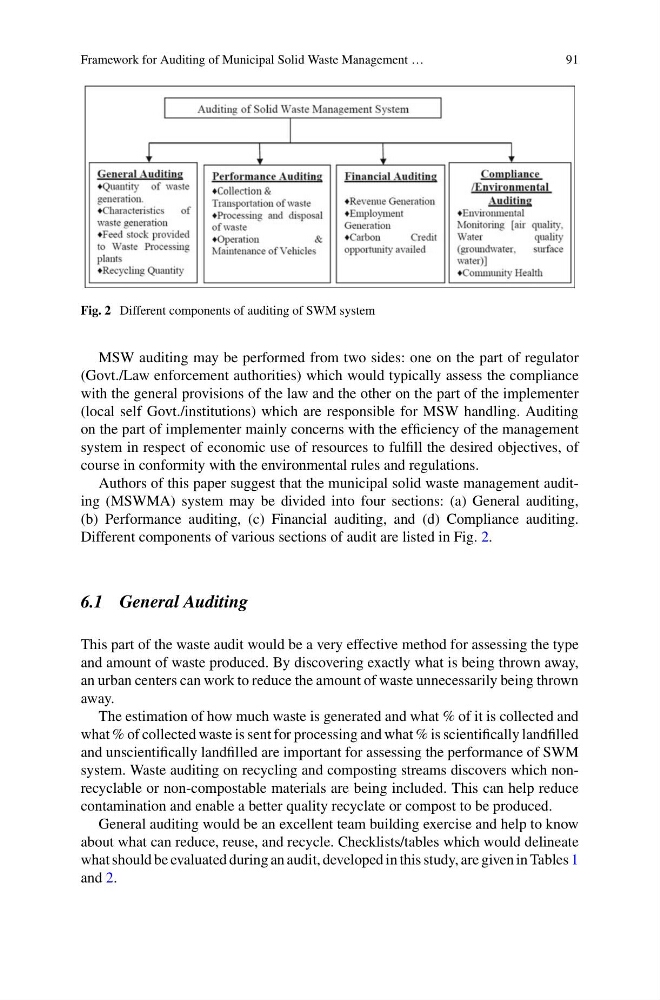
Fig. 2 Different components of auditing of SWM system
MSW auditing may be performed from two sides: one on the part of regulator
(Govt./Law enforcement authorities) which would typically assess the compliance
with the general provisions of the law and the other on the part of the implementer
(local self Govt./institutions) which are responsible for MSW handling. Auditing
on the part of implementer mainly concerns with the efficiency of the management
system in respect of economic use of resources to fulfill the desired objectives, of
course in conformity with the environmental rules and regulations.
Authors of this paper suggest that the municipal solid waste management auditing (MSWMA) system may be divided into four sections: (a) General auditing,
(b) Performance auditing, (c) Financial auditing, and (d) Compliance auditing.
Different components of various sections of audit are listed in Fig. 2.
6.1 General Auditing
This part of the waste audit would be a very effective method for assessing the type
and amount of waste produced. By discovering exactly what is being thrown away,
an urban centers can work to reduce the amount of waste unnecessarily being thrown
away.
The estimation of how much waste is generated and what % of it is collected and
what % of collected waste is sent for processing and what % is scientifically landfilled
and unscientifically landfilled are important for assessing the performance of SWM
system. Waste auditing on recycling and composting streams discovers which nonrecyclable or non-compostable materials are being included. This can help reduce
contamination and enable a better quality recyclate or compost to be produced.
General auditing would be an excellent team building exercise and help to know
about what can reduce, reuse, and recycle. Checklists/tables which would delineate
what should be evaluated during an audit, developed in this study, are given in Tables 1
and 2.
91
Fig. 2 Different components of auditing of SWM system
MSW auditing may be performed from two sides: one on the part of regulator
(Govt./Law enforcement authorities) which would typically assess the compliance
with the general provisions of the law and the other on the part of the implementer
(local self Govt./institutions) which are responsible for MSW handling. Auditing
on the part of implementer mainly concerns with the efficiency of the management
system in respect of economic use of resources to fulfill the desired objectives, of
course in conformity with the environmental rules and regulations.
Authors of this paper suggest that the municipal solid waste management auditing (MSWMA) system may be divided into four sections: (a) General auditing,
(b) Performance auditing, (c) Financial auditing, and (d) Compliance auditing.
Different components of various sections of audit are listed in Fig. 2.
6.1 General Auditing
This part of the waste audit would be a very effective method for assessing the type
and amount of waste produced. By discovering exactly what is being thrown away,
an urban centers can work to reduce the amount of waste unnecessarily being thrown
away.
The estimation of how much waste is generated and what % of it is collected and
what % of collected waste is sent for processing and what % is scientifically landfilled
and unscientifically landfilled are important for assessing the performance of SWM
system. Waste auditing on recycling and composting streams discovers which nonrecyclable or non-compostable materials are being included. This can help reduce
contamination and enable a better quality recyclate or compost to be produced.
General auditing would be an excellent team building exercise and help to know
about what can reduce, reuse, and recycle. Checklists/tables which would delineate
what should be evaluated during an audit, developed in this study, are given in Tables 1
and 2.