

4 Some Biochemical Reflections on Information and Communication
85
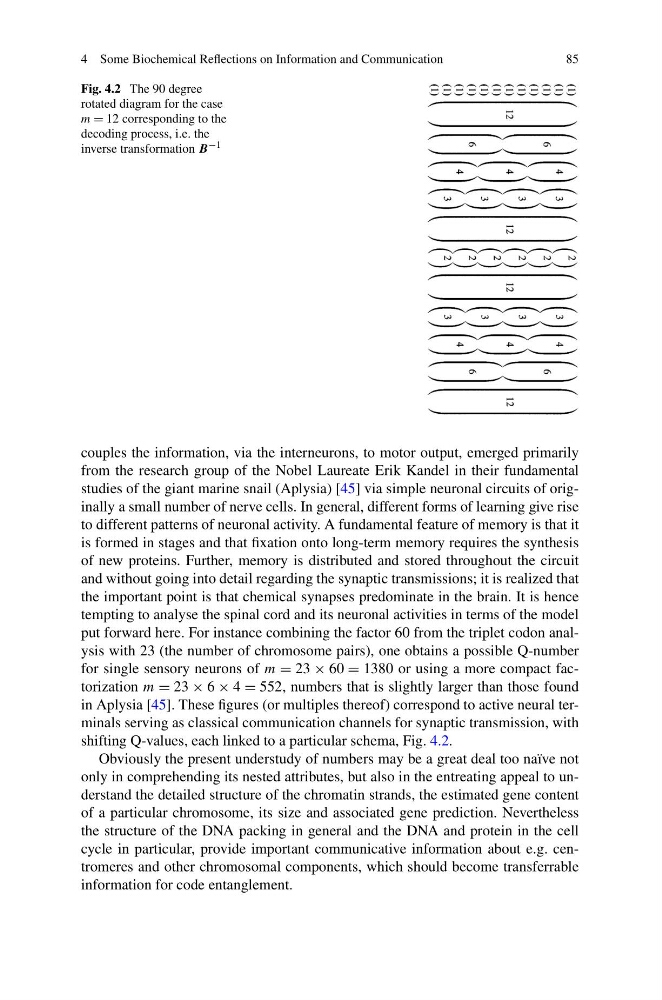
Fig. 4.2 The 90 degree
rotated diagram for the case
m = 12 corresponding to the
decoding process, i.e. the
inverse transformation B −1
couples the information, via the interneurons, to motor output, emerged primarily
from the research group of the Nobel Laureate Erik Kandel in their fundamental
studies of the giant marine snail (Aplysia) [45] via simple neuronal circuits of originally a small number of nerve cells. In general, different forms of learning give rise
to different patterns of neuronal activity. A fundamental feature of memory is that it
is formed in stages and that fixation onto long-term memory requires the synthesis
of new proteins. Further, memory is distributed and stored throughout the circuit
and without going into detail regarding the synaptic transmissions; it is realized that
the important point is that chemical synapses predominate in the brain. It is hence
tempting to analyse the spinal cord and its neuronal activities in terms of the model
put forward here. For instance combining the factor 60 from the triplet codon analysis with 23 (the number of chromosome pairs), one obtains a possible Q-number
for single sensory neurons of m = 23 × 60 = 1380 or using a more compact factorization m = 23 × 6 × 4 = 552, numbers that is slightly larger than those found
in Aplysia [45]. These figures (or multiples thereof) correspond to active neural terminals serving as classical communication channels for synaptic transmission, with
shifting Q-values, each linked to a particular schema, Fig. 4.2.
Obviously the present understudy of numbers may be a great deal too naïve not
only in comprehending its nested attributes, but also in the entreating appeal to understand the detailed structure of the chromatin strands, the estimated gene content
of a particular chromosome, its size and associated gene prediction. Nevertheless
the structure of the DNA packing in general and the DNA and protein in the cell
cycle in particular, provide important communicative information about e.g. centromeres and other chromosomal components, which should become transferrable
information for code entanglement.
85
Fig. 4.2 The 90 degree
rotated diagram for the case
m = 12 corresponding to the
decoding process, i.e. the
inverse transformation B −1
couples the information, via the interneurons, to motor output, emerged primarily
from the research group of the Nobel Laureate Erik Kandel in their fundamental
studies of the giant marine snail (Aplysia) [45] via simple neuronal circuits of originally a small number of nerve cells. In general, different forms of learning give rise
to different patterns of neuronal activity. A fundamental feature of memory is that it
is formed in stages and that fixation onto long-term memory requires the synthesis
of new proteins. Further, memory is distributed and stored throughout the circuit
and without going into detail regarding the synaptic transmissions; it is realized that
the important point is that chemical synapses predominate in the brain. It is hence
tempting to analyse the spinal cord and its neuronal activities in terms of the model
put forward here. For instance combining the factor 60 from the triplet codon analysis with 23 (the number of chromosome pairs), one obtains a possible Q-number
for single sensory neurons of m = 23 × 60 = 1380 or using a more compact factorization m = 23 × 6 × 4 = 552, numbers that is slightly larger than those found
in Aplysia [45]. These figures (or multiples thereof) correspond to active neural terminals serving as classical communication channels for synaptic transmission, with
shifting Q-values, each linked to a particular schema, Fig. 4.2.
Obviously the present understudy of numbers may be a great deal too naïve not
only in comprehending its nested attributes, but also in the entreating appeal to understand the detailed structure of the chromatin strands, the estimated gene content
of a particular chromosome, its size and associated gene prediction. Nevertheless
the structure of the DNA packing in general and the DNA and protein in the cell
cycle in particular, provide important communicative information about e.g. centromeres and other chromosomal components, which should become transferrable
information for code entanglement.