

70
J. Maruani
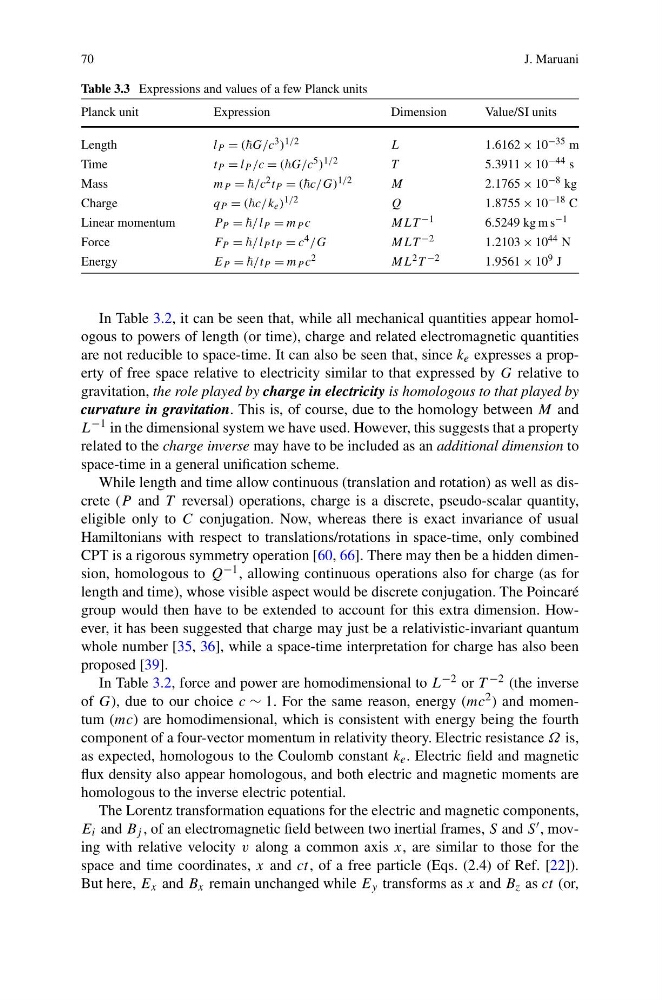
Table 3.3 Expressions and values of a few Planck units
Planck unit
Expression
Dimension
Value/SI units
Length
l P = (G/c 3 ) 1/2
L
1.6162 × 10 −35 m
Time
t P = l P /c = (G/c 5 ) 1/2
T
5.3911 × 10 −44 s
Mass
m P = /c 2 t P = (c/G) 1/2
M
2.1765 × 10 −8 kg
Charge
q P = (c/k e ) 1/2
Q
1.8755 × 10 −18 C
Linear momentum
P P = /l P = m P c
M L T −1
6.5249 kg m s −1
Force
F P = /l P t P = c 4 /G
MLT −2
1.2103 × 10 44 N
Energy
E P = /t P = m P c 2
ML 2 T −2
1.9561 × 10 9 J
In Table 3.2, it can be seen that, while all mechanical quantities appear homologous to powers of length (or time), charge and related electromagnetic quantities
are not reducible to space-time. It can also be seen that, since k e expresses a property of free space relative to electricity similar to that expressed by G relative to
gravitation, the role played by charge in electricity is homologous to that played by
curvature in gravitation. This is, of course, due to the homology between M and
L −1 in the dimensional system we have used. However, this suggests that a property
related to the charge inverse may have to be included as an additional dimension to
space-time in a general unification scheme.
While length and time allow continuous (translation and rotation) as well as discrete (P and T reversal) operations, charge is a discrete, pseudo-scalar quantity,
eligible only to C conjugation. Now, whereas there is exact invariance of usual
Hamiltonians with respect to translations/rotations in space-time, only combined
CPT is a rigorous symmetry operation [60, 66]. There may then be a hidden dimension, homologous to Q −1 , allowing continuous operations also for charge (as for
length and time), whose visible aspect would be discrete conjugation. The Poincaré
group would then have to be extended to account for this extra dimension. However, it has been suggested that charge may just be a relativistic-invariant quantum
whole number [35, 36], while a space-time interpretation for charge has also been
proposed [39].
In Table 3.2, force and power are homodimensional to L −2 or T −2 (the inverse
of G), due to our choice c ∼ 1. For the same reason, energy (mc 2 ) and momentum (mc) are homodimensional, which is consistent with energy being the fourth
component of a four-vector momentum in relativity theory. Electric resistance Ω is,
as expected, homologous to the Coulomb constant k e . Electric field and magnetic
flux density also appear homologous, and both electric and magnetic moments are
homologous to the inverse electric potential.
The Lorentz transformation equations for the electric and magnetic components,
E i and B j , of an electromagnetic field between two inertial frames, S and S , moving with relative velocity v along a common axis x, are similar to those for the
space and time coordinates, x and ct, of a free particle (Eqs. (2.4) of Ref. [22]).
But here, E x and B x remain unchanged while E y transforms as x and B z as ct (or,
J. Maruani
Table 3.3 Expressions and values of a few Planck units
Planck unit
Expression
Dimension
Value/SI units
Length
l P = (G/c 3 ) 1/2
L
1.6162 × 10 −35 m
Time
t P = l P /c = (G/c 5 ) 1/2
T
5.3911 × 10 −44 s
Mass
m P = /c 2 t P = (c/G) 1/2
M
2.1765 × 10 −8 kg
Charge
q P = (c/k e ) 1/2
Q
1.8755 × 10 −18 C
Linear momentum
P P = /l P = m P c
M L T −1
6.5249 kg m s −1
Force
F P = /l P t P = c 4 /G
MLT −2
1.2103 × 10 44 N
Energy
E P = /t P = m P c 2
ML 2 T −2
1.9561 × 10 9 J
In Table 3.2, it can be seen that, while all mechanical quantities appear homologous to powers of length (or time), charge and related electromagnetic quantities
are not reducible to space-time. It can also be seen that, since k e expresses a property of free space relative to electricity similar to that expressed by G relative to
gravitation, the role played by charge in electricity is homologous to that played by
curvature in gravitation. This is, of course, due to the homology between M and
L −1 in the dimensional system we have used. However, this suggests that a property
related to the charge inverse may have to be included as an additional dimension to
space-time in a general unification scheme.
While length and time allow continuous (translation and rotation) as well as discrete (P and T reversal) operations, charge is a discrete, pseudo-scalar quantity,
eligible only to C conjugation. Now, whereas there is exact invariance of usual
Hamiltonians with respect to translations/rotations in space-time, only combined
CPT is a rigorous symmetry operation [60, 66]. There may then be a hidden dimension, homologous to Q −1 , allowing continuous operations also for charge (as for
length and time), whose visible aspect would be discrete conjugation. The Poincaré
group would then have to be extended to account for this extra dimension. However, it has been suggested that charge may just be a relativistic-invariant quantum
whole number [35, 36], while a space-time interpretation for charge has also been
proposed [39].
In Table 3.2, force and power are homodimensional to L −2 or T −2 (the inverse
of G), due to our choice c ∼ 1. For the same reason, energy (mc 2 ) and momentum (mc) are homodimensional, which is consistent with energy being the fourth
component of a four-vector momentum in relativity theory. Electric resistance Ω is,
as expected, homologous to the Coulomb constant k e . Electric field and magnetic
flux density also appear homologous, and both electric and magnetic moments are
homologous to the inverse electric potential.
The Lorentz transformation equations for the electric and magnetic components,
E i and B j , of an electromagnetic field between two inertial frames, S and S , moving with relative velocity v along a common axis x, are similar to those for the
space and time coordinates, x and ct, of a free particle (Eqs. (2.4) of Ref. [22]).
But here, E x and B x remain unchanged while E y transforms as x and B z as ct (or,