

2 A Comment on the Question of Degeneracies in Quantum Mechanics
51
ΔE 0 = 2
k,k
u
k −k
2
ω o,k −k
(ε 0
c,k − ε 0
v,k ) 2 − (ω o,k −k ) 2
+ 4
k,r∈R
u
r
2
ρ r
(ε 0
c,k − ε 0
v,k ) 2
+ 4
k,r∈T
u
r
2
τ r
(ε 0
c,k − ε 0
v,k ) 2
(2.35)
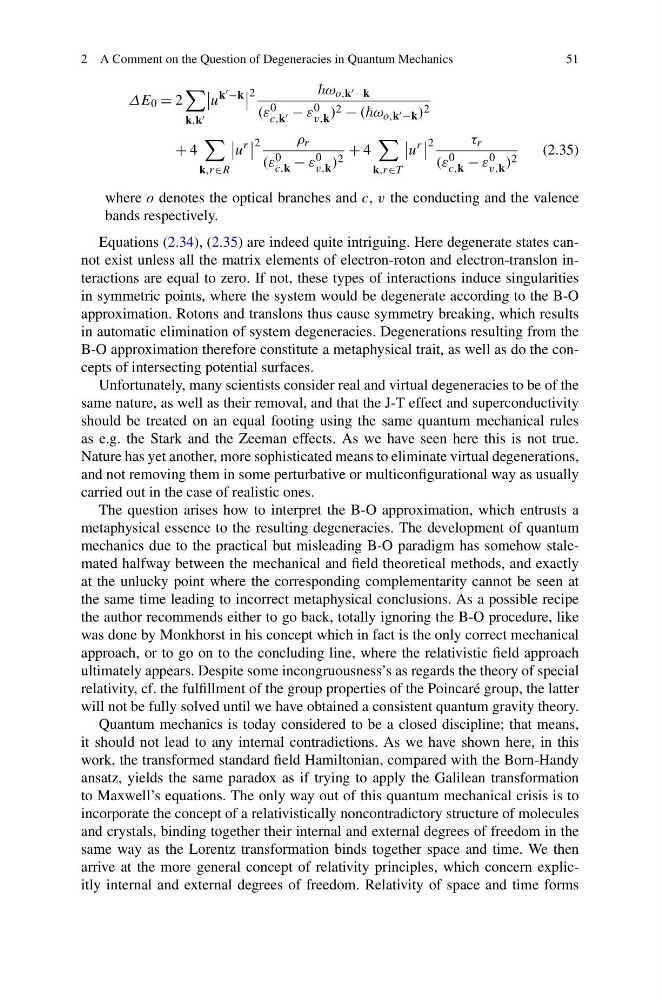
where o denotes the optical branches and c, v the conducting and the valence
bands respectively.
Equations (2.34), (2.35) are indeed quite intriguing. Here degenerate states cannot exist unless all the matrix elements of electron-roton and electron-translon interactions are equal to zero. If not, these types of interactions induce singularities
in symmetric points, where the system would be degenerate according to the B-O
approximation. Rotons and translons thus cause symmetry breaking, which results
in automatic elimination of system degeneracies. Degenerations resulting from the
B-O approximation therefore constitute a metaphysical trait, as well as do the concepts of intersecting potential surfaces.
Unfortunately, many scientists consider real and virtual degeneracies to be of the
same nature, as well as their removal, and that the J-T effect and superconductivity
should be treated on an equal footing using the same quantum mechanical rules
as e.g. the Stark and the Zeeman effects. As we have seen here this is not true.
Nature has yet another, more sophisticated means to eliminate virtual degenerations,
and not removing them in some perturbative or multiconfigurational way as usually
carried out in the case of realistic ones.
The question arises how to interpret the B-O approximation, which entrusts a
metaphysical essence to the resulting degeneracies. The development of quantum
mechanics due to the practical but misleading B-O paradigm has somehow stalemated halfway between the mechanical and field theoretical methods, and exactly
at the unlucky point where the corresponding complementarity cannot be seen at
the same time leading to incorrect metaphysical conclusions. As a possible recipe
the author recommends either to go back, totally ignoring the B-O procedure, like
was done by Monkhorst in his concept which in fact is the only correct mechanical
approach, or to go on to the concluding line, where the relativistic field approach
ultimately appears. Despite some incongruousness’s as regards the theory of special
relativity, cf. the fulfillment of the group properties of the Poincaré group, the latter
will not be fully solved until we have obtained a consistent quantum gravity theory.
Quantum mechanics is today considered to be a closed discipline; that means,
it should not lead to any internal contradictions. As we have shown here, in this
work, the transformed standard field Hamiltonian, compared with the Born-Handy
ansatz, yields the same paradox as if trying to apply the Galilean transformation
to Maxwell’s equations. The only way out of this quantum mechanical crisis is to
incorporate the concept of a relativistically noncontradictory structure of molecules
and crystals, binding together their internal and external degrees of freedom in the
same way as the Lorentz transformation binds together space and time. We then
arrive at the more general concept of relativity principles, which concern explicitly internal and external degrees of freedom. Relativity of space and time forms
51
ΔE 0 = 2
k,k
u
k −k
2
ω o,k −k
(ε 0
c,k − ε 0
v,k ) 2 − (ω o,k −k ) 2
+ 4
k,r∈R
u
r
2
ρ r
(ε 0
c,k − ε 0
v,k ) 2
+ 4
k,r∈T
u
r
2
τ r
(ε 0
c,k − ε 0
v,k ) 2
(2.35)
where o denotes the optical branches and c, v the conducting and the valence
bands respectively.
Equations (2.34), (2.35) are indeed quite intriguing. Here degenerate states cannot exist unless all the matrix elements of electron-roton and electron-translon interactions are equal to zero. If not, these types of interactions induce singularities
in symmetric points, where the system would be degenerate according to the B-O
approximation. Rotons and translons thus cause symmetry breaking, which results
in automatic elimination of system degeneracies. Degenerations resulting from the
B-O approximation therefore constitute a metaphysical trait, as well as do the concepts of intersecting potential surfaces.
Unfortunately, many scientists consider real and virtual degeneracies to be of the
same nature, as well as their removal, and that the J-T effect and superconductivity
should be treated on an equal footing using the same quantum mechanical rules
as e.g. the Stark and the Zeeman effects. As we have seen here this is not true.
Nature has yet another, more sophisticated means to eliminate virtual degenerations,
and not removing them in some perturbative or multiconfigurational way as usually
carried out in the case of realistic ones.
The question arises how to interpret the B-O approximation, which entrusts a
metaphysical essence to the resulting degeneracies. The development of quantum
mechanics due to the practical but misleading B-O paradigm has somehow stalemated halfway between the mechanical and field theoretical methods, and exactly
at the unlucky point where the corresponding complementarity cannot be seen at
the same time leading to incorrect metaphysical conclusions. As a possible recipe
the author recommends either to go back, totally ignoring the B-O procedure, like
was done by Monkhorst in his concept which in fact is the only correct mechanical
approach, or to go on to the concluding line, where the relativistic field approach
ultimately appears. Despite some incongruousness’s as regards the theory of special
relativity, cf. the fulfillment of the group properties of the Poincaré group, the latter
will not be fully solved until we have obtained a consistent quantum gravity theory.
Quantum mechanics is today considered to be a closed discipline; that means,
it should not lead to any internal contradictions. As we have shown here, in this
work, the transformed standard field Hamiltonian, compared with the Born-Handy
ansatz, yields the same paradox as if trying to apply the Galilean transformation
to Maxwell’s equations. The only way out of this quantum mechanical crisis is to
incorporate the concept of a relativistically noncontradictory structure of molecules
and crystals, binding together their internal and external degrees of freedom in the
same way as the Lorentz transformation binds together space and time. We then
arrive at the more general concept of relativity principles, which concern explicitly internal and external degrees of freedom. Relativity of space and time forms