

44
M. Svrˇ cek
compensated via the Born-Huang (or Born-Handy) [9, 10] ansatz, which provides
the lowest diagonal adiabatic correction to the B-O formulation. The Born-Handy
ansatz has been tested numerous times, and it yields accurate results in agreement
with experiment. The reason behind the popularity of the Born-Handy ansatz and
why it has been so carefully verified was its approximate avoidance of the COM
problem in the B-O separation. Handy’s contribution consisted, in addition to formulating the procedure, in convincing the broad scientific community of the value
of this pragmatic ansatz, without having to solve the full COM problem, which
amongst other things demands the introduction of relative coordinates and masses.
Kutzelnigg then gave the proof that the Born-Handy ansatz fully replaces the very
complicated and difficult COM solution [11].
Unfortunately, there exists no analogy of the Born-Handy ansatz in the field theoretical equation (2.6), which would compensate for the error in the determination
of the centre of mass by means of the B-O approximation. If we perform its generalization for systems without translational symmetry (applicable not only to crystals
with translational symmetry but also to molecules), and subsequently applying the
Fröhlich transformation (cf. Fröhlich’s attempts to explain superconductivity [13]),
we obtain, for the ground state of the hydrogen molecule, only about 20 % of the
total adiabatic correlation energy, while, in quantum mechanics, the Born-Handy
ansatz yields the correct result [14, 15]. Of course, insulators or conductors are
not as sensitive to these effects, and there we prevail with Eq. (2.6). Nevertheless,
cf. non-adiabatic effects in connection with superconductivity, we have to devote
deeper thoughts to the correctness of the Hamiltonian representation (2.6).
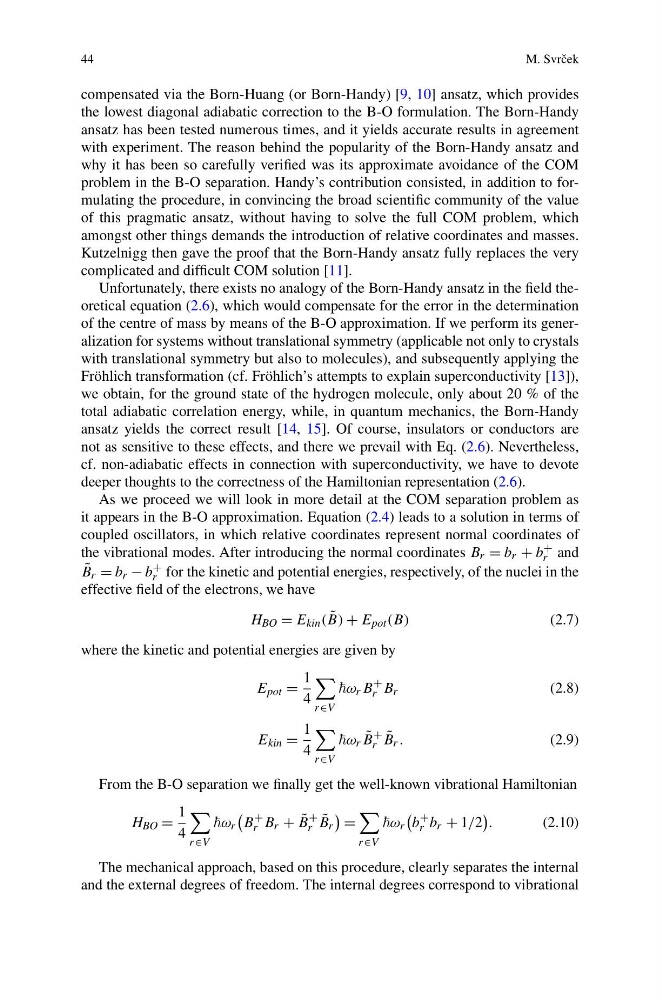
As we proceed we will look in more detail at the COM separation problem as
it appears in the B-O approximation. Equation (2.4) leads to a solution in terms of
coupled oscillators, in which relative coordinates represent normal coordinates of
the vibrational modes. After introducing the normal coordinates B r = b r + b +
r and
˜
B r = b r − b +
r for the kinetic and potential energies, respectively, of the nuclei in the
effective field of the electrons, we have
H BO = E kin ( ˜
B) + E pot (B)
(2.7)
where the kinetic and potential energies are given by
E pot =
1
4
r∈V
ω r B
+
r B r
(2.8)
E kin =
1
4
r∈V
ω r ˜
B
+
r
˜
B r .
(2.9)
From the B-O separation we finally get the well-known vibrational Hamiltonian
H BO =
1
4
r∈V
ω r
B
+
r B r + ˜
B
+
r
˜
B r
=
r∈V
ω r
b
+
r b r + 1/2
.
(2.10)
The mechanical approach, based on this procedure, clearly separates the internal
and the external degrees of freedom. The internal degrees correspond to vibrational
M. Svrˇ cek
compensated via the Born-Huang (or Born-Handy) [9, 10] ansatz, which provides
the lowest diagonal adiabatic correction to the B-O formulation. The Born-Handy
ansatz has been tested numerous times, and it yields accurate results in agreement
with experiment. The reason behind the popularity of the Born-Handy ansatz and
why it has been so carefully verified was its approximate avoidance of the COM
problem in the B-O separation. Handy’s contribution consisted, in addition to formulating the procedure, in convincing the broad scientific community of the value
of this pragmatic ansatz, without having to solve the full COM problem, which
amongst other things demands the introduction of relative coordinates and masses.
Kutzelnigg then gave the proof that the Born-Handy ansatz fully replaces the very
complicated and difficult COM solution [11].
Unfortunately, there exists no analogy of the Born-Handy ansatz in the field theoretical equation (2.6), which would compensate for the error in the determination
of the centre of mass by means of the B-O approximation. If we perform its generalization for systems without translational symmetry (applicable not only to crystals
with translational symmetry but also to molecules), and subsequently applying the
Fröhlich transformation (cf. Fröhlich’s attempts to explain superconductivity [13]),
we obtain, for the ground state of the hydrogen molecule, only about 20 % of the
total adiabatic correlation energy, while, in quantum mechanics, the Born-Handy
ansatz yields the correct result [14, 15]. Of course, insulators or conductors are
not as sensitive to these effects, and there we prevail with Eq. (2.6). Nevertheless,
cf. non-adiabatic effects in connection with superconductivity, we have to devote
deeper thoughts to the correctness of the Hamiltonian representation (2.6).
As we proceed we will look in more detail at the COM separation problem as
it appears in the B-O approximation. Equation (2.4) leads to a solution in terms of
coupled oscillators, in which relative coordinates represent normal coordinates of
the vibrational modes. After introducing the normal coordinates B r = b r + b +
r and
˜
B r = b r − b +
r for the kinetic and potential energies, respectively, of the nuclei in the
effective field of the electrons, we have
H BO = E kin ( ˜
B) + E pot (B)
(2.7)
where the kinetic and potential energies are given by
E pot =
1
4
r∈V
ω r B
+
r B r
(2.8)
E kin =
1
4
r∈V
ω r ˜
B
+
r
˜
B r .
(2.9)
From the B-O separation we finally get the well-known vibrational Hamiltonian
H BO =
1
4
r∈V
ω r
B
+
r B r + ˜
B
+
r
˜
B r
=
r∈V
ω r
b
+
r b r + 1/2
.
(2.10)
The mechanical approach, based on this procedure, clearly separates the internal
and the external degrees of freedom. The internal degrees correspond to vibrational