

42
M. Svrˇ cek
states there are many unresolved questions. A typical example is the situation of
degenerate states arising in connection with the use of the Born-Oppenheimer (B-O)
approximation [1]. Since the wave function of the system of electrons and nuclei can
be decomposed due to their small mass ratio m/M into
Ψ (r, R) = ψ(r, R)χ(R)
(2.1)
we can separately solve the equations for the electron and the nuclear states. Quantization is carried out in a hierarchical manner: First the electron states are parametrically quantized at given internuclear distances R
H e (R)
ψ(r, R)
= E e (R)
ψ(r, R)
(2.2)
after which the introduction of the kinetic energy of electrons, T e , the electronnuclear and two-electron potentials, E eN and E ee , respectively, the electron Hamiltonian H e in Eq. (2.2) is expressed as
H e = T e (r) + E eN (r, R) + E ee (r).
(2.3)
Finally the nuclear motions are quantized as
H N
χ(R)
= E
χ(R)
(2.4)
where one obtains for the nuclear Hamiltonian in Eq. (2.4) (T N is the kinetic energy
of nuclei and E NN the internuclear potential)
H N = T N (R) + E NN (R) + E e (R).
(2.5)
When Eq. (2.2), at the nuclear equilibrium position, causes a degenerate solution, represented by the crossing of two or more potential surfaces, the Jahn-Teller
(J-T) effect [2] shows up. The usual responses to this impasse are the incorporation of standard non-adiabatic corrections as the only cure capable of removing the
degeneracies originating from the B-O approximation.
There would be no further reason to think about the origin of this type of degeneracies, if field theoretic methods did not exist. In the latter situation, with an
approach, borrowed from quantum electrodynamics and made operational within
quantum mechanics and furthermore widely used in the theory of solids, we are in
fact facing a similar degeneracy problem, but with a completely different method of
solution regarding degeneracy removal. Perhaps the most famous is the model field
Hamiltonian
H =
k,σ
ε k a
+
k,σ a k,σ +
q
ω q
b
+
q b q + 1/2
+
k,q,σ
u
q
b q + b
+
−q
a
+
k+q,σ a k,σ .
(2.6)
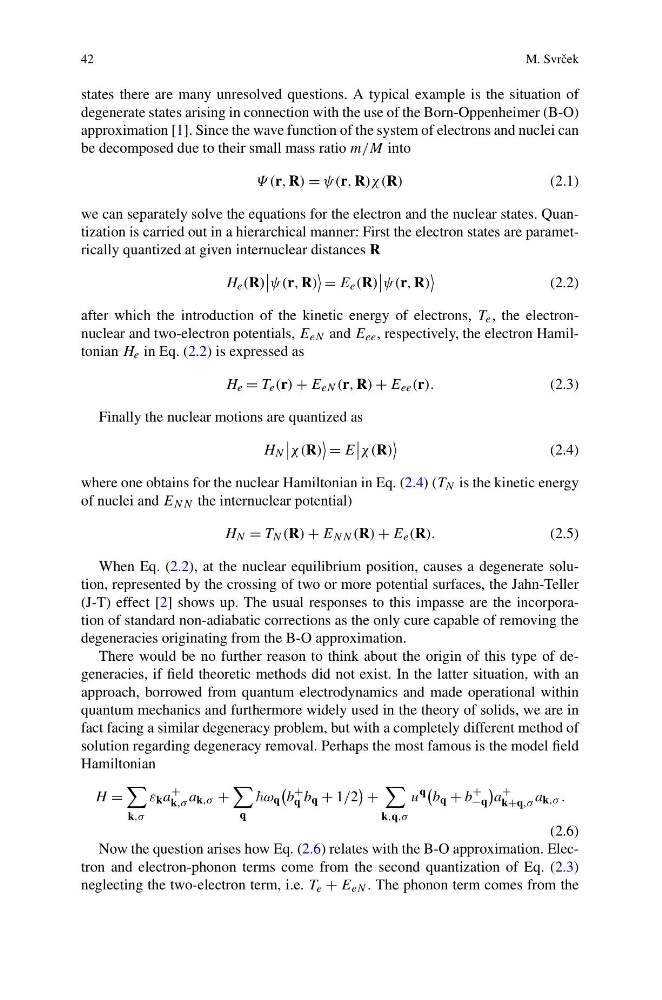
Now the question arises how Eq. (2.6) relates with the B-O approximation. Electron and electron-phonon terms come from the second quantization of Eq. (2.3)
neglecting the two-electron term, i.e. T e + E eN . The phonon term comes from the
M. Svrˇ cek
states there are many unresolved questions. A typical example is the situation of
degenerate states arising in connection with the use of the Born-Oppenheimer (B-O)
approximation [1]. Since the wave function of the system of electrons and nuclei can
be decomposed due to their small mass ratio m/M into
Ψ (r, R) = ψ(r, R)χ(R)
(2.1)
we can separately solve the equations for the electron and the nuclear states. Quantization is carried out in a hierarchical manner: First the electron states are parametrically quantized at given internuclear distances R
H e (R)
ψ(r, R)
= E e (R)
ψ(r, R)
(2.2)
after which the introduction of the kinetic energy of electrons, T e , the electronnuclear and two-electron potentials, E eN and E ee , respectively, the electron Hamiltonian H e in Eq. (2.2) is expressed as
H e = T e (r) + E eN (r, R) + E ee (r).
(2.3)
Finally the nuclear motions are quantized as
H N
χ(R)
= E
χ(R)
(2.4)
where one obtains for the nuclear Hamiltonian in Eq. (2.4) (T N is the kinetic energy
of nuclei and E NN the internuclear potential)
H N = T N (R) + E NN (R) + E e (R).
(2.5)
When Eq. (2.2), at the nuclear equilibrium position, causes a degenerate solution, represented by the crossing of two or more potential surfaces, the Jahn-Teller
(J-T) effect [2] shows up. The usual responses to this impasse are the incorporation of standard non-adiabatic corrections as the only cure capable of removing the
degeneracies originating from the B-O approximation.
There would be no further reason to think about the origin of this type of degeneracies, if field theoretic methods did not exist. In the latter situation, with an
approach, borrowed from quantum electrodynamics and made operational within
quantum mechanics and furthermore widely used in the theory of solids, we are in
fact facing a similar degeneracy problem, but with a completely different method of
solution regarding degeneracy removal. Perhaps the most famous is the model field
Hamiltonian
H =
k,σ
ε k a
+
k,σ a k,σ +
q
ω q
b
+
q b q + 1/2
+
k,q,σ
u
q
b q + b
+
−q
a
+
k+q,σ a k,σ .
(2.6)
Now the question arises how Eq. (2.6) relates with the B-O approximation. Electron and electron-phonon terms come from the second quantization of Eq. (2.3)
neglecting the two-electron term, i.e. T e + E eN . The phonon term comes from the